-
aljawahermetalcoating
- August 18, 2026
- Comments (4)
Understanding Electroless Nickel Plating for Industrial Components
Table of Contents
- Key takeaways
- What is electroless nickel plating?
- How does the electroless plating process work?
- Types of electroless nickel coatings
- Key benefits for industrial components
- Industries that rely on this coating
- Common mistakes and expert tips
- Choosing the right plating partner
- Bottom line
- Frequently asked questions
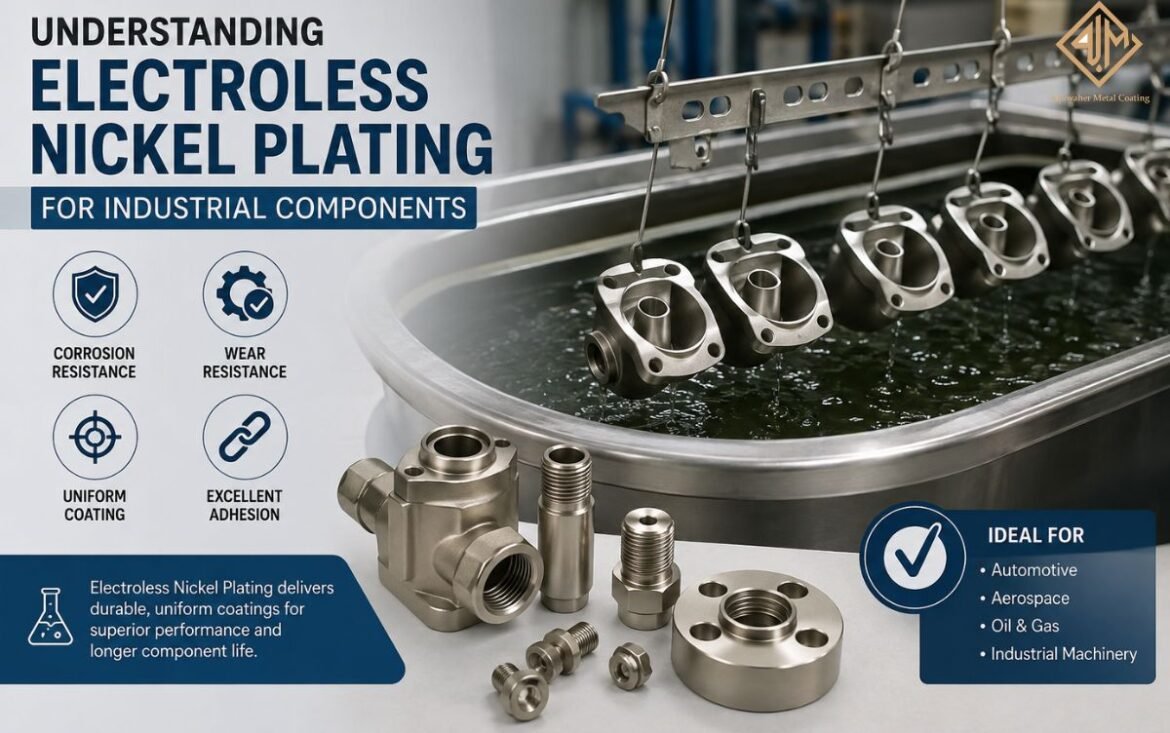
Electroless nickel plating is a process that uses chemistry to apply a nickel-phosphorus layer to metal components without using electricity. The fact that it can work with complex shapes, internal passages, and threads makes it applicable in several areas. The coating is regulated by ASTM B733, which categorizes coatings according to their phosphorus content (from less than 1 percent to more than 10 percent). High-phosphorus coatings with P contents of 10 to 13 percent have shown resistance to corrosion of more than 1,000 hours in the ASTM B117 test for salt spray.
Key takeaways
- Electroless nickel plating employs reactions to ensure uniform coating thickness on complicated structures.
- According to ASTM B733, coatings are defined by their phosphorus content, which causes different behaviors.
- Coatings with a lower amount of phosphorus are harder, while coatings with higher phosphorus concentration are better protective against corrosion.
- It is recommended to choose suppliers based on their phosphorus regulation practices, testing, and documentation.
What is electroless nickel plating?
Nickel-phosphorus alloy is applied to the metal surface without the use of electric current in electroless nickel plating. Unlike electroplating, electroless nickel plating doesn’t utilize electrical current. The process relies on a hypophosphite solution, with the applied coating formed by the chemical reaction at the exposed metal.
The distinctiveness of the process lies in the fact that while electroless nickel produces uniform coating thickness across different areas of the part, electroplating is affected by current density. An electroplated item presents a coating of varying thickness depending on the shape and configuration of the part.
When the buyer looks for an electroless nickel plating service in Dubai, he realizes very quickly that the two methods are different. Such common plating shops may be sufficient for simple parts, but for complex ones, it has to utilize the autocatalytic process.
How does the electroless plating process work?
The sequence isn’t complicated on paper, but getting consistent results takes tight process control.
- Surface preparation – the part is degreased, then chemically or mechanically cleaned to remove oxide layers and contaminants.
- Activation– a catalytic layer, usually a thin strike, is applied so nickel deposition can begin on the base metal.
- Plating bath immersion– the part goes into a heated nickel-phosphorus solution, typically between 85-95°C, where the coating builds gradually.
- Rinsing and inspection – parts are rinsed, then checked for thickness, adhesion, and appearance.
- Optional heat treatment – for applications needing maximum hardness, parts are baked at controlled temperatures, sometimes raising hardness to 850 HK.
However, bath chemistry drifts over time as phosphorus and nickel get consumed. Shops that don’t monitor bath concentration closely end up with inconsistent phosphorus content from batch to batch. That inconsistency is usually invisible to the naked eye, but it shows up later as premature corrosion or coating failure.
Types of electroless nickel coatings
ASTM B733 classifies coatings by phosphorus percentage, and that percentage affects almost everything about how the coating performs. This is also where a lot of confusion happens. Buyers often ask for “standard” electroless nickel without realizing there are meaningfully different types.
| Type | Phosphorus Content | As-Plated Hardness | Best For |
|---|---|---|---|
| Low Phosphorus | 1–4% | 620–750 HK100 | Wear resistance, magnetic applications, hard automotive parts |
| Mid Phosphorus | 4–8% | 500–600 HK100 | General industrial use, balanced hardness and corrosion resistance |
| High Phosphorus | 9–13% | 450–550 HK100 | Chemical processing, offshore, aggressive corrosive environments |
High-phosphorus deposits form an amorphous structure once phosphorus content passes roughly 10.5%, which reduces porosity almost entirely. That’s why high-phos coatings can pass 1,000+ hours of ASTM B117 salt spray testing, while lower-phosphorus deposits typically fall in the 48-200 hour range before red rust appears.
Therefore, buyers comparing nickel plating services in Dubai for offshore or chemical-plant components should ask specifically which phosphorus range a supplier is quoting. The difference isn’t cosmetic; it changes service life.
Key benefits for industrial components
The reasons manufacturers specify electroless nickel over other coating options usually come down to a handful of practical factors:
- Uniform thickness on complex geometries, including internal bores and threads
- Hardness that rivals hard chrome, without the environmental disposal issues chrome plating carries
- Strong corrosion resistance, especially with high-phosphorus formulations
- Good solderability for electronic components, particularly low-phosphorus types
- Compatibility with a wide range of base metals, including steel, aluminum, brass, and some plastics
For companies searching for electroless nickel plating near me because they need fast turnaround on production runs, uniform thickness also means less rework. Parts that come out under-plated in recessed areas fail dimensional checks and go back for reprocessing, which adds cost and delay that a properly run electroless line avoids.
Industries that rely on this coating
Electroless nickel shows up across a wider range of sectors than most people expect.
Oil and gas components use high-phosphorus coatings because of hydrogen sulfide exposure and saltwater environments. Automotive parts such as fuel system components, brake pistons, and gears often use low-phosphorus types for their hardness and wear resistance. Aerospace and defense applications reference ASTM B733 alongside AMS 2404 or MIL-C-26074 as supporting specifications. Electronics manufacturers use low-phosphorus coatings on connectors for solderability and conductivity.
Moreover, structural steel fabricators, precision machine shops, and valve manufacturers across the region also rely on plating partners for corrosion-resistant finishing. A dependable best metal coating company in Dubai for any of these sectors needs to demonstrate more than plating capability. It needs documented testing: hardness readings, thickness verification, and salt spray results when the application calls for it.
Common mistakes and expert tips
A few mistakes come up repeatedly with buyers who are new to specifying electroless nickel.
- Not specifying phosphorus content- Asking for “electroless nickel” without a type or percentage leaves the supplier to decide, and results can vary between vendors, or even between batches from the same vendor.
- Skipping stress-relief pretreatment on hardened steel- This step reduces the risk of hydrogen embrittlement. Skipping it on high-strength steel parts can cause cracking under load.
- Assuming thickness alone guarantees corrosion resistance- A thick low-phosphorus coating won’t outperform a thinner high-phosphorus one in a corrosive environment. Alloy composition matters more than thickness in that scenario.
- Ignoring heat treatment requirements- Some applications need post-plating heat treatment for adhesion or hardness. Leaving it out because it adds time is a false economy if the part fails in service.
From experience, the buyers who get the best results are the ones who bring drawings with clear callouts, including phosphorus type, thickness range, and any relevant spec such as ASTM B733 or AMS 2404, rather than leaving those decisions to the plating shop by default. For anyone commissioning electroless nickel plating services in Dubai on parts headed for demanding service conditions, that upfront clarity saves rework later.
Choosing the right plating partner
Not every plating shop runs the same quality controls, and price differences between vendors often trace back to how tightly they manage bath chemistry and testing.
Look for a few specifics before committing to a supplier:
- Ask whether they test phosphorus content per batch, not just occasionally
- Request salt spray or hardness test data on request, not just a certificate of conformance
- Confirm they can handle your part’s geometry, since some shops struggle with deep bores or fine threads
- Check turnaround time against your production schedule, since electroless lines run in batches
Furthermore, when searching for electroless nickel plating near me, it also helps to visit the facility if possible. Bath tank condition, rinse water clarity, and general housekeeping tell you more about consistency than a sales conversation will.
Bottom line
Electroless nickel plated parts offer uniform and durable plating on complex parts. It is suitable for areas where electroplating might not provide even coating. Appropriate results require the use of the right type of phosphorus. It also assists in working with a supplier with a strict and consistent process.
Aljawaher Metal Coating is a metal coating company in Dubai with the expertise to offer electroless nickel plating facilities to manufacturers and fabricators from all over the region. Provide part information, and the team will help select the correct coating for your application.
Frequently asked questions
While more uniform than chrome, electroless nickel is not as hard-wearing as chrome in some sliding-contact applications, and it does not have the environmental disposal issues associated with chrome.
The thickness varies depending on the application; most industrial coatings are between 0.0005 and 0.002 inches, and the minimum required will be determined by the requirements of the service condition according to ASTM B733.
Yes, if correctly pretreated. There must be a strike layer, such as a zincate or other strike layer, to which the nickel can bond and adhere to the aluminum, or it will not bond directly to the bare aluminum oxide.
Coatings of low phosphorus content can maintain the magnetic properties, and if the thickness of the coatings is high phosphorus content (above approximately 11%), the magnetic property will be lost because of the amorphous structure of the coating.
Inquire about minimum ordering quantities and batch scheduling with potential suppliers. Many shops that do large production runs will also be able to do prototype production runs or repair production runs.
It can be extremely effective to retard corrosion, but it will not make a part rust-proof forever. The actual protection time depends on coating type, thickness, and environment.
The largest consumers of electroless nickel coating in the region include oil and gas, automotive parts, structural steel fabrication, and precision machining.
Time to turn around will vary based on part size and the batch scheduling of the parts, but standard production runs would be within a few days of the part being prepped and queued for plating.
The most common causes of early failures are the use of the wrong type of phosphorus for the application, poor surface preparation, and inconsistent bath chemistry.
The phosphorus content directly affects the hardness, corrosion resistance, and magnetic properties, so two coatings classified with the same term can have completely different service characteristics.
Comments (4)
Nickel Plating: How It Dramatically Boosts Corrosion Resistance
[…] anyone specifically searching for electroless nickel plating services in Dubai, the geometry of the part usually decides which process makes sense. Simple flat brackets […]
Nickel Plating vs Zinc Plating for Corrosion Protection
[…] just looks. Oil and gas, precision manufacturing, and industrial equipment companies reach for electroless nickel plating services in Dubai because the parts involved are expensive, hard to replace, and run in conditions that would […]
Nickel Plating Thickness Standards for Dubai Manufacturers
[…] a supplier is providing you with electroless nickel plating services in Dubai, then they are expected to give you whichever package you are looking for, along with […]
Copper vs Nickel Plating: Which Is Better for Metal Parts?
[…] the use of electroless nickel plating services in Dubai is typically requested by manufacturers who are creating precision components and valves, as […]