-
aljawahermetalcoating
- September 7, 2026
- No Comments
Nickel Plating Thickness and Performance Standards: A Practical Guide for Dubai Manufacturers
Table of Contents
- Key takeaways
- Why plating thickness isn’t just a number?
- Understanding ASTM B733 and service condition classes
- Electroless vs. electrolytic nickel: thickness behaves differently
- Matching thickness to real-world performance
- Common mistakes businesses make when specifying thickness
- How to choose the right plating partner in Dubai?
- Expert insights
- Conclusion
- Frequently asked questions
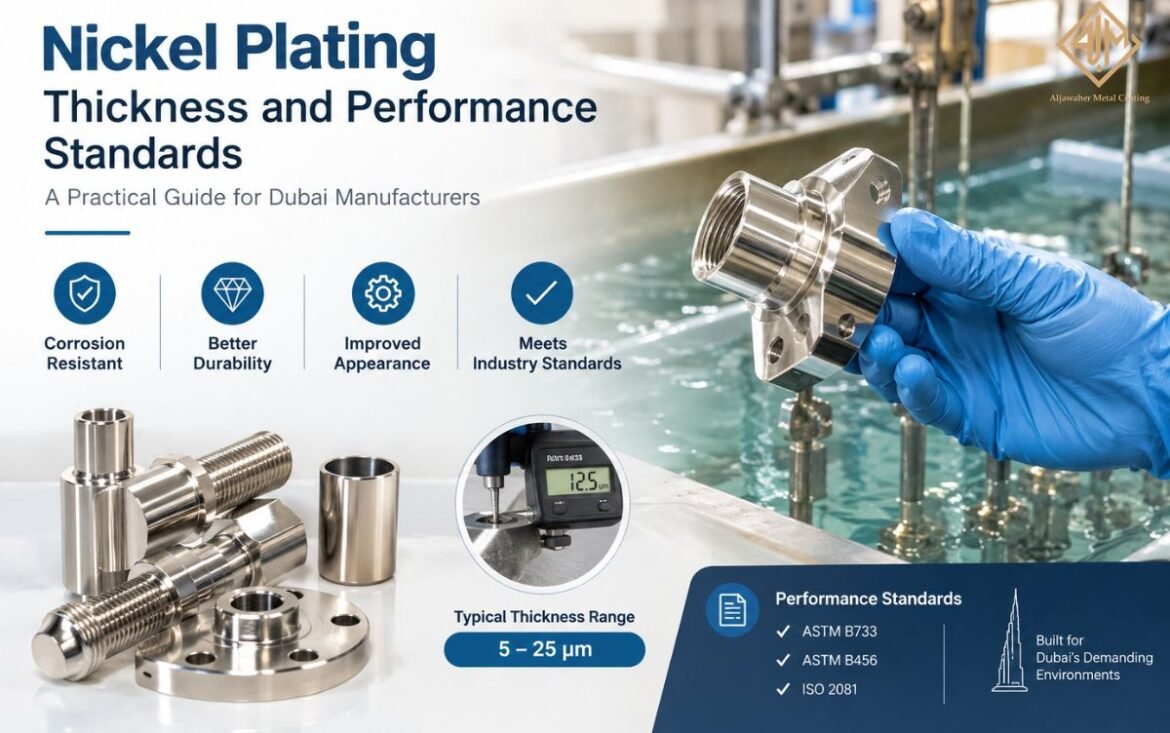
The longevity of a nickel-plated component is largely contingent on the thickness of the coating. The range of electroless nickel coatings as prescribed by ASTM B733 is from SC0 to SC4, where the SC0 coating is as small as 0.1 microns, which is suitable for components for cosmetic use or for indoor applications, while the SC4 coating is in excess of 50 microns, which is good for durable industrial applications or offshore applications.
For most manufacturing components, the coating thickness of about 12 to 25 microns is appropriate for coatings capable of sustaining saltwater for a duration ranging from 48 to 100 hours as per ASTM B117. Heat-treated electroless nickel is also capable of achieving hardness levels of around 1000 HVN and is comparable to hardened tool steel.
Therefore, the best metal coatings company in Dubai will take into consideration the working environment of the component in selecting the coating thickness that will be applicable.
Key takeaways
- The thickness of coatings does not guarantee performance because phosphorus levels, preparation, and heat treatment also play a role.
- ASTM B733 defines five service classes from SC0 to SC4.
- Neither over-plating nor under-plating is advisable, as both result in similar problems.
- Good platers will analyze the service conditions before making coating thickness recommendations.
Why plating thickness isn’t just a number?
Thicker plating is generally assumed to provide superior protection. But this is not always the case.
Nickel is used to protect the metal by forming a barrier to moisture, salt, and oxygen. As the coating gets thicker, you have to pay more. It may also impact the precision part dimensions that are needed.
The indoor bracket, for instance, doesn’t require 40 microns of electroless nickel. In that environment, 8- 12 microns could be sufficient. A valve, when exposed to a seawater environment, however, must be protected to a much higher degree to prevent early corrosion.
What is the true value of nickel plating services Dubai? It’s the selection of the appropriate thickness. The coating should match the part’s real operating environment.
Understanding ASTM B733 and service condition classes
The most commonly used standard for autocatalytic (electroless) nickel-phosphorus coatings is ASTM B733. It sorts coatings by 3 different variables: type of phosphorus, service condition (thickness), and post-plate heat treatment class.
The “service condition scale” ranges from SC0 (which means 0.1 to 8 micrometres) for mild environments, to SC1, SC2, and SC3 for moderate to severe industrial exposure, up to SC4 for the toughest jobs. The thickness is as important here as the phosphorus content. Medium- and high-phosphorus electroless nickel coatings are either 5 to 9 percent or more than 10 percent in weight of phosphorus and require at least 5 micrometres. They are heat treated from 180 to 200°C and from 260 to 400°C, respectively, for best corrosion resistance.
Moreover, in general engineering applications, such as pump housings, fasteners, and hydraulic fittings, the typical thickness of electroless nickel is between 12 and 25 microns. Most parts that are plated in that range require no additional post-plating machining or finishing. If a supplier is quoting a thickness that varies significantly from that, that’s a good thing to remember to take out of your back pocket.
Heat treatment classes: The part people forget
Additionally, B733 categorizes coatings into heat treatment groups. Class 1 is as-deposited, no heat treatment at all. In class 2, baking is performed at up to 400°C, giving a minimum hardness of 850 Knoop. Adhesion treatments for steel, aluminum, and titanium are covered for classes 3-6. If you skip this step, or use the wrong class for the substrate, you will have one of the most common failures in plated parts adhesion testing.
If a supplier is providing you with electroless nickel plating services in Dubai, then they are expected to give you whichever package you are looking for, along with phosphorus type, service condition, and the heat treatment class.
Electroless vs. electrolytic nickel: thickness behaves differently
Electrolytic nickel is powered with electricity, which translates to an uneven build-up. Higher on edges and corners, lower in recesses and bores. Instead, electroless nickel is formed through an autocatalytic (self-catalytic) chemical reaction and forms a uniform deposit no matter what the shape of the part is.
This is more important than most consumers realize. Plating something with internal threads, blind holes, or complicated machined features? Electroless nickel provides uniform thickness in all areas where the solution can physically be installed. The inside of that part may be left thin in spots where it is not subjected to the same corrosion tests as the outside of the part was, and the outside appears to be fine. This is typically the deciding factor for complex or precision geometry, and not cost.
Matching thickness to real-world performance
Here’s roughly how it plays out on the shop floor:
| Environment | Recommended Thickness Range | Typical Application |
| Indoor, low humidity | 5–10 microns | Electronics housings, indoor fixtures |
| Mixed indoor/outdoor | 10–15 microns | General machinery, automotive brackets |
| Outdoor, high humidity | 15–25 microns | Marine hardware, oilfield fittings |
| Chemical/offshore exposure | 25–50+ microns | Valves, pumps, subsea components |
Under ASTM B117 salt spray testing, electroless nickel in the standard thickness range holds up for roughly 48 to 100 hours before red rust appears on the base metal. Worth remembering when you’re comparing quotes. Ask anyone offering electroless nickel plating near me whether they can actually produce salt spray data for their process, not just a thickness figure on a spec sheet.
Hardness is the other number worth tracking. Heat treatment can improve hardness to 1000 HVN, but reduces corrosion resistance; ideal for abrasive applications.
Common mistakes businesses make when specifying thickness
- Specifying thickness without specifying phosphorus type- A 15-micron high-phosphorus coating and a 15-micron low-phosphorus coating are basically different products once they’re in a corrosive environment. Low-phosphorus gives you better hardness and wear resistance but weaker chemical resistance. High-phosphorus does the opposite. Say “15 microns of nickel” without the phosphorus percentage, and you’ve left way too much to chance.
- Ignoring dimensional buildup on tight-tolerance parts- Plating adds material on every plated surface, so a bore plated at 20 microns just lost 40 microns of diameter clearance. That needs to be built into the machining allowance before plating starts, not discovered after an assembly won’t fit.
- Assuming more plating fixes bad surface preparation- Nickel only adheres as well as what’s underneath it. Skip proper degreasing, activation, or stress relief before plating, and you’ll get flaking no matter how thick the deposit is. Shops that actually know what they’re doing run bend, impact, or thermal shock tests before parts ship, specifically to catch this.
- Choosing thickness based on cost alone- It’s tempting to ask for the bare minimum a spec allows to save a few dirhams. But if the part fails early because of it, the rework and downtime cost a lot more than the extra plating would have.
How to choose the right plating partner in Dubai?
Dubai’s industrial base covers oil and gas, marine, construction, and manufacturing, and each of those has its own corrosion and wear demands. A provider offering genuine nickel plating services in Dubai should be able to talk you through phosphorus type, service condition, and heat treatment options for your specific industry, rather than pushing the same standard package on every part that comes through the door.
A few questions worth asking before you commit to a supplier:
- Do they actually test and report coating thickness (micrometer, X-ray spectrometry, coulometric method), or are they estimating it?
- Can they hand you salt spray or adhesion test results for your batch?
- Do they offer both electroless and electrolytic nickel, and can they explain which one your part needs?
- What’s their turnaround for the volume and geometry you’re bringing them?
At Aljawaher Metal Coating, this is the conversation we have with every client before we quote anything. A mismatched thickness spec ends up costing more down the line than a longer conversation upfront ever would.
Expert insights
One thing keeps coming up. Clients whose plated parts fail almost always specified thickness on its own, without mentioning where the part would actually be used. A pump seal in hydraulic fluid and one in seawater need completely different phosphorus content, even if you plate them to the same thickness. The fix isn’t more coating. It’s different chemistry.
Additionally, worth knowing: post-plating baking for hydrogen embrittlement relief gets skipped on high-strength steel parts more often than it should, usually to save time, and it’s a leading cause of delayed cracking in fasteners and structural components. If your part is high-strength steel and safety-critical, confirm this step is actually happening. Don’t assume it, and choosing the best metal coating company in Dubai will be the smart option.
Conclusion
Nickel plating thickness isn’t really one decision. It’s the result of matching phosphorus content, service condition, and heat treatment to what the part will actually deal with in use. ASTM B733 gives you a solid framework for that, but only if someone’s applying it correctly and backing it up with real testing instead of guesswork. Whether it’s a marine fitting or a precision-machined component, getting the thickness right the first time saves money and downtime later. Getting it wrong just means doing the job twice.
If you’re weighing options for nickel plating services in Dubai, Aljawaher Metal Coating can look at your part’s operating environment and recommend an actual coating specification, not just throw a thickness number at you.
Frequently asked questions
Most industrial components are in the 12 to 25 micron range, but the exact thickness required is a function of the part’s service environment and the ASTM B733 service condition that it is designed to meet.
For outdoor applications in high humidity, a good starting point is 15 to 25 microns. Parts for coastal or offshore applications typically require a heavier deposit.
SC0 is the minimum thickness for mild, mostly cosmetic use. SC4 is the heaviest coating class, built for severe corrosion or chemical exposure.
Not really. Once you’ve sealed the base metal properly, extra microns mostly add cost and can mess with tolerances without adding much protection.
Look for a shop that tests and documents thickness and adhesion instead of just quoting you a number verbally. Ask to see their actual test methods.
Yes. Plating builds up on every plated surface, so on tight-tolerance parts, that thickness has to be factored into the machining allowance beforehand.
As-deposited coatings usually land around 500 to 600 HV. Heat-treated coatings can get close to 1000 HVN, depending on the treatment temperature.
Standard thickness electroless nickel typically resists 48 to 100 hours of continuous salt spray before red rust shows, per ASTM B117.
Phosphorus level drives hardness, corrosion resistance, and magnetic properties on its own, separate from thickness. Specify one without the other, and performance becomes a guessing game.
Go with someone who asks about your part’s operating environment, backs claims with documented testing, and can point to the correct ASTM B733 classification instead of handing you a generic thickness.