-
aljawahermetalcoating
- September 30, 2026
- No Comments
Why Is Tin Plating Used on Electrical Components?
Table of Contents
- Key takeaways
- What does a tin layer actually do?
- Where is tin plating used in electrical work?
- How does the tin plating process work?
- How does tin compare with other finishes?
- What are the limitations of tin plating?
- What should you look for in a plating partner?
- Bottom line
- Frequently asked questions
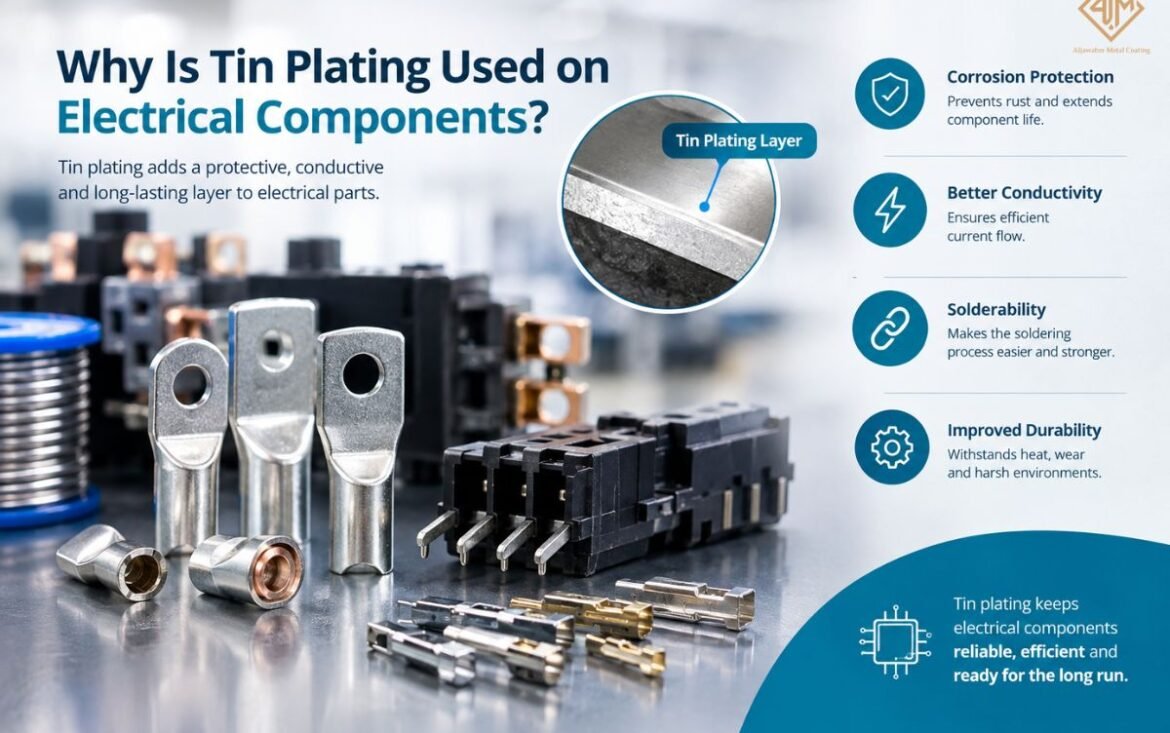
Tin plating protects electrical components because its primary function is to cover the base metal, which is copper or brass, and provide a surface for soldering and connections. Additionally, a thin tin layer protects the surface from oxidation and corrosion, thus avoiding contamination of contacts. Furthermore, this operation helps to provide reliable electrical contact in joints, reliable soldering results, and durability of the component itself. Although tin is not a very good electrical conductor as such, it keeps the copper’s conductivity intact at the surface of the connection.
Key takeaways
- Copper and brass get shielded from oxidation due to the presence of tin and the solderable quality of the surface.
- It is one of the most economical finishing processes for contacts, terminals, busbars, and electronic components.
- Tin whiskers pose a serious risk. Reflow, matte finish method, and a nickel layer as a substrate reduce this risk.
- Selection of thickness and type of deposit, as well as base metal, should be carried out considering the application.
What does a tin layer actually do?
Each benefit answers a specific problem in electrical assemblies, so it is worth taking them separately.
- Conductivity and electrical contact
Pure tin conducts modestly. Its resistivity is roughly six to seven times higher than copper’s, so tin does not improve conductivity. What it does is stop the copper underneath from degrading.
However, bare copper oxidises in air, and the film raises contact resistance. Tin oxidises too, but its oxide is thin and soft. When two tin-plated surfaces are pressed or wiped together, the film breaks and metal meets metal. That is why tin performs well as a contact finish at low to moderate currents and voltages.
- Solderability
Manufacturers choose tin mostly for this reason. Molten solder wets a clean tin surface easily and forms a strong joint with it. Tin-lead was the standard for decades, and after RoHS the industry moved to pure tin and other lead-free finishes.
A fresh deposit stays solderable for a long time if it is thick enough and stored properly.
- Corrosion protection
Tin is chemically stable in most indoor and enclosed environments. It covers the base metal and keeps moisture and airborne contaminants off it. In a hot, humid climate, bare copper tarnishes fast, and joints can loosen, which makes this coating more useful than it first appears.
- Durability and formability
Tin is soft and ductile. Parts can be stamped, bent, and formed after plating without the coating cracking badly. The softness also acts like a lubricant, so connectors often mate with lower insertion force than they would with a harder finish.
Where is tin plating used in electrical work?
Almost every category of electrical hardware uses it somewhere.
- Connectors and terminals
Crimp terminals, ring lugs, spade connectors, and board-to-wire connectors are commonly tin-plated. The finish keeps the contact surface stable and makes crimped or soldered connections dependable. In automotive and industrial harnesses, it is often the default.
- Busbars
Copper busbars in switchgear, distribution panels, and battery systems are frequently tin-plated. Bare copper oxidises at bolted joints, and the rising joint resistance produces heat. Tin slows that oxidation. It also narrows the galvanic gap where copper meets aluminium, which reduces corrosion at the interface.
- PCB components
Component leads, pads, and SMD terminations often carry a tin finish so they solder cleanly in reflow or wave soldering. Shelf life matters here, because parts can sit in storage for months before assembly.
- Wire connections
Tinned copper wire resists corrosion better than bare copper, which is why marine, outdoor, and humid installations use it. Tinned strand ends are also easier to hand solder and less likely to fray.
- Electrical contacts
Relay contacts, switch terminals, fuse clips, and battery contacts use tin where cost matters and the load is moderate. For very low signal levels or frequent mating cycles, another finish may suit better.
How does the tin plating process work?
Electroplating is the usual method for electrical parts. The steps are simple on paper, but each one affects the final quality.
- Cleaning removes oils, oxides, and residues through degreasing and acid activation. Poor cleaning causes most adhesion failures.
- Some parts then get a thin nickel or copper underlayer. Nickel acts as a diffusion barrier between the copper and the tin.
- The part goes into a tin electrolyte bath, and current deposits a controlled layer onto the surface.
- Rinsing and drying remove chemical residue that could stain or corrode the part later.
- If the specification calls for it, the part is reflowed. Brief heating melts the tin and lets it re-solidify, giving a smoother, denser surface and a lower whisker risk.
Two choices shape performance more than the rest.
- Matte tin has a duller finish, a larger grain, and lower internal stress. It is generally preferred for electronics and lead-free soldering. Bright tin looks better but carries a higher whisker risk.
- Thickness is the other. Thin layers suit low insertion force, while thicker layers give longer solderability and better corrosion resistance. ASTM B545 defines thickness classes from very thin flash coatings up to heavy deposits, so the drawing should name the class rather than say “standard plating.”
Hot-dip tinning is a separate route, used mostly for strip, wire, and some larger parts, but tin plating in Dubai is helpful.
How does tin compare with other finishes?
The right finish depends on current, mating cycles, environment, and budget. This table shows how the common options differ.
| Finish | Cost | Solderability | Contact performance | Best suited for |
| Tin | Low | Very good | Good at low to moderate loads | General connectors, terminals, busbars, PCB parts |
| Silver | Medium | Good | Excellent conductivity | High-current contacts, RF parts |
| Gold | High | Good (thin layers) | Excellent, very stable | Low-signal, high-reliability contacts |
| Nickel | Low to medium | Poor without activation | Moderate, hard surface | Barrier layer, wear resistance |
Tin is cheapest and solders best. Gold and silver earn their price only when contact stability or conductivity really is critical.
What are the limitations of tin plating?
Tin is common because it works, but it has weak spots that engineers should plan around.
1. Tin whiskers
Tin whiskers are thin, hair-like crystals that can grow out of a tin surface over time, mostly because of internal stress in the deposit. If one bridges two conductors, it can short them. Bright tin and thin layers directly over copper carry the highest risk.
The usual countermeasures are:
- Use matte tin instead of bright tin.
- Add a nickel underlayer so copper cannot migrate into the tin.
- Reflow or fuse the tin after plating.
- Control thickness and bath conditions.
For high-reliability or fine-pitch assemblies, whisker control belongs in the written specification.
2. Fretting corrosion
Where contacts vibrate or flex slightly, the tin can wear through and re-oxidise again and again. Resistance creeps up as a result. Adequate contact force and good design help, and gold may be the safer choice for critical contacts under vibration.
3. Softness and wear
Tin is soft, so it wears faster than harder finishes in connectors that see many mating cycles. The finish has to match the expected service life.
4. Intermetallic growth
Copper and tin slowly diffuse into each other and form a copper-tin intermetallic layer. If the tin is thin, that layer can consume it and ruin solderability. A nickel barrier and enough thickness slow the process, and so does sensible storage.
5. Temperature limits
Tin melts at about 232 °C. Parts exposed to sustained high heat need a different finish.
What should you look for in a plating partner?
Plating quality depends more on process control than on the metal. Whether you source locally or abroad, a few questions apply.
- Can they plate to a named standard such as ASTM B545 and confirm thickness?
- Do they offer matte tin, nickel underlayers, and reflow when your part needs them?
- Can they handle your part size, volume, and base material?
- Do they test adhesion, thickness, and appearance before shipping?
Local support matters in the UAE. Shorter turnaround, faster sample approval, and direct technical conversations all cut project delays. For many manufacturers, tin plating in Dubai also means quicker rework when a batch fails inspection.
Moreover, Aljawaher Metal Coating is a Dubai metal coating provider with experience in both decorative and functional plating. When you compare tin plating services in Dubai, ask each supplier to explain their process controls in plain terms. The same test applies if you are searching for the best metal coating company in Dubai judge on process discipline, testing, and honest advice about finish selection, not on claims.
Bottom line
Tin plating earns its place on electrical components because it solves several practical problems cheaply. It shields copper and brass from oxidation, keeps parts solderable, supports dependable contact, and survives forming and assembly. Whiskers, fretting, and wear are real weaknesses, but matte deposits, nickel underlayers, reflow, and correct thickness keep them manageable.
What matters most is matching the finish to the job. A busbar, a crimp terminal, and a PCB lead all use tin differently. For manufacturers and suppliers buying tin plating in Dubai, a clear specification and a supplier who follows it will do more for reliability than any single material choice.
If you are planning a project and want advice on finish, thickness, or process, you can contact Aljawaher Metal Coating to discuss your requirements for tin plating services in Dubai. And if you are still shortlisting the best metal coating company in Dubai, sending the same drawing to a few suppliers and comparing their answers is a good way to decide.
Frequently asked questions
No. Tin conducts less well than copper. The plating protects the copper surface so contact resistance stays stable over time.
It slows oxidation at bolted joints, which keeps joint resistance and heat down. It also reduces galvanic corrosion where copper meets aluminium.
Matte tin is duller, has lower internal stress, and is preferred for electronics. Bright tin looks shinier but is more prone to whiskers.
They are tiny crystal filaments that grow from tin surfaces. They can bridge conductors and cause short circuits, especially in fine-pitch assemblies.
Use matte tin, add a nickel underlayer, reflow the deposit after plating, and keep thickness and bath conditions under control.
Pure tin is lead-free and generally meets RoHS. Older tin-lead finishes do not, so check what your plating specification actually calls for.
It depends on the use. Thin layers suit low insertion force, and thicker ones suit solderability and corrosion resistance. ASTM B545 classes give you a way to specify it.
Look for a supplier that plates to a named standard, tests thickness and adhesion, and can advise on underlayers. Ask for samples before committing to a large batch