-
aljawahermetalcoating
- August 25, 2026
- No Comments
How Nickel Plating Enhances Corrosion Resistance
Table of Contents
- Key takeaways
- What does nickel plating actually do to metal?
- How does corrosion resistance really work at the surface?
- Electroless vs. electrolytic nickel plating
- Industries in Dubai that depend on this process
- Common mistakes that undermine a nickel coating
- Finding reliable coating nearby
- Choosing a metal coating partner you can trust
- Bottom line
- Frequently asked questions
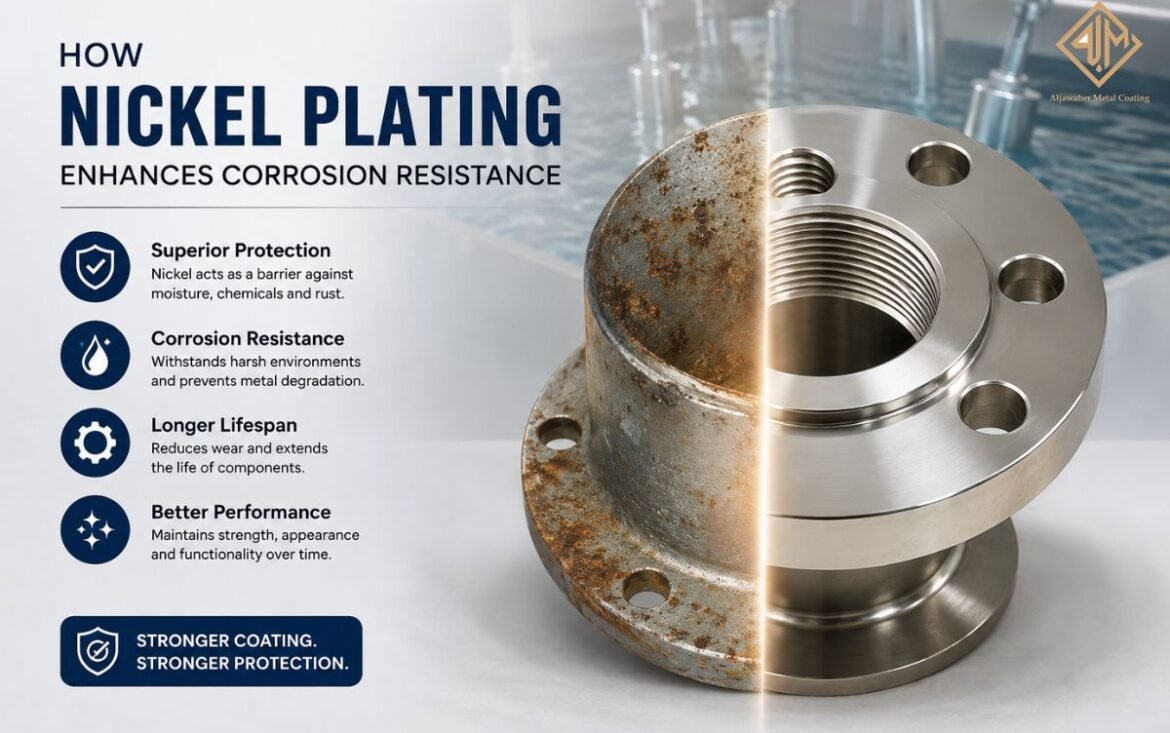
Nickel plating offers corrosion protection to metals due to its ability to produce a compact barrier of minimum porosity, making it difficult for oxygen and moisture to get to the underlying metal. Electroless nickel coatings are manufactured by chemical means, unlike electroplating, which uses electrical power, and they pass 500 to 1,000 hours in salt spray testing as per ASTM B117 standards without showing signs of red rust, while uncoated carbon steel survives approximately 96 to 200 hours.
The phosphorus content of the coatings varies from 2% to 14% and determines the hardness of the coatings as well as the resistance to exposure to salts or acids. When searching for Nickel Plating Services in Dubai, remember to check the serviceability of the coatings for complex shapes, resistance to humid coastal air, and surface hardness.
Key takeaways
- Nickel plating knows how to close the surface of metal, hence the very important thickness and porosity features.
- The electroless nickel process is about applying a nickel layer to holes and threads without the use of electric current.
- Dubai’s humidity and salty environment require greater corrosion resistance from plated metals.
- Poor surface preparation results in many more coating failures than errors in the execution of the plating method.
What does nickel plating actually do to metal?
Nickel plating involves the application of an ultra-thin layer of nickel, usually only between 5 and 75 micrometres thick, that is located between the underlying metal and exposure to the environment. This layer does not serve primarily for aesthetic purposes. Instead, it physically prevents oxygen, moisture, and salt from coming in contact with the steel or aluminum once again.
The problem with nickel plating is that it can be porous. Coating that has microscopic voids creates a means for corrosion to penetrate. Upon reaching the underlying metal even through the tiniest of holes, moisture starts to cause corrosion under the coating where it is invisible. However, this is also the reason why the services for electroless nickel plating in Dubai are usually of much better quality compared to regular electroplating when the parts have complex internal shapes.
I have seen brackets that were not failing externally but had to be removed after one year of service.
How does corrosion resistance really work at the surface?
Corrosion is an example of an electrochemical process wherein iron combines with oxygen and water to produce iron oxide or rust. For corrosion to be successful, some continuous pathway of exposed metal must keep existing. Nickel coating serves as a disruption to this path.
Through metallurgy, nickel happens to be very effective in this regard as well. Nickel forms a thin protective layer of oxide when subjected to air exposure, thus preventing any further oxidation process from happening. In the end, there are two protective layers at work here, like the nickel protective layer itself, and the oxide layer that is produced just above the nickel coating.
The phosphorus content makes all the difference when it comes to electroless plating. Low-phosphorus nickel (2-4%) is harder and more wear-resistant, but less resistant to corrosion in acidic environments. High-phosphorus nickel (10-14%) is virtually amorphous in structure, which gives it better chemical resistance, including resistance to salt spray and mild acids, but has a lower hardness. A good plating facility will take the actual conditions in which the part will be used into consideration in choosing the phosphorus level and not simply apply a default recipe.
Electroless vs. electrolytic nickel plating
People often assume all nickel plating is the same process with a different name. It isn’t.
| Factor | Electroless Nickel Plating | Electrolytic (Electroplated) Nickel |
| Coating uniformity | Even thickness on all surfaces, including recesses and threads | Thicker on edges and corners, thinner in recesses |
| Process | Autocatalytic chemical reaction, no current needed | Requires an electric current and an anode |
| Hardness (as deposited) | 45–58 HRC, up to 68–70 HRC after heat treatment | 150–500 Vickers, varies by additives |
| Corrosion resistance | Higher, especially with high-phosphorus formulations | Good, but weaker on complex geometry |
| Typical cost | Higher per part | Lower per part |
| Best suited for | Precision parts, internal bores, valves, connectors | Flat or simple-geometry parts, decorative finishes |
For anyone specifically searching for electroless nickel plating services in Dubai, the geometry of the part usually decides which process makes sense. Simple flat brackets don’t need the extra cost of electroless plating. Valve bodies, hydraulic components, and anything with internal channels almost always do.
Industries in Dubai that depend on this process
Dubai’s climate is part of why this matters more here than in a lot of places. High humidity, salt-laden coastal air, and long stretches of intense heat all speed up corrosion on unprotected steel.
Automotive workshops rely on nickel plating for engine components and fasteners that would rust within months if left bare near the coast. Structural fabricators plate load-bearing hardware mostly because swapping out a corroded bolt on an installed structure costs far more than getting the coating right the first time. Signage companies plate the frames and mounting brackets that sit outside year-round, exposed to whatever the weather brings. Machinery shops plate shafts and valve fittings too, where wear resistance matters as much as keeping the surface sealed.
Therefore, anyone comparing nickel plating services in Dubai across these industries will notice the requirements shift a lot depending on end use. A decorative sign bracket doesn’t need the same coating spec as a hydraulic valve stem, even though both technically get “nickel plated.”
Common mistakes that undermine a nickel coating
Most plating failures I’ve seen trace back to a handful of repeat mistakes, not exotic problems.
- Skipping proper degreasing before plating, which leaves a thin oil film that stops the coating from bonding
- Under-specifying coating thickness for the environment, especially on parts near saltwater or heavy rain exposure
- Using electrolytic plating on parts with deep recesses or blind holes, where current can’t reach evenly
- Rushing the rinse stages between chemical baths, which leaves residue that causes early pitting
- Choosing a shop based purely on price without asking what phosphorus content or thickness they’re actually delivering
However, that last point matters more than people expect. Two shops can both advertise as the best metal coating company in Dubai, but one might be running a 5-micron coating where the job needed 15. You won’t see the difference on delivery day. You’ll see it in eight months.
Finding reliable coating nearby
When someone searches for electroless nickel plating near me, they’re usually trying to solve two problems at once: turnaround time and trust. Local proximity matters for anything urgent, like a broken machine part holding up production, but it shouldn’t be the only filter.
Ask for the coating thickness range they’ll actually apply, not just a general quote. Ask whether they test with salt spray equipment or just eyeball the finish. A shop that can explain phosphorus content options for electroless nickel plating near me searches, rather than just quoting a flat price per kilogram, is usually the one that understands what they’re doing.
Distance is convenient. It isn’t a quality guarantee.
Choosing a metal coating partner you can trust
There isn’t one universal answer to who counts as the best metal coating company in Dubai, because “best” depends on what you’re plating and why. What’s consistent across good shops is a willingness to ask questions before quoting: what environment will this part sit in, what’s the base metal, does it need to survive chemical exposure or mechanical wear or both.
Aljawaher Metal Coating works through that conversation with clients before recommending a process, rather than defaulting to whatever’s fastest to run that week. For automotive parts, structural hardware, or signage components exposed to Dubai’s coastal humidity, that upfront conversation tends to save money later, since redoing a failed coating job costs more than doing it right the first time.
Bottom line
Nickel plating earns its reputation for corrosion resistance because of how the coating physically works, not because of marketing around it. A dense, properly applied layer with the right phosphorus content and thickness for the job will outlast a rushed or under-specified one by years, not months. That gap is exactly why the process, the prep work, and the shop you choose all matter more than the price on the quote.
If you’re weighing Nickel Plating Services in Dubai for a specific application, Aljawaher Metal Coating can walk through the environment and load requirements with you before recommending a coating spec.
Frequently asked questions
For indoor use, the electroless nickel will last for 10 to 20 years, depending on thickness and the amount of phosphorus present, and for outdoor use in coastal and industrial environments, for 3 to 8 years.
It prevents rust as long as the coating remains intact and does not have any holes. A scratch or a lack of porosity provides a starting point in the coating for corrosion to begin.
Nickel plating provides greater corrosion resistance and is more effective on intricate components. Most often, nickel is used under chrome plating for hardness and decoration.
Yes, but without the zincate pre-treat, nickel will not bond directly and reliably to any aluminum natural oxide, because aluminum has a natural oxide layer that prevents direct bonding.
The chemical process uses more costly baths and needs greater temperature control but provides even coverage on shapes that cannot be electroplated evenly by the chemical process, such as threaded holes.
Electroless nickel is resistant to saltwater for long service life in most marine applications, but some may require a thicker coating or sealants instead.
For most outdoor industrial applications, a minimum of 15 microns is required; however, for heavily exposed coastal applications, a minimum of 25 to 50 microns is desired.
Once all rust and pitting have been removed. Plating over corrosion only holds it in place and will cause premature failure.
The industry standard salt spray testing is in accordance with ASTM B117, which is the test of the time for coated parts and how many hours the parts can withstand salt fog.
Please inquire about their coating thickness in microns, and if they have test results, please ask for their salt spray test results. Both are readily available in a good shop.