-
aljawahermetalcoating
- October 20, 2026
- No Comments
Does Copper Plating Prevent Rust? Everything You Need to Know
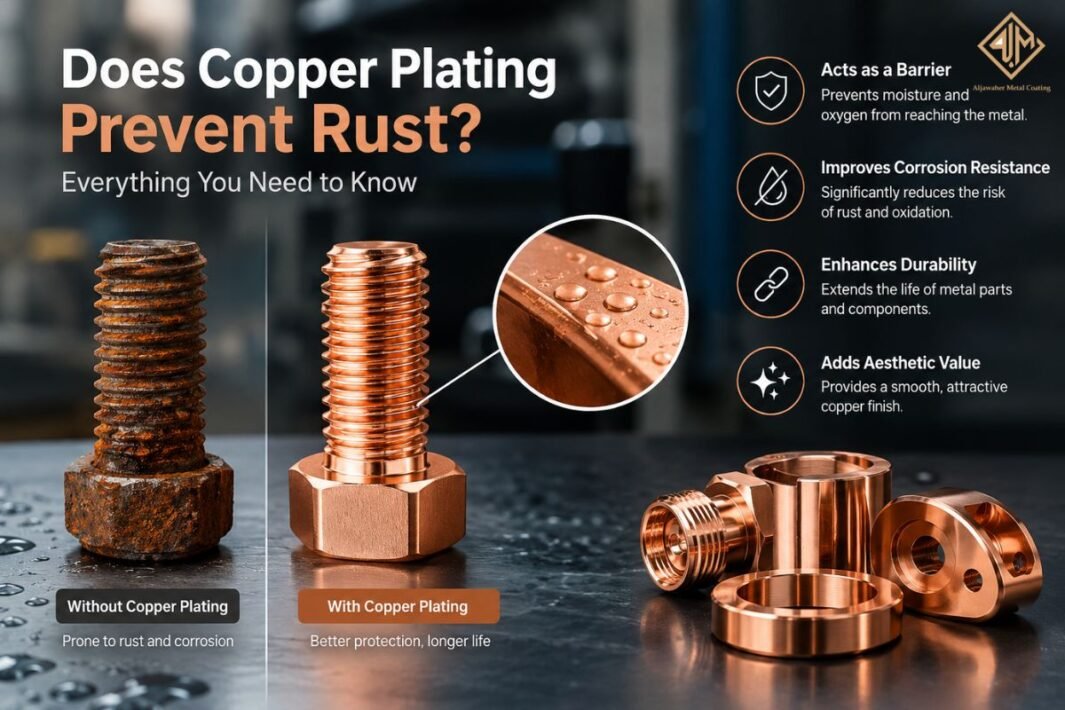
Copper plating prevents rust, but it is not done in the manner that many think. Rust is a combination of iron and oxygen. Copper does not rust because it is not iron. Copper plating acts as a barrier to stop moisture and oxygen from coming into contact with the base metal when it is overplated with copper.
That barrier only works as long as it remains intact. Scratches or pores can allow the underlying steel to show through, creating a breeding ground for rust to begin forming quickly. Most industrial or decorative parts require copper as an undercoat for nickel or chrome, which is why most buyers are looking for copper plating services in Dubai.
Key takeaways
- Copper is not corroded by itself, but the continuous copper layer can protect the steel from moisture.
- Copper works best in a layered system because scratches and pores might reveal the underlying material.
- The high humidity, salt air, and high temperatures of Dubai necessitate increased attention to corrosion protection measures.
- The key to results is to select a provider who provides testing and documentation.
What is copper plating and how does it work?
Copper plating involves coating with a thin layer of copper. Electroplating is used most commonly in commercial applications. The part is immersed in a bath of a copper-based electrolyte and is connected to a direct current source. The copper ions move to the part and form a uniform layer on it over the course of time.
How does the electroplating process work?
The layer thickness varies with time, current, and bath chemistry. The thickness of the protective and decorative layers varies from a few microns to several tens of microns. Thicker layers will also provide greater protection but are more expensive and time-consuming to produce.
Why do manufacturers choose copper?
Copper has good electrical conductivity, a tendency to adhere to many base metals, and a soft, ductile surface that allows other coatings to be applied easily. Due to these characteristics, it is frequently utilized as an intermediate finish.
Does this plating really prevent rust?
Yes, the copper plating does make it harder for rust to form on steel and iron by providing a barrier layer over the base metal. It does not render the surface rust-proof, however. If scratches, wear, or corrosion occurs on the copper surface, corrosion will occur on the steel surface, as this is the nature of copper; it is best used in conjunction with other coatings.
Why does copper not rust?
Rust is a type of corrosion product – it is iron oxide that is the result of corrosion of iron and steel by oxygen and moisture. Copper is a non-corrosive material. Rather, a thin oxide or sulfide film forms that darkens with age, which is commonly known as “tarnish” or “patina. Sometimes, that film can be the protecting element, and the copper roofs or plumbing can last for many decades.
The distinction matters. The phrase copper prevents rust is normally used to describe the copper layer on the iron protecting it from moisture and oxygen. The copper always remains copper while the steel below may rust if the copper layer is broken.
The barrier effect and its limits
Copper is used as a physical barrier. For water and oxygen to get to the steel, they have to go through the copper layer. This has a significant effect: a thick, pore-free layer slows the corrosion. But electroplated coatings are seldom completely dense. Moisture can seep in through microscopic holes and hairline cracks.
Copper also has a greater nobility than iron. When moisture penetrates through a defect, the steel is sacrificed and corrodes more quickly around the defect. That’s why a part with a scratch on it may rust where a plain steel part would not. With experienced platers such as the best metal coating company in Dubai, this is considered by using the correct thickness and layering system.
How does copper plating compare to other anti-rust coatings?
One of the options is copper. The selection will depend on the environment, function of the part, and budget.
| Coating | Rust Protection | Strengths | Limitations | Typical Use |
| Copper plating | Moderate as a barrier; best as an underlayer | Good adhesion, conductivity, base for other finishes | Scratches expose base metal | Underlayer under nickel or chrome |
| Nickel plating | Good | Hard, corrosion-resistant, attractive finish | Usually costs more than copper | Valves, fittings, decorative hardware |
| Zinc galvanizing | Very good, sacrificial | Protects even where scratched | Rougher finish, less suited to fine parts | Structural steel, outdoor frames |
| Powder coating | Good barrier | Wide color range, durable | Chips expose metal; thicker build | Machinery, railings, enclosures |
If raw steel is to be left exposed to the outside elements, zinc galvanizing is frequently the most effective sole method of protection, as it corrodes more readily than iron. That is not a good application for copper plating alone.
Why is Dubai’s climate making corrosion protection essential?
Dubai has high humidity levels, salt in the air, hot weather, and dust in the air. Constant moisture from the Gulf and aerosols that accelerate corrosion are present on metal surfaces here. When a part is mounted close to the water or in an outdoor piece of equipment, it may deteriorate at a higher rate than the same type of part mounted inland where there is less exposure to water. Due to this, copper plating in Dubai is typically used in conjunction with other coating possibilities, rather than as a single coating.
It doesn’t just take heat. The higher temperatures increase the rate of chemical reactions, and the daily temperature fluctuations can fracture or cause microcracks in coatings. Dust on metal surfaces can also retain moisture on the surface.
- Humidity and salt air
One of the most ferocious corrosion accelerators is salt. Coatings and protective films are broken down by chloride ions. Some salt deposits form on exposed surfaces, therefore making it necessary to have exposed parts routinely inspected and cleaned in coastal areas.
- Heat, dust, and daily temperature swings
When base metals and coatings are subjected to thermal cycling (heating and cooling), they expand and contract at slightly different rates. This can cause cracks to develop over time. When used with abrasive dust, the surface may lose its protection faster than anticipated.
Is copper plating worth it for your parts?
Yes, for many parts. For enhanced adhesion, electrical conductivity, or as a base for nickel or chrome, copper plating is an excellent choice. Not as effective as steel protection alone when exposed to salt and moisture. Galvanized or powder-coated structures tend to provide better protection on their own when exposed to the outdoors.
Best applications for copper plating
Copper plating is suitable for certain applications:
- Electrical connectors and busbars that require good electrical conductivity.
- Quickly coated in decorative nickel or chrome.
- Mechanical components that need a stress-free underlayer.
- Plating in limited areas of a component.
When another coating makes more sense?
In structural steel, outdoor railings, or large frames in severe coastal conditions, copper is not enough to offer sufficient protection. Galvanizing, or a combination of galvanizing and powder coating, generally is more effective. It is best to make the right choice at the outset to avoid expensive replacement.
How to choose a reliable plating partner?
The performance of the coating is dependent on the quality of the plating process. A quality provider will tell you what is happening at each stage: surface preparation, inspection, etc.
What makes the metal coating company best in Dubai?
The ideal metal coating contractor in Dubai is the one that lets you know the specifics of the process clearly, provides documentation of the thickness of the coating, and shares the truth about which process is better suited. Ask the following questions when assessing copper plating services in Dubai: pre-treatment, bath control, and testing. Ask for references from clients in your industry.
Before any work begins, Aljawaher Metal Coating suggests you ask the following questions:
- What cleaning and pre-treatment process do you employ?
- What is the method used to measure and record coating thickness?
- Are there salt spray or adhesion tests performed?
- Do you have any ideas for a layered system for our environment?
How to maintain plated parts over time?
Care of any plated part will increase the length of its life. Follow these steps:
- Check surfaces monthly for rust, early rust spots, or discoloration.
- Wash off salt and dust with clean water and a non-abrasive cleaner.
- Dry parts before storing or reinstalling again.
- Repair damaged surfaces promptly before they come into contact with moisture and with the base metal.
- Put a protective lacquer or wax on beautiful items to reduce the rate of tarnishing.
- Once the wear is general, re-plating or recoating is scheduled for professionals.
Final thoughts
Copper plating is one of the many tools that can be used to prevent rust. Select a coating that suits the surroundings, advocate appropriate screening, and collaborate with a top metal coating firm in Dubai that you can rely on for dependable and enduring outcomes.
Frequently asked questions
No. It protects against rust by creating a barrier; however, moisture can get through scratches or holes to the underlying steel.
No. Iron oxide is rust; copper does not rust. Rusts or rusts into a patina, which are typically benign.
The lifespan varies according to thickness, environment, and maintenance. Outdoor parts in coastal applications require earlier inspection than those in inland applications.
The cost of copper plating is typically less than nickel or chrome plating, but more than painting. Prices vary according to the size and thickness of parts.