-
aljawahermetalcoating
- October 22, 2026
- No Comments
Does Chemical Etching Damage the Metal?
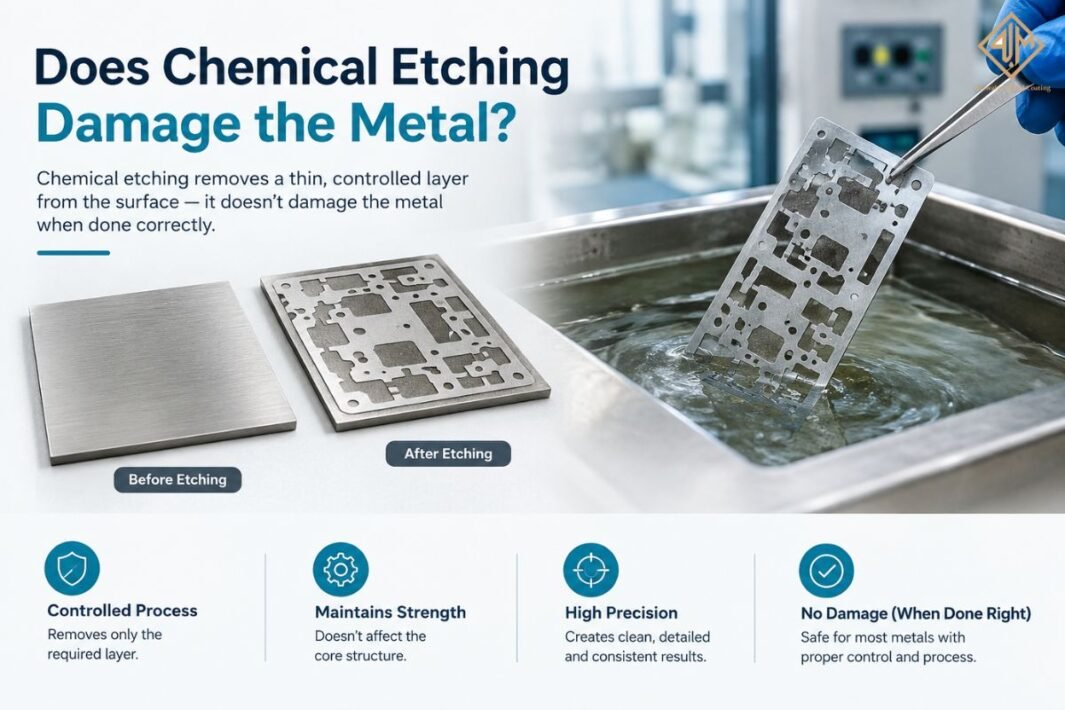
Chemical etching does not harm metal provided it is executed in controlled settings. The process involves taking away a specified layer of material, resulting in the development of patterns, engravings, and different surfaces, while retaining most of the strength of solid metals. The damage occurs mainly due to improper process control, such as over-etching, improper selection of etchant, omitting neutralizing processes, etc.
This guide explains where the actual risks exist and how they can be avoided. If you are planning to carry out a project, a chemical etching partner operating in Dubai may be the difference between having good results and having to make costly corrections.
Key takeaways
- Chemical etching, when properly controlled, will only remove a controlled thin layer and will not weaken most structural metals.
- Over-etching or incorrect etchant chemistry, inadequate rinsing, or absorption of hydrogen are the main causes of damage.
- The best protection is process control and sample testing that are specific to the material.
- A clear provider that has documented inspection and rinsing procedures minimises risk and rework.
What is chemical etching and how does it work?
Chemical etching is a metal removal process that is carried out with an etchant to remove specified areas of metal. The parts not to be dissolved are protected by a resist or mask, while the remaining parts are dissolved by the chemical. It is commonly used for high-precision patterns, logos, and thin parts.
The following steps are most important in the etching process.
- Cleaning: The metal surface is degreased to ensure uniform reaction with the etchant.
- The resist is applied: The design is created in the resist either by photo-resisting or screen printing.
- Exposure and development: Curing or development of the resist to expose areas to be removed.
- Etching: The part is dipped or spray-treated in the etchant for a predetermined period of time.
- Neutralization and rinsing: Any residual chemicals are neutralized and rinsed away to prevent further reaction.
- Inspection: Dimensions, depth, and surface quality are checked.
Does this really damage the metal?
No, not if it is done right. Chemical etching is a process that involves the removal of a controlled amount of metal by the use of a precise solution of acids or alkalis. This process may leave a matte or textured finish, but if the temperature, time, and concentration are controlled, there will be no cracking or distortion of the metal.
The thickness of the layer removed in practice is typically quite small, a few micrometres up to a few fractions of a millimetre depending on the task. This is why etching is trusted with parts that are delicate and cannot be handled by mechanical tools.
Where can damage actually occur?
The most likely source of problems is the process, not the method. The most common problems are:
- Over-etching: Letting parts remain in the bath longer than specified may thin edges and affect dimensions.
- Pitting: When there is local contact with or contamination of the uneven etchant, it can lead to pits on the surface.
- Intergranular attack: Some alloys may have a tendency to be attacked at the grain boundaries if the wrong chemistry is used.
- Hydrogen embrittlement: High strength steels may pick up hydrogen during the process and become brittle.
- Rinsing: Even if the part is rinsed well, corrosion can occur after it has been removed from the shop.
Why does process control matter most?
Monitor the bath consistently for results. The operators must monitor the concentration of the etchant, the ambient temperature, and the immersion time, and must change the solutions before they have been exhausted. However, process variations are significant, and small variations can make a huge difference, which is why it is important for experienced shops to keep a record of their processes.
Which metals are most sensitive to etching?
Various metals will react differently to various etchants, and the correct chemistry is important. The following table outlines some of the common materials used, along with the principal precautions to take for each.
| Metal | Typical Etchant Type | Main Risk | Control Tip |
| Stainless steel | Ferric chloride or acid mixtures | Pitting from uncontrolled chlorides | Monitor bath chemistry and rinse thoroughly |
| Aluminum | Alkaline solutions or ferric chloride | Over-etching and surface dulling | Limit immersion time and check temperature |
| Copper and brass | Ferric chloride or ammonium persulfate | Uneven etch depth | Agitate the bath for even contact |
| Titanium | Hydrofluoric and nitric acid mixtures | Hydrogen absorption and handling hazards | Use trained staff and certified chemical handling |
| High-strength steel | Acid-based etchants | Hydrogen embrittlement | Apply post-process baking when required |
Chemical etching vs mechanical machining
There are many buyers who equate etching with cutting, or milling or stamping. There are advantages to each method and will depend on the part and budget.
| Factor | Chemical Etching | Mechanical Machining |
| Stress on the part | Minimal, no mechanical force | Can introduce residual stress |
| Burrs | Typically burr-free | Often requires deburring |
| Fine detail | Excellent for thin, intricate designs | Limited by tool size |
| Heat effects | No heat-affected zone | Heat may alter surface properties |
| Small batch cost | Cost-effective with no tooling | Tooling can be expensive |
Therefore, in some cases, such as thin sheet materials, delicate patterns or heat-sensitive materials, etching may preserve the part better than mechanical processes. Thick sections or high volume straight cuts still might be more practical to machine.
How can you protect metal during etching?
The key to protecting the metal is to begin protection before the first part enters the bath. Taking the following precautions will reduce risk:
- Check the alloy: Ensure correct grade, otherwise the etchant may not be compatible with the alloy.
- Test on samples: Do trial pieces to check depth, finish and dimensions.
- Keep track of time and temperature: Time and temperature logs for each batch.
- Stir the solution: Make sure there is even coverage of the surface.
- Rinse and neutralize thoroughly: Wash off all chemicals after etching.
- Bake as needed: treat with hydrogen relief for susceptible high strength steels.
- Inspect and document: Take measurements and maintain batch data.
How do you choose a reliable provider?
Select a supplier that is able to record the process controls, use material specific etchants and inspect parts prior to delivery. Request for samples, references, and information about neutralizing and rinsing. The quality of project work is evident when there is transparent communication.
Before you order, be sure to ask these questions:
- What are the etchants for my particular alloy?
- What are your etch depth and dimensional tolerance control methods?
- Do you give inspection reports or sample approval?
- What is your approach to neutralizing, rinsing and disposing of waste?
- Are there any recommendations for post process baking of high strength steel?
Looking for the best metal coating company in Dubai is only beneficial if the company can prove it. Do not take the word of an advert, look for proof. A good team will have a discussion with you before quoting about your alloy, tolerances, and finish expectations, and will let you know what compromises will be made.
Moreover, if you need continuous production, you should find a chemical etching service in Dubai that can guarantee results from batch to batch. It’s not just one good sample that is important; consistency is important; consistency ensures your schedule and brand are protected.
Conclusion
Under the control of metal and chemistry experts, chemical etching can be a safe and accurate technique. The dangers lie in taking shortcuts, not in the process. Confirming the alloy, testing samples, controlling the time and temperature, and rinsing thoroughly–all of these can help to ensure the clean, reliable results every time.
The first step in selecting the best metal coating company in Dubai is to understand the importance of process control and quality checks. If you have any specific requirements, Aljawaher Metal Coating welcomes the opportunity to discuss them with you and outline the steps taken to ensure that your material is safeguarded from inception to completion.
Frequently asked questions
In practice, etching under good control removes only a thin and carefully determined amount and is seldom a factor in weakening structural metals.
Typical metals that are etched are stainless steel, aluminum, copper, brass, and titanium, and each metal has different etching solutions available and conditions that must be controlled.
There is a possibility that during etching a high strength steel can absorb hydrogen, which may result in brittleness; therefore baking treat is sometimes used after etching.
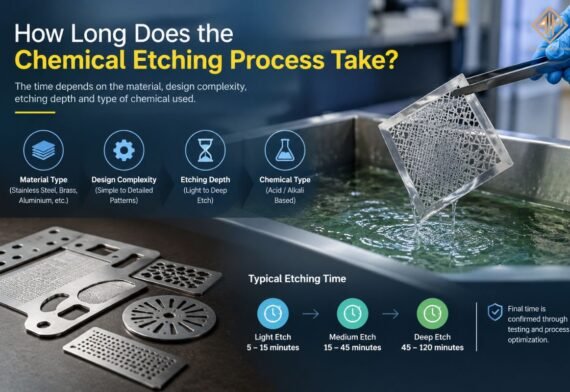
Timing varies by type of metal, etchant strength and desired depth, and can take minutes to several hours.