-
aljawahermetalcoating
- October 17, 2026
- No Comments
How Long Does the Chemical Etching Process Take?
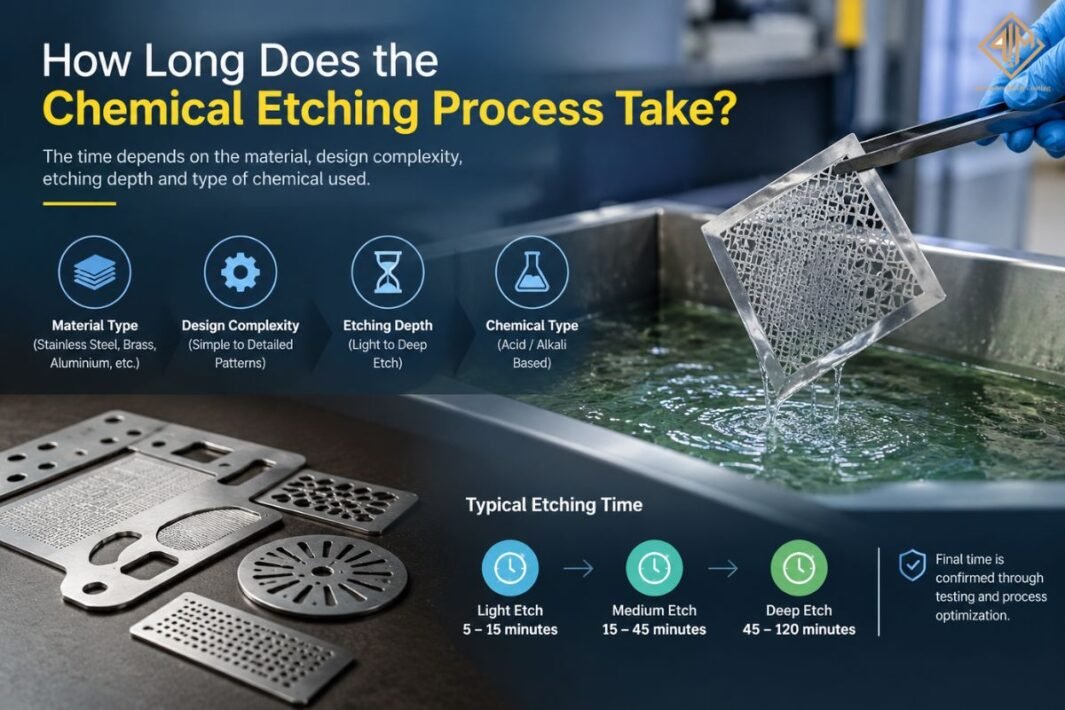
Chemical etching usually takes a few minutes to about an hour for the actual bath, but the full turnaround is longer. Most projects are completed in 1-5 working days, including cleaning, masking, rinsing, neutralizing, and inspection. The actual time will depend on the type of metal, etch depth, the complexity of the design, and the number of parts that are etched in a batch.
A simple pattern on a thin stainless steel sheet will move through the line quickest; a deep or multi-stage process will take longer. Each of these steps is explained in detail, allowing you to plan production schedules with realistic expectations.
Key takeaways
- The etching bath is typically the shortest part of the process, and full turnaround typically takes 1-5 working days.
- The most significant factors affecting timing are metal type, etch depth, and the complexity of the design.
- The copper etches the fastest, and stainless steel and nickel alloys require longer.
- Production-ready drawings and early material confirmation can save a lot of time.
What is the chemical etching process?
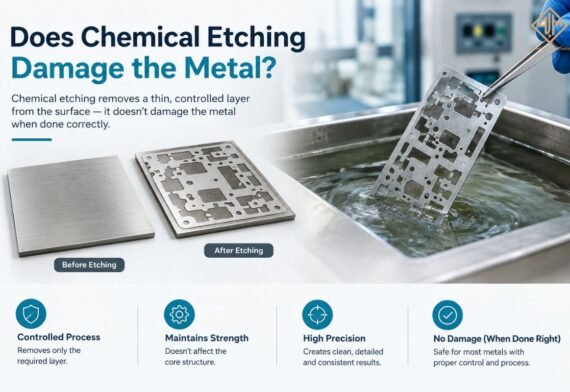
Chemical etching is an etching process in which selected areas of the metal sheet are removed by a controlled acid or alkaline solution. A protective mask is used to cover the parts that are not to be touched, and the uncovered parts dissolve at a predictable rate. The outcome will be accurate patterns, logos, fine holes, or thin profiles without stress associated with cutting or stamping.
This application is common for electronics components, decorative panels, signage, filters and precision parts. No physical force comes into contact with the metal, so burrs and warping are rare. One of the advantages it has is this precision, which makes it a favourite choice for parts that are required to have a narrow tolerance.
The core steps at a glance
The process of getting a job typically goes through the following steps:
- Rinse the metal surface to clean off oils, oxides, and contaminants.
- Coat with the photoresist or protective mask to specify the design.
- Expose and develop the mask and open up the etch areas.
- Dip the part in the etchant bath.
- Wash, neutralize, and remove the mask.
- Check and record dimensions of the completed product.
Every step contributes to the time, but if the job is well planned, some steps can be shortened or performed in parallel.
How long does each stage take?
Many clients think the bath time is all there is. In fact, the bath is usually the briefest step in the manufacturing process. Here are the normal ranges when you have a normal job. These are planning estimates and not guarantees, as actual times depend on the project.
| Stage | Typical Duration | What Happens |
| Cleaning and preparation | 30 minutes to 2 hours | Removes oils, oxides, and surface residue |
| Mask application and curing | 1 to 4 hours | Applies photoresist or protective coating |
| Exposure and development | 30 minutes to 2 hours | Defines the design on the mask |
| Etching bath | 5 minutes to 1 hour | Removes metal from exposed areas |
| Rinsing and neutralizing | 15 to 45 minutes | Stops the reaction and cleans the surface |
| Mask stripping and drying | 30 minutes to 1 hour | Removes protective layers |
| Inspection and measurement | 30 minutes to several hours | Checks depth, dimensions, and finish |
Why the bath is not the bottleneck
All the steps are to be carefully executed, except for etching itself, which moves quickly. Both too fast and too slow in the cleaning stage can result in an uneven etch, and not examining the work can result in rework, which will take much longer than the work was originally done. This is why preparation and quality checking are seen as a critical part of the timeline at experienced shops.
Batch size and scheduling
The bath time is almost the same for running one part and running a full tray of parts. That’s why batching is important. A shop that processes similar jobs in a similar window can process large orders in a similar window to small orders, which can lead to a lower per-part cost.
What factors change the etching time?
There are some factors that will move the timeline up or down. You can better plan and ask questions when you ask for a quote if you know them.
- Etch depth: Longer bath exposure or multiple baths are needed for deeper etches.
- Complex design: Fine lines, small holes, and close spacing require careful masking and checking.
- The thickness of the metal sheet: thicker sheets require more time to be completely etched.
- Tolerance requirements: The tighter the tolerances, the more measurement and possibly more process control.
- Finish requirements: Matte, bright, or textured surfaces may require additional processing after etching.
- Order volume: Large orders may need more setup time, but then tend to run smoothly.
- Time involved in sourcing materials: If the metal is to be sourced first, then days are added before the work begins.
Additionally, a nice, finished, and dimensional drawing can save time. Inadequate information causes the production to be delayed by days due to a round-trip communication process.
How does metal type affect etch time?
A variety of metals will etch at different speeds. Some dissolve rapidly and easily; others require more potent solutions or more time. The table below presents general trends for typical materials. They should be confirmed by your supplier for the particular alloy and etch depth.
| Metal | Relative Etch Speed | Typical Bath Time Range | Notes |
| Copper | Fast | 5 to 20 minutes | Commonly used in electronics and PCBs |
| Aluminum | Moderate | 10 to 30 minutes | Needs careful surface preparation |
| Brass | Moderate | 10 to 30 minutes | Good for decorative and signage work |
| Stainless steel | Slower | 20 to 60 minutes | Requires stronger etchants for deep cuts |
| Nickel alloys | Slower | 30 to 60 minutes | Used in precision and specialty parts |
Stainless steel is one of the most demanded materials and is usually on the lower end of the spectrum. Not a problem for quality, but the schedule does need to take into account longer exposures, particularly on thick sheets.
Why choose chemical etching services?
Working with local experts decreases shipping time, makes communication easier, and makes revisions easier. For UAE companies, the decision to rely on chemical etching services in Dubai can lead to much shorter lead times than importing the finished products from abroad. Local shops can also act quicker in case of a design modification or a sample adjustment.
Don’t be fooled by the price quoted when comparing providers. Inquire about how they prepare, whether they look at every batch, and how they let people know when they are delayed. A supplier that can be clear in their timeline is typically a supplier that has a good handle on production.
When it comes time to order, you should be prepared with some questions you want to ask-
- How long does it take to get to delivery from sketching and approval?
- Perform inspections during or after etching?
- What do you do if the batch is not within tolerance?
- Will we have a sample or first article part before production?
Moreover, the answers to these questions provide insights into a shop’s scheduling and quality control practices, both of which can impact the time required to complete your order.
How can you shorten the turnaround time?
There is no set time frame for timelines. Many projects can go faster without sacrificing accuracy with good planning!
- Submit production-ready files- If the drawings are vector-based and include dimensions and tolerances, they eliminate delays.
- Confirm material early- Ensure the alloy and thickness are specified before ordering.
- Batch your orders- Running similar parts in a single run decreases setup and bath cycles.
- Approve samples quickly- A quick vote on the first of the articles ensures that the entire run is not delayed.
- Inspection plan- Factor in time during your build to inspect it so it’s not a surprise delay.
These are some of the steps that can help ensure the success of chemical etching services in Dubai projects, particularly when the deadline is tight or multiple parts are being shipped together.
Why does Aljawaher Metal Coating stand out?
Aljawaher Metal Coating is known for its meticulous preparation, bath control, and open scheduling. Another client note we frequently hear is that the team communicates with clients about each step of the process so that they have an understanding of what to expect before production.
There are plenty of people who are looking for a supplier that can provide them with more than just a quick job. They are looking for a business partner who knows about tolerance, finish, and repeatability. Hence, their approach is to work within controlled conditions with a batch inspection and clear communication from quote to delivery. These habits are just as significant as speed for businesses seeking the best metal coating company in Dubai.
What clients can expect?
Each drawing is checked before production is begun, and any problems that might impact timing will be flagged. Material, etch depth, and finish are confirmed in writing – there is no need for surprises. They update their clients at significant stages of production and give our clients an inspection report before they are shipped.
Bottom line
The bath is not the only factor that determines the etching time. The cleaning, masking, rinsing, and inspection all influence the schedule, and each one contributes to the quality of the part being produced. Knowing these stages and the variables that impact them can help you to establish realistic deadlines and keep delays to a minimum.
For future projects, people should begin by communicating their drawings, materials, and schedule. It is easier to work with an experienced chemical etching services provider in Dubai from the initial quote to the final delivery. The best results and clear timelines are provided by Aljawaher Metal Coating, so they will be able to help you get started.
Frequently Asked Questions
The bath usually takes between 5 minutes and one hour. Timing will vary depending on the kind of metal, the depth of the etch, and the concentration of the etchant.
This will take extra time for preparation, masking, rinsing, stripping, and inspection. These steps must be followed because they are crucial to quality; they can not be skimped on or rushed if defects are to be avoided.
Yes, in many cases. Approved materials and clear drawings, along with batching with similar jobs, can speed up the schedule. Rush jobs are based on the shop’s workload.
Generally, yes. Stainless steel is more difficult to dissolve and typically requires longer bath exposure or more aggressive etchants than copper.