-
aljawahermetalcoating
- October 6, 2026
- No Comments
Is Copper Plating Good for Corrosion Resistance?
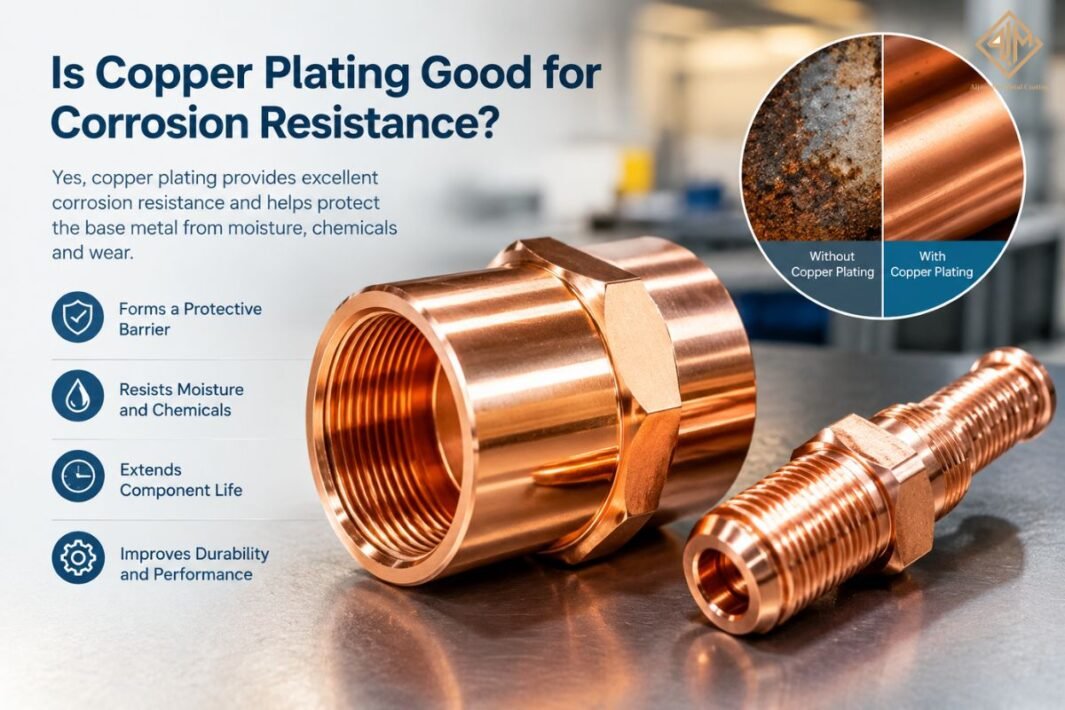
Table of Contents
- Key takeaways
- How does copper plating work?
- Does copper plating resist corrosion?
- Where does copper plating perform well?
- What are the limitations of copper plating?
- What factors affect corrosion protection?
- How does copper compare with other plating options?
- When should you use or avoid copper plating?
- How to choose a copper plating provider in Dubai?
- Conclusion
- Frequently asked questions
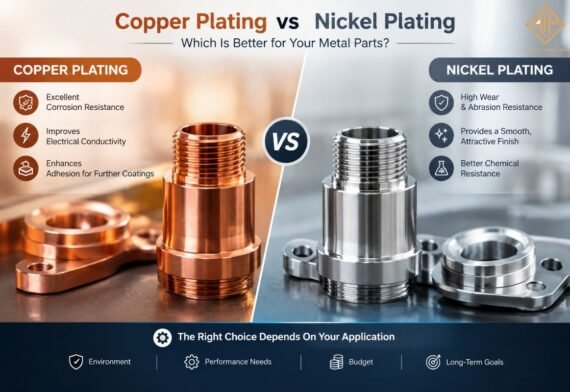
Copper plating works well in terms of corrosion resistance only in specific scenarios. Copper has good corrosion resistance in air. A thin coat of copper on steel is porous, which means that it allows moisture to penetrate and enhance the process of rusting. Copper is best as a primer under nickel, chrome, or in any type of interior application.
Copper is widely used in some industries, from PCB manufacturing to decorative items. Copper pipes and roofs do not rust and can last for decades. Thus, many people believe that copper will prevent rust on any other type of metal as well. However, copper-finished steel shows that it works differently.
In this blog, we will explain how the process of copper plating works, where it performs well, where it fails, and if it is suitable for your applications.
Key takeaways
- Copper has natural corrosion resistance; however, thin coatings are not sufficient to act as barriers.
- Copper acts as a cathode for steel; therefore, when the surface has pores or scratches, corrosion happens faster.
- Copper achieves optimum performance in combination with nickel and chrome coatings or protective lacquers.
- The thickness, surface preparation, and treatment after application might be important factors that contribute to the success of copper protection against harsh weather conditions in Dubai.
How does copper plating work?
Copper plating is defined as an electroplating process. The part to be plated is immersed in the solution with copper ions and is connected to the negative terminal of the power source. As current flows through the solution, copper accumulates on the surface of the component as a continuous film.
What are the key processes of the procedure?
- Cleaning involves removal of oil, grease, and dirt from the surface.
- Surface preparation is accomplished with an acid solution that removes oxides.
- A very thin copper film is created to ensure adherence to the component surface.
- The actual plating involves deposition of copper until the required thickness is achieved.
- Rinsing and drying serve to remove any chemicals from the surface.
- Post-treatment involves applying an anti-tarnish layer and lacquer to the part.
Which copper baths are used?
Acid copper baths mostly consist of sulfate and result in deposits that are smooth, shiny, and thick. However, they can not be used directly on steel since steel can initiate the formation of a weak deposit that has poor bonding properties. This is why steel components are treated first with aqueous alkaline copper plating in a cyanide or non-cyanide bath.
Does copper plating resist corrosion?
What natural protection does copper offer?
Copper produces a surface layer of oxide that impedes its future corrosion from oxygen. As time passes, copper undergoes oxidation and changes to a characteristic green color known as patina.
However, this protective film has certain limitations. In the presence of air that has sulfurous compounds, copper turns brown or black, while the process of darkening copper occurs more rapidly in wet and saline environments.
Why does plated copper behave differently on steel?
Copper is a more noble metal than steel. When a pore, cut, or sharp edge of steel is exposed, moisture forms a galvanic cell. Steel becomes the anode and leads to corrosion, while the large surface area of copper acts as the cathode. This means that a small exposed area suffers much worse damage due to the large area of copper.
Zinc allows itself to be sacrificed to save steel, but with copper the opposite happens.
Take a bright copper-plated bracket left in a humid workshop. It might demonstrate orange rust spots that started from pores in a thin deposit and bled through.
Where does copper plating perform well?
Copper plating in Dubai works well in a coating system or in some controlled environments.
| Application | Role of copper | Corrosion relevance |
| Undercoat for nickel-chrome finishes | Improves adhesion, fills small surface flaws, adds a smooth base | Protection comes mainly from the nickel and chrome layers on top |
| Electronics and circuit boards | Provides conductivity | Surface is usually covered by tin, gold or solder finish |
| Indoor decorative hardware | Gives a warm metallic look | Needs lacquer or clear coat to slow tarnishing |
| Busbars and electrical contacts | Carries current | Usually overplated with tin or silver for protection |
| Heat treatment masking | Blocks carburizing on selected areas | Not a corrosion function |
What are some practical examples?
- Copper under nickel and chrome is used on chrome-plated automotive trim for a smooth base on which a bright finish is applied.
- Electrical components with copper plating are maintained in a stable and dry area of enclosures.
- Decorative indoor fittings are lacquered copper-plated, which retains their colour in air-conditioned rooms.
What are the limitations of copper plating?
- Thin deposits have tiny holes that allow water to penetrate the base metal.
- If there is any damage to the steel, it can accelerate substrate corrosion.
- Copper will get dark in moist or polluted air and will change rapidly on its surface.
- Copper is soft and vulnerable to scratches, which can be a starting point for corrosion.
- For coastal use in conditions of chlorides, bare copper over steel is a poor selection.
Moreover, the high humidity, salty air in the coastal regions, and the heat and dust in Dubai caused these limits to show up earlier in the state.
What factors affect corrosion protection?
A copper layer protects a part for a number of reasons.
- Coating thickness
The thicker the copper, the fewer through pores. The thickness of the strike layer is typically a few microns, which provides virtually no barrier protection, or it can be quite thick, depending on the specification, if it is used to provide barrier protection. ASTM B734 is for engineering applications of electrodeposited copper, such as thickness and testing.
- Surface preparation
Weak adhesion is due to poor cleaning. If blistered or peeled, the metal will become exposed, and corrosion will soon occur.
- Base metal
Copper will bond with steel, brass, zinc die-cast (with proper strike) and a variety of other metals. Corrosion behaviour will be influenced by the reaction of the substrate with copper, depending on the extent of the damage to the coating.
- Bath control and process quality
The density and uniformity of the layer is influenced by the chemistry of the bath, the current density, and the temperature. Rough, porous, or uneven deposits are caused by poor control.
- Post-treatment
The weak points are sealed by a clear lacquer, anti-tarnish dip, or topcoat of nickel, chrome, or tin. Often this step is more important than the copper layer.
- Part design and environment
Any sharp edges, deep recesses, or moisture that can become trapped increase the exposure to corrosion. Service indoors, dry, is much better than service outdoors, coastal. Salt spray testing according to ASTM B117 is a good indicator of the comparative ability to survive salt spray conditions, but is not an exact predictor of service life.
How does copper compare with other plating options?
| Plating | How it protects | Best for | Watch out for |
| Copper | Barrier layer only, natural patina | Undercoat, electrical parts, indoor decorative items | Porosity and galvanic risk on steel |
| Zinc | Sacrificial protection for steel | Fasteners, brackets, general steel parts | Needs chromate or passivation for longer life |
| Nickel | Dense barrier layer | Engineering parts, base for chrome | Can be cathodic to steel if pores exist |
| Nickel-chrome | Barrier with hard, bright finish | Automotive and decorative parts | Needs enough nickel thickness |
| Tin | Barrier with good solderability | Electrical contacts, food-contact items | Soft surface, whisker risk in some cases |
When long-term corrosion protection is required, zinc or a copper-nickel-chrome system will generally give better results than copper.
When should you use or avoid copper plating?
Use copper plating when:
- Copper is a part of a system of undercoat that may consist of nickel-chrome or similar.
- The part can be used indoors under dry conditions and in a controlled environment.
- Electrical conductivity is most important, and a protective topcoat is also included.
- Surface to be lacquered and a decorative copper look is required.
Avoid copper plating when
- Steel bare parts will be exposed to outside elements or sea breezes.
- The part will experience little or no abrasion or handling.
- Long-term protection is needed with no topcoat.
- Moisture or chemical exposure is expected to be constant.
How to choose a copper plating provider in Dubai?
The results are very much dependent on the plating shop. As you research the best metal coating company in Dubai, you should ask the following questions about your copper project:
- Are they able to suggest the right coating system for your component and environment?
- What do they use to measure the thickness, and what thickness do they apply?
- Do they use a strike layer and correct surface preparation for your base metal?
- What is the best topcoat or post-treatment recommended?
- Are they able to meet a recognised specification like ASTM B734 if required for your project?
Therefore, before the price is discussed, good copper plating services in Dubai start by asking some questions regarding the use of the part.
Conclusion
Copper Plating is used for particular tasks. When used as an undercoat on interior components and in electrical applications, particularly for use with a topcoat, it is a good performer. Copper may be a harmful coating to apply to bare steel in Dubai’s humid, salty environment, as the copper can easily become compromised.
The correct option will rely on the metal base, the surrounding environment, and the finish desired. The best metal coating company in Dubai like Aljawaher Metal Coating can assist you in selecting the appropriate coating system for your parts if you are considering a project and are looking for a professional solution in metal coating.
Frequently asked questions
No, copper will not rust, but plated steel can. Even when the copper is thin or damaged, the steel can still corrode.
Only partly. It serves as a barrier and breaks down when there are holes or scratches in it that allow the steel to be exposed. Zinc is more effective at protecting steel.
Copper enhances adhesion, reduces minor surface defects, and provides a good base for nickel and chrome. The ultimate protection is the nickel and chrome layers.
Yes. Copper gets dark in air, particularly if it is humid or polluted. This is slowed down by the use of a clear lacquer or anti-tarnish dip.
Not on its own. The thin coatings are hard to withstand salt, humidity, and heat. The outdoor components typically require a more robust system, like nickel-chrome or zinc.
This will depend on the application and specification. The denser the deposit, the fewer pores there are, but copper is not always the only protection afforded on steel.
Yes. Copper is more noble than steel; any damage to the coating can accelerate corrosion of the steel at the site of the damage.
Generally, no, for steel parts. Zinc gives sacrificial protection. Copper is used in special applications like undercoats and in electrical parts.
Yes. Lacquer is found frequently on decorative and indoor copper objects and stabilizes the colour.
Share the base metal, where the part will be used, the expected finish, and any standard you need to meet. This assists them in the selection of the appropriate system.