-
aljawahermetalcoating
- July 23, 2026
- No Comments
Why Does Nickel Plating Fail? Common Causes and Fixes
Table of Contents
- Key Takeaways
- What does nickel plating failure mean?
- Poor surface preparation issues
- Wrong bath chemistry problems
- Uneven plating thickness causes
- Adhesion failure and peeling
- Electroless vs electrolytic plating differences
- How to prevent plating failure?
- Choosing the right plating partner
- Conclusion
- Frequently asked questions
Key Takeaways
- Most nickel plating failures trace back to one thing: the surface wasn’t cleaned properly before coating even started
- A bath that’s slightly off on temperature or chemical balance leaves you with weak, uneven adhesion
- Electroless nickel plating services in Dubai handle complex shapes far more evenly than standard methods
- The right coating partner saves you money in the long run, not just on the invoice but in avoided rework
If your plated parts are peeling, spotting, or rusting sooner than they should, the cause is almost never a mystery. It’s surface prep, bath chemistry, or plating thickness, in some combination. Good Nickel Plating Services in Dubai catches these problems before a part ever leaves the shop. This guide covers the most common causes of plating failure, what actually fixes them, and what to look for in a vendor before your next job.
What does nickel plating failure mean??
Plating failure doesn’t always announce itself right away. Sometimes you see flaking or bubbling the moment a part comes out of the tank. Other times the part looks fine, ships out, and rust shows up three months later on the job site.
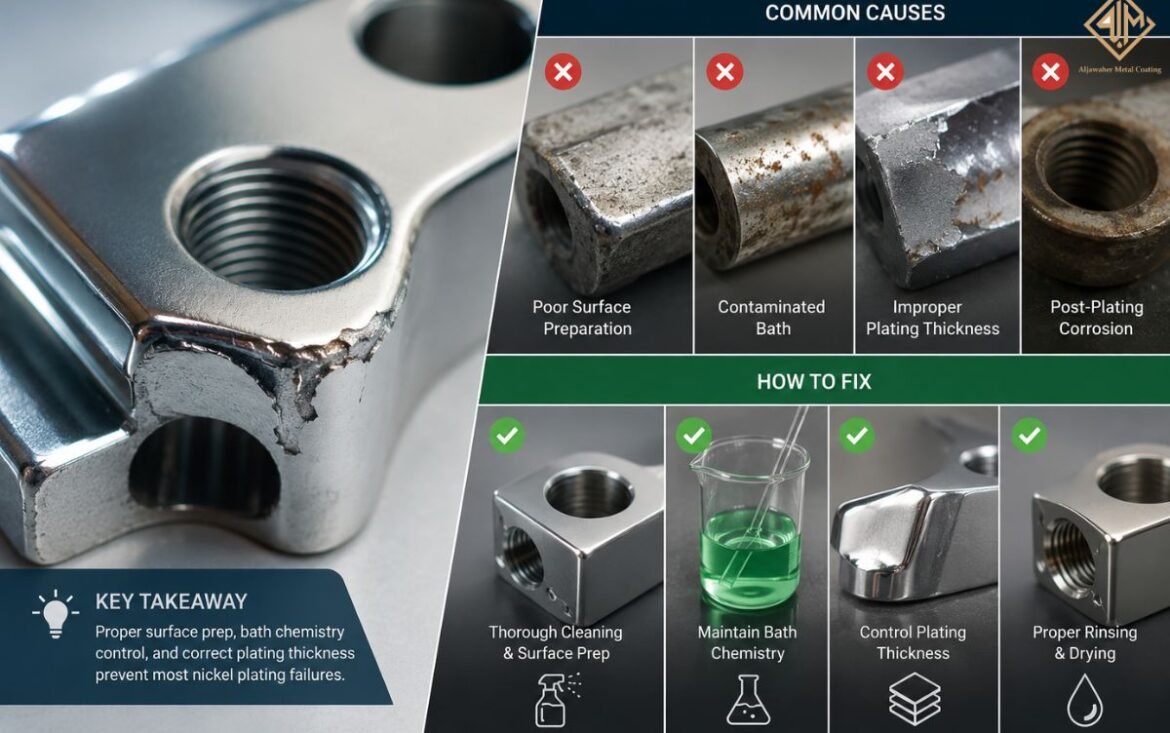
A failed plating job usually points to one of a few things:
- The base metal wasn’t cleaned properly before coating.
- The plating bath had the wrong chemical balance.
- The current flow during the process was inconsistent.
- The coating thickness varied across the part.
Furthermore, skip any of these steps, or rush them, and the nickel layer just doesn’t bond right. Good nickel plating services in Dubai inspect the base material closely before the coating starts, because catching a problem at that stage is a lot cheaper than catching it after.
Poor surface preparation issues
This is the single biggest reason plating jobs fail, full stop. Leave oil, rust, dust, or old coating residue on the metal, and the nickel has nothing solid to grip.
The usual mistakes:
- Skipping the degreasing step or using a cleaning agent that’s too weak for the job
- Leaving traces of old plating or oxidation behind
- Rushing the rinse between cleaning and plating
- Ignoring the surface roughness a particular metal actually needs
At Aljawaher Metal Coating, preparation of all surfaces is considered a distinct part of the process rather than being viewed as a mere technicality. Every component must undergo a process of cleaning, etching and rinsing before being subjected to plating. The cost incurred in skipping this critical step can be considerably greater than the time saved.
Wrong bath chemistry problems
The plating bath, where the plating actually takes place, must be kept in balance at all times while it is being used. Let pH, temperature, or metal ion concentration drift even a little, and you will see it in the finish.
| Problem | Likely Cause | Visible Effect |
| Dull, grey finish | Low nickel concentration | Weak, patchy coating |
| Pitting on surface | Contaminated bath solution | Small holes or craters |
| Burnt edges | Temperature too high | Discoloration at edges |
| Uneven color | Inconsistent current density | Blotchy appearance |
Moreover, shops running electroless nickel plating services in Dubai test their bath solutions on a schedule, not whenever someone remembers to. Smaller operations that test infrequently, or only after a batch already looks wrong, are usually the ones with the most rework.
Uneven plating thickness causes
Thickness matters more than it gets credit for. Too thin and the coating wears through fast. Uneven across the part, and the thin spots become exactly where corrosion starts first.
What usually causes it:
- Poor part positioning inside the plating tank
- Inconsistent electrical current distribution
- Complex shapes with corners the coating struggles to reach
- Plating time that ran too short or too long
Parts with awkward geometry, brackets, fittings, and machined components with deep grooves are where this shows up most. Electroless nickel plating near me offers uniform deposition on intricate components and deep holes.
Adhesion failure and peeling
Adhesion failure is when the nickel layer separates from the base metal, either right away or weeks into the part being in use.
What usually causes it:
- A contaminated or improperly activated surface
- A base metal and plating combination that don’t suit each other
- Trapped air or hydrogen during plating
- Not enough of a bonding layer before the nickel goes on
However, a bend test or tape test right after plating catches most adhesion problems before the part ever ships. Good Nickel Plating Services in Dubai run these checks by default, not because a customer asked for them.
Electroless vs electrolytic plating differences
The method you choose affects your failure rate too. Both have their place, but using the wrong one for a given part invites problems that were entirely avoidable.
| Factor | Electroless Nickel | Electrolytic Nickel |
| Thickness uniformity | Very even, even on complex shapes | Depends on current flow |
| Corrosion resistance | Generally higher | Good, but varies by finish |
| Cost | Slightly higher upfront | Usually lower |
| Best for | Intricate parts, tight tolerances | Flat or simple-shaped parts |
If a part has irregular shapes or internal surfaces, electroless is the safer choice more often than not. It’s part of why people searching electroless nickel plating near me for precision components tend to land on it over standard electrolytic options.
How to prevent plating failure?
Fixing a failed batch always costs more than preventing it would have. A few habits make most of the problems above avoidable.
What actually helps:
- Ask for a surface inspection report before plating begins.
- Find out how often your vendor tests bath chemistry.
- Confirm the thickness range they’re targeting for your part.
- Request adhesion test results from a sample batch.
- Match the method, electroless or electrolytic, to your part’s shape.
None of this takes much extra time. It does extend how long your parts last and cuts down on downtime from corrosion or wear you didn’t see coming.
Choosing the right plating partner
Coating shops don’t all hold themselves to the same standard, and that gap is usually what separates a good finish from a failed one. When you’re comparing vendors, look past the price sheet and ask about their process, their testing routine, and their experience with your specific metal.
Worth asking before you sign on with anyone:
- Do they show you test reports or quality checks?
- Can they actually handle your part’s size and shape?
- Do they offer both electroless and electrolytic plating?
- What’s their turnaround if a batch needs rework?
Aljawaher Metal Coating is one of the established names for nickel-plate services in Dubai, working with automotive, industrial, and precision- manufacturing clients. Surface testing, bath monitoring, and post-plating checks are built into every job, which covers most of what causes the failures in this guide.
Conclusion
There are several common causes of nickel plating problems. This can be the result of poor surface cleaning, use of the wrong plating solution, irregular coating thickness, or poor adhesion. If a problem is detected before and after the plating process, it can be avoided, and the cost of a repair can be saved.
To find the best metal coating company in Dubai, you should opt for the company that has strict quality checks and testing procedures. Aljawaher Metal Coating offers trustworthy Ni plating services that prioritize quality and durability. Call their team today to speak about your project and have it done right the first time.
Frequently asked questions
If the surface to be plated is not cleaned properly before plating or the base metal is contaminated with some other material, the nickel layer cannot bond to the base metal as it should.
With proper use, a normal life span of several years is expected; however, the actual life span will depend upon the base metal, the thickness of the coating, and use conditions.
Generally, yes, for complex shapes and tight tolerances, as it does not depend on current flow and will evenly coat all surfaces.
In most cases, yes. Once the actual cause of the problem, contamination, chemistry, or thickness, is corrected, the part is stripped and replated.
The typical symptoms are peeling, dull or blotchy color, pits, rust spots, or clearly uneven thickness.
The common ones are steel, brass, copper, and aluminum, but each requires a slightly different surface preparation to achieve a good bond.
It’s dependent upon part size, piece count, method, and thickness, so the only true answer is to get a quote for your job.
A local shop has a deep knowledge of the regional climate and industrial requirements, is able to cycle work more quickly, and facilitates easier inspection of work prior to delivery.