-
aljawahermetalcoating
- September 21, 2026
- No Comments
What Is Tin Plating Used For? Common Industrial Applications Explained
Table of Contents
- Key takeaways
- How does tin plating actually work?
- Where does tin plating show up in industry?
- Why does it matter more in Dubai’s climate?
- Benefits worth knowing
- Where does tin plating fall short?
- Cost and process factors
- Final thoughts
- Frequently asked questions
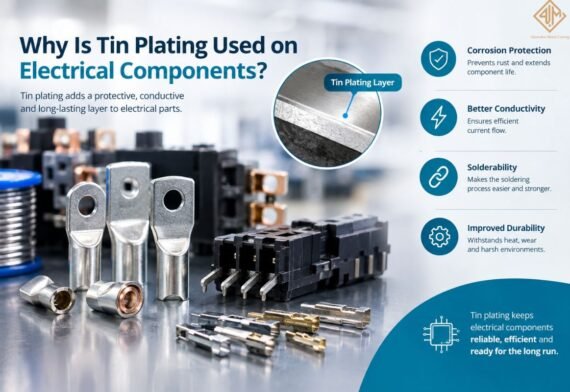
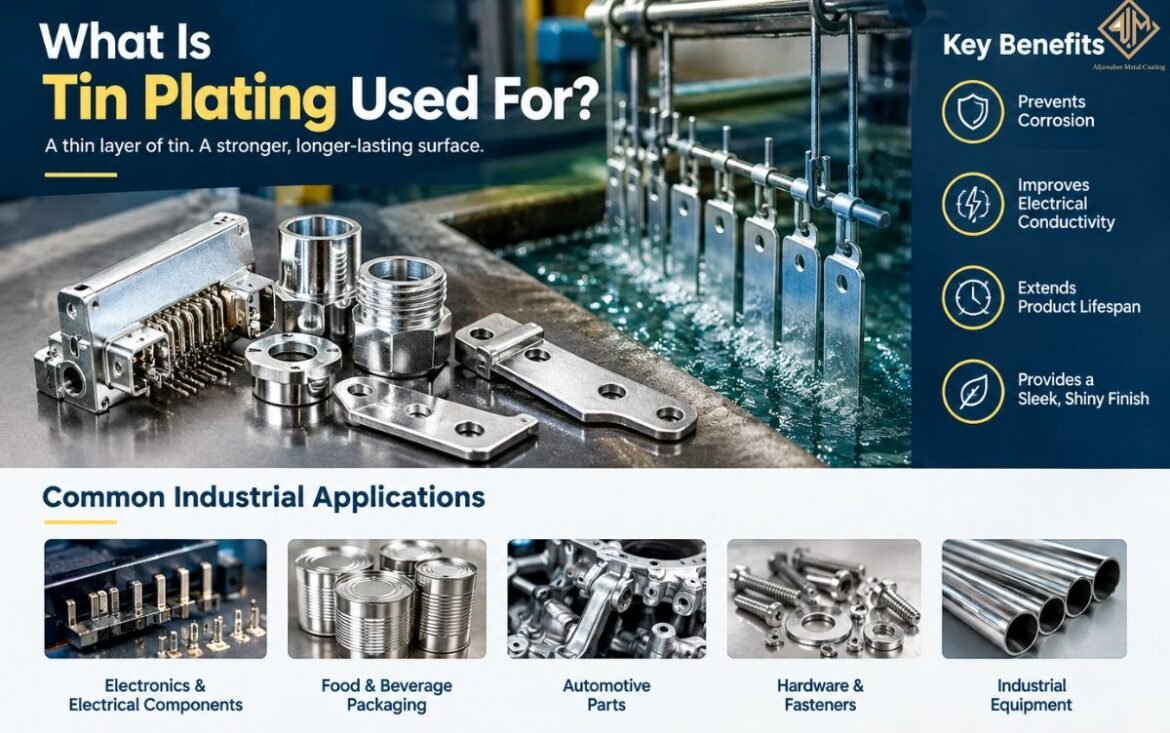
Tin plating is a thin tin layer applied over another metal, usually steel, copper, or brass, so that metal underneath stops corroding and becomes easier to solder or wire up electrically. You’ll spot it on connectors, food cans, kitchen equipment, fasteners, busbars.
The tin isn’t there to add strength. It sits on top as a barrier and a conductor, and it happens to be non-toxic enough to touch food without issue. Low cost, decent corrosion resistance, and food safety in one package is why so many industries reach for it before silver or gold.
Key takeaways
- Tin plating stops corrosion and makes soldering easier, which is basically why electronics and food equipment lean on it so hard.
- You get it two ways: electroplating or hot-dip tinning. The method decides your thickness, cost, and finish.
- In a place like Dubai, humid and salty air turns tin plating from a nice extra into something outdoor and marine-adjacent hardware genuinely needs.
- It’s cheap compared to most other metal finishes. Just don’t expect it to survive high heat or heavy wear.
How does tin plating actually work?
Two main routes get tin onto a surface, and which one you pick changes what you end up holding.
- Electroplating runs current through a tin-salt solution, pulling tin ions onto whatever’s being coated. Thickness control is tight here, usually somewhere between 2 and 20 micrometres, and the coat comes out uniform with fewer pinholes. Most connector and PCB makers plate this way because precision beats bulk for their purposes.
- Hot-dip tinning is more straightforward: dunk the part in molten tin. Cheaper equipment, thicker coat, often 1 to 3 microns or more in a single pass. Wire and strip producers running high volumes tend to prefer it, along with anyone who wants heavier corrosion protection and doesn’t mind the extra tin cost.
Neither wins outright. Therefore, a connector pin inside a phone charger wants a thin, precise electroplated layer. A crate of outdoor fasteners headed to a job site does fine with a thicker hot-dip coat. You can also tune the look, matte or bright, depending on whether appearance matters or the part just needs to function.
Where does tin plating show up in industry?
Wider than most people assume.
- Electronics and connectors- Probably tin’s biggest job right now. Terminals, circuit breakers, PCB components, wire connectors- all get plated because tin solders cleanly and blocks the surface oxidation that would otherwise ruin an electrical contact over time. A connector meant to last a decade in a control panel needs a coating that doesn’t quietly fail somewhere in year six.
- Food and beverage equipment- Tin’s FDA-approved for food contact and has been part of canning for well over a hundred years. Bowls, trays, cans, processing gear in commercial kitchens and food plants get tin-plated so they hold up against acids and moisture without leaching anything into the product.
- Automotive and marine hardware- Fasteners, brackets, small components exposed to road salt or seawater benefit here. Marine hardware in particular needs it, since untreated steel near saltwater corrodes fast, and tin gets you real protection without paying stainless-steel prices.
- Construction and signage- Screws, interconnects, and structural fittings on buildings often carry a tin layer, especially anything exposed to weather during installation or over the years after. Signage work, aluminium fittings, exterior hardware in a hot, humid market run into this constantly.
- Solar panels- Newer use, growing fast. Tin-coated ribbon and interconnects inside solar modules need to survive decades of thermal cycling and moisture without the electrical path corroding out.
- Jewelry and decorative work- Here it’s about looks, not corrosion. Tin gives a bright, silvery finish at a fraction of what silver plating costs, which is why costume jewelry and decorative hardware use it.
| Industry | What Gets Plated | Main Reason |
| Electronics | Connectors, terminals, PCBs | Solderability, oxidation resistance |
| Food service | Cans, trays, processing gear | Non-toxic, corrosion resistance |
| Automotive/marine | Fasteners, brackets | Salt and moisture resistance |
| Construction | Screws, fittings, interconnects | Weather exposure |
| Solar | Ribbon, interconnects | Long-term thermal/moisture stability |
Why does it matter more in Dubai’s climate?
Heat by itself doesn’t corrode metal that quickly. It’s heat plus humidity plus the salt riding in off the Gulf that eats through untreated steel and aluminium fittings across the UAE. Fasteners and connectors in signage, exterior fixtures, HVAC housings, industrial equipment- none of them get the mild dry-climate break that slows corrosion elsewhere.
That’s a real part of why demand for tin plating in Dubai has climbed alongside construction, signage, and industrial work here. A fastener that would last a decade untreated somewhere drier can show surface corrosion within a year or two in this climate, especially near the coast or wherever AC condensation collects. Companies going after tin plating services in Dubai are usually doing it because their parts sit in that exposure daily, not as some optional upgrade.
Moreover, there’s a sour reality too. A good chunk of manufacturing and fabrication work here depends on imported raw components that still need surface treatment locally before installation, since shipping finished parts back and forth adds cost and time nobody wants. That’s where local finishers, Aljawaher Metal Coating among them, do their work: tin plating and related finishes for hardware fabricated or assembled here rather than sent overseas and back.
Benefits worth knowing
- Corrosion resistance- Protects steel, copper, and copper alloys from oxidation and general wear from moisture.
- Excellent solderability- Tin-plated surfaces tend to hold reliable electrical connections, which is the whole reason electronics lean on it.
- Non-toxic- Fine for food contact. Zinc, for comparison, isn’t.
- Cost- One of the cheaper finishing options next to silver or gold, without giving up much protection.
- Flexibility and ductility- Parts that need bending or forming after coating tend to keep the tin layer intact, where harder finishes would crack.
Where does tin plating fall short?
It’s not a fix for everything.
Tin’s operating ceiling sits under about 450°F (232°C). Push past that, and the coating breaks down. It’s also soft, so tin-plated surfaces wear faster under friction than something like nickel or chrome would handle. Electronics folks also have to watch for tin whiskers, tiny conductive filaments that can grow on pure tin over time and cause short circuits. Nobody fully understands why they form, which is part of why a lot of electronics now use tin-lead or tin-silver-copper alloys instead of pure tin, mainly to cut that whisker risk down.
That doesn’t make tin a bad option. It just means it fits some jobs and not others, high-heat engine parts or heavy-wear industrial components being the obvious exceptions, where something harder makes more sense.
Cost and process factors
A handful of things move the price on any tin plating job:
- Coating thickness – thicker, closer to hot-dip range, costs more in raw tin and time than a thin electroplated coat.
- Part volume and geometry – small parts in bulk run cheaper per unit than odd shapes needing careful handling.
- Base metal – steel, copper, and brass each behave a bit differently during plating, which changes pretreatment steps.
- Finish requirement – bright and decorative usually costs a little more than plain matte industrial.
- Passivation – skip it, and you risk oxidation spots showing up during storage or shipping. Cheaper to build it now than fix it later.
Additionally, it is worth asking the best metal coating company in Dubai, specifically about thickness tolerances and whether passivation is included, since those two details matter more for long-term performance than the number on the quote.
Final thoughts
Tin plating sticks around in industry because it solves one problem cleanly: it keeps metal from corroding while staying cheap, food-safe, and easy to solder. It won’t help with high-heat or high-wear parts, but for connectors, fasteners, food equipment, and outdoor hardware in a climate like Dubai’s, it holds up. Local shops like Aljawaher Metal Coating handle this kind of finishing on-site, which saves anyone the cost and wait of shipping parts abroad just for a coating.
Anyone lining up tin plating services in Dubai for a project should be asking about thickness, base metal fit, and passivation before anything else. That’s what actually determines how the part performs five years down the line, not the price per unit today.
Frequently asked questions
Stopping corrosion and improving solderability on connectors, fasteners, food equipment, and anything else exposed to moisture or oxidation.
Yes, it’s FDA-approved and has been standard in canning and kitchen equipment for over a century.
Electroplates tend to run 2 to 20 micrometres. Hot-dip usually starts thicker, around 1 to 3 microns and up.
It actually does better there than bare steel. Heat, humidity, and salt air speed up corrosion, so the plating earns its keep.
Local conditions corrode untreated metal fast, and tin plating in Dubai gives you real protection for fasteners and fittings without paying for silver or specialty alloys.
No, it protects conductivity by blocking oxidation, though bare copper or silver still edge it out slightly on raw conductivity.
Hot-dip gives you a thicker, cheaper coat. Electroplating gives tighter control and a more even, usually thinner layer.
Ask what thickness control they can hold, whether passivation is standard, and how often they work with your specific base metal. Experience with your exact material beats a generic sales pitch every time.