-
aljawahermetalcoating
- August 13, 2026
- No Comments
Understanding the Chemical Process of Brass Plating
Table of Contents
- Key Takeaways
- The chemistry behind the process
- Surface preparation before plating
- Common mistakes that ruin a brass finish
- Where is brass plating used?
- How to choose a reliable provider?
- Conclusion
- Frequently asked questions
Key Takeaways
- Brass plating is a process that involves electrochemical processes rather than simply applying paint or coating the metal.
- The importance of preparation is far greater than the actual process. The failures of the plating process often have their roots in pre-plating preparation.
- Improper rinsing is the biggest influence on defective finishes.
- If you need high-quality brass plating in Dubai, look for those who actually know what they are doing.
Brass plating involves applying a thin layer of brass derived from copper and zinc onto a base metal using the process of electric current. First, the base metal is submerged in a chemical solution that consists of the two metals, and through the process of electricity, ions of these metals start adhering to the surface.
There is a certain value in brass plating that makes the metal have a golden tone and makes it resistant to corrosion. Because of that, brass plating is very popular in Dubai when it comes to hardware, fittings, and various decorative items.
It would be ideal to note that brass plating may not be referred to as paint or any other coating applied manually. Moreover, this process has nothing in common with anodizing and electroless nickel plating. The part becomes part of a live electrical circuit. That single fact explains most of the process’s quirks, why current density matters, why bath temperature matters, why the shape of the part matters. All of it feeds back into how evenly the brass actually lands.
The chemistry behind the process
Brass plating runs on electrodeposition. Usually, the plating bath contains copper and zinc salts in the alkaline solution. Newer formulas that don’t use cyanide have become popular due to their safety for the users and the environment.
In the process of plating, the part acts as a cathode or negative electrode. An inert or brass anode is used to sustain the metal ions in the bath. Gradually this process allows bonding of these ions to the part creating the brass coating.
A rough breakdown of what’s happening in the tank:
| Stage | What Occurs | Why It Matters |
| Ionization | Copper and zinc dissolve into ions in the bath | Supplies the metal for deposition |
| Current application | DC runs through the circuit | Pulls ions toward the part |
| Reduction | Metal ions pick up electrons at the surface | Turns ions back into solid metal |
| Alloy formation | Copper and zinc deposit together | Produces the brass finish and its tone |
Moreover, the copper-to-zinc ratio in the bath is what sets the color. Push copper higher, and you get a deeper, reddish-gold. More zinc and it drifts paler, more yellow. That’s why platers who’ve done this a while will tweak the bath depending on whether the client wants something closer to fresh brass hardware or an antiqued look.
Temperature and current density matter more than most people assume. Push current density too high, and the deposit turns rough, almost burnt at the edges. Too low and coverage goes patchy, especially in recesses or around sharp corners. This is usually where you can tell a shop that knows the general steps apart from one that’s actually calibrated the process across hundreds of real parts.
Surface preparation before plating
If one stage decides whether a brass plating job holds up, it’s this one, not the bath. Oil, rust, or leftover coatings block proper bonding no matter how well the electrochemical side is run.
A typical preparation sequence:
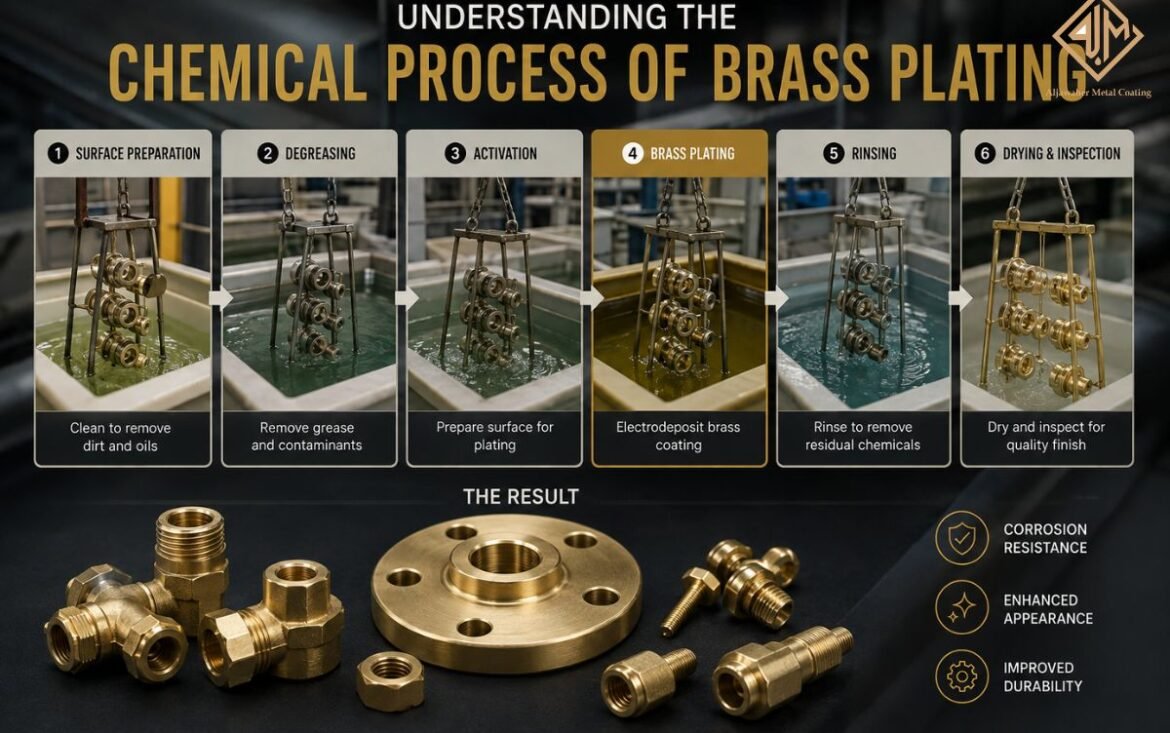
- Degreasing to strip oils and machining residue
- Descaling, mechanical or chemical, to remove rust and scale
- Acid pickling to activate the surface
- Rinsing between every single stage, no exceptions
- A final activation dip right before plating starts
Additionally, skip or rush any of these, and you’ve got the most common reason plated parts fail early: flaking, dull patches, tone that’s inconsistent across the piece.
Common mistakes that ruin a brass finish
The issues that show up most often when we inspect parts plated somewhere else:
- Rinsing too little between stages- carries residue into the next bath and weakens adhesion
- Wrong current density for the part- burnt edges, thin coverage in recesses
- Plating over existing rust or old coatings instead of stripping down to bare metal first
- Bath composition drifting over time without correction, so the color shifts batch to batch
- Rushing the drying and post-treatment, leaving parts open to spotting or early tarnish
None of these are hard to avoid. They just require someone actually paying attention to the process instead of running parts through and hoping.
Where is brass plating used?
Brass plating turns up in more places than people expect once they start noticing. Around Dubai, demand tends to cluster in a few areas:
- Architectural hardware such as door handles, hinges, decorative fittings
- Furniture parts like legs, brackets, trim, both residential and hospitality
- Automotive and marine fittings that need to survive humid, coastal air
- Electrical connectors and terminals, where conductivity and corrosion resistance both count
- Decorative signage and retail fixtures
However, the climate here doesn’t do untreated steel any favors. Humidity and salt air chew through bare fittings faster than they would somewhere drier, and that’s a big part of why a decent brass plating service in Dubai isn’t purely about looks for most clients. It’s tied directly to how long a piece survives outdoors or near the coast.
How to choose a reliable provider?
Not every finishing shop that lists plating on its menu actually specializes in it. Before handing over a job, it’s worth asking:
- Can they show samples of past brass plating on similar base metals?
- Do they check bath composition on a schedule, or only after something goes wrong?
- How do they handle parts with tricky geometry or deep recesses?
- Is there any warranty or rework guarantee on the finish?
- Can they walk you through their prep process in real detail, not just “we clean the parts”?
Furthermore, a shop that has real answers, not vague reassurance, is usually treating plating as a controlled process rather than something they knock out between other jobs. That distinction tends to be what separates the best metal coating company in Dubai from a shop that just happens to own a plating tank.
Conclusion
The effectiveness of brass plating can be attributed to three constituents: right surface preparation, proper bath chemistry, and appropriate current regulation. Familiarity with them allows interpreting the quality of plating and, thus, avoiding problems in the course of production.
If you plan brass plating in Dubai, you can rely on Aljawaher Metal Coating, as all of their stages will be performed properly instead of somehow omitting them. The company can also provide samples for approval before the actual full-scale run is started.
Frequently asked questions
Steel, iron, and zinc die-cast are the usual candidates. Aluminum’s trickier because of its natural oxide layer, which fights standard plating adhesion unless it’s pre-treated properly.
Indoors, with a decent lacquer topcoat, you’re looking at several years. Outdoors or near the coast without sealing, that number drops fast.
Not really. Brass mimics gold’s warm tone using a copper-zinc alloy at a fraction of the cost. Gold plating actually deposits gold, and it holds up to corrosion better over time.
Nine times out of ten, it’s inconsistent current density, or the bath composition has drifted. Complex shapes make this worse since current doesn’t distribute evenly across them.
Yes, but only once the rust is fully stripped through descaling and pickling. Plate over existing corrosion and you’re just sealing the problem in, which fails early.
It helps, but brass itself can tarnish in humid or salty air over time. For anything outdoors, a protective lacquer topcoat is basically non-negotiable.
The copper-to-zinc ratio in the bath. More copper pushes it reddish-gold, more zinc pushes it paler and yellow.
Cyanide baths have historically given more predictable results, but cyanide-free options have closed a lot of that gap and are increasingly the safer, more compliant choice.
Yes, though it takes careful current density work to avoid thin spots in recesses or burnt buildup on edges that stick out.
Even color across the whole surface, no pitting or roughness, and the finish shouldn’t flake or lift at edges when you test it gently with a fingernail.