-
aljawahermetalcoating
- May 18, 2026
- No Comments
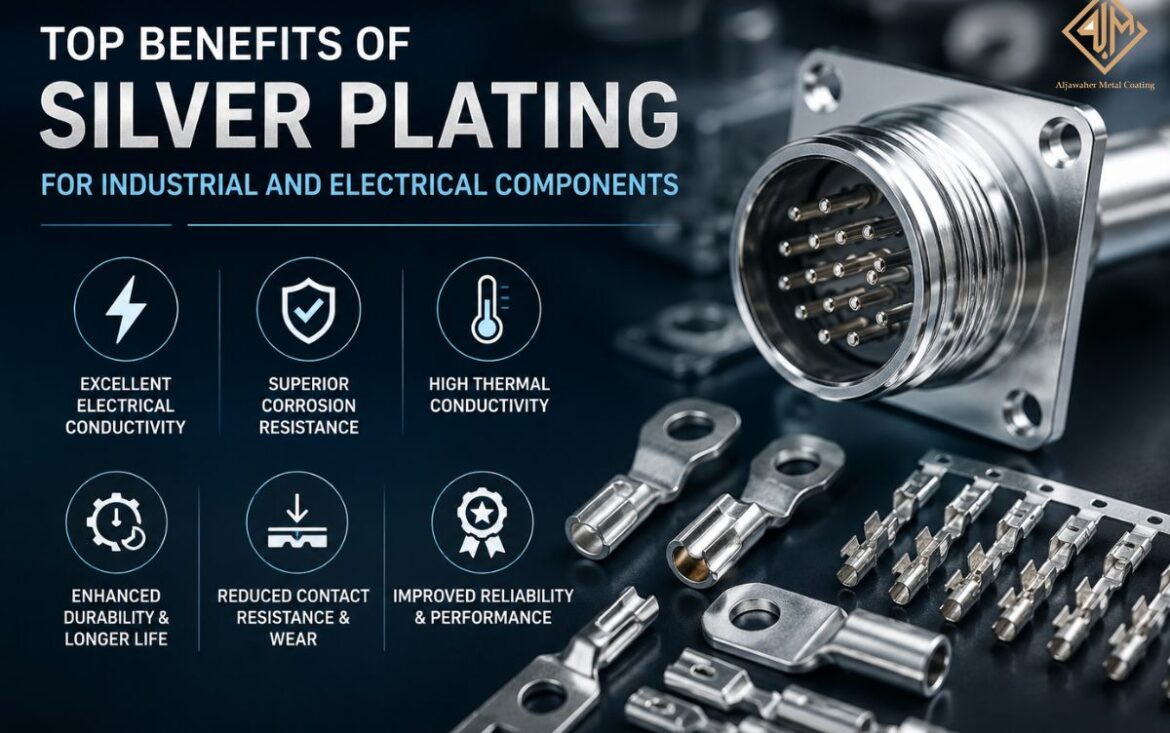
Top Benefits of Silver Plating for Industrial and Electrical Components
Table of Contents
- Key Takeaways
- How does silver plating improve conductivity?
- Why is corrosion resistance important?
- Does silver plating increase component life?
- Where is silver plating commonly used?
- How does it help industrial performance?
- What makes professional coating important?
- Wrapping up
- Frequently asked questions
Key Takeaways
- Silver plating makes a significant contribution to the electrical conductivity.
- It is used to prevent corrosion of industrial components.
- Silver-coated parts will last longer if used heavily.
- Maintenance and downtime expenses are lower across the industries.
Industrial and electrical parts require adequate protection, high conductivity, and durability. Silver plating can aid in all three. It enhances electrical conductivity, decreases heat, and safeguards metal components from damage. Nowadays, a variety of industries are opting for silver-plated items for their daily use due to their durability.
Aljawaher metal coating is professionally trusted by companies that seek long-lasting and outstanding finish solutions in the fields of electrical and industrial applications.
Precision is used in modern industries. A minor electricity outage may interrupt production, result in equipment damage, or increase maintenance expenses. As a result, manufacturers now have a bigger interest in studying the advanced metal finishing technologies that result in better safety and efficiency.
How does silver plating improve conductivity?
Silver is one of the best metals for electrical conductivity. It is a material that lets electricity flow at a high speed and with little resistance. This in turn results in more efficient electrical parts and reduced operating temperatures.
This is one of the main reasons for industries to opt for the silver plating service in Dubai for connectors, switches, terminals, and electrical contacts.
Main conductivity benefits:
- Faster electrical transfer
- Lower energy loss
- Reduced overheating
- Better signal quality
- Good performance in high load conditions.
Besides, silver plating is effective in low-voltage as well as high-voltage systems. This can be useful in factories, automation systems, telecom equipment, and power distribution units.
Overheating is a critical problem in many industrial plants. The natural solution to this issue is to have silver-coated parts to keep electricity flowing smoothly.
Why is corrosion resistance important?
Industrial environments don’t always provide for clean, dry conditions. Metal parts can slowly deteriorate from moisture, chemicals, dust, and heat. Corrosion causes loss of efficiency and can cause sudden equipment failures.
Silver plating forms a protective layer on the base metal. This means that components remain safer in difficult work environments.
Common industries that benefit:
| Industry | Why Silver Plating Helps |
| Electrical | Protects conductive parts |
| Automotive | Handles heat and vibration |
| Aerospace | Improves reliability |
| Manufacturing | Reduces wear and rust |
| Telecom | Maintains signal stability |
Additionally, the surfaces that are plated are easier to maintain than the metals that are untreated. This provides companies with a cost-saving solution in the long run.
Experienced coating specialists may be the best choice for businesses looking for reliable silver plating in Dubai, as they are likely to provide high-quality service that guarantees the correct thickness, smooth finish, and durability of the coating.
Does silver plating increase component life?
Yes. Extended life of components is one of the best benefits of silver plating. Industrial machinery operates for extended periods and in a continuous fashion. This results in constant friction, electrical stress, and temperature changes to metal surfaces.
A silver coating helps to minimize surface wear and helps to stabilize the part for a longer term.
Benefits of longer lifespan:
- Fewer replacements
- Lower maintenance costs
- Reduced downtime
- Better machine reliability
- Higher operational efficiency
However, silver plating does not lose its performance rapidly when repeatedly subjected to electrical contact. This is particularly important in electrical relays and switching systems.
A well-plated component can perform well for many years after being used by industries. As a result, many manufacturers consider “silver plating” an investment and not an additional cost.

Where is silver plating commonly used?
Silver plating is very common in areas where high conductivity and good performance are demanded.
Common applications include:
- Electrical connectors
- Busbars
- Battery terminals
- Circuit breakers
- RF connectors
- Switchgear components
- Industrial control panels
In heavy industries, machines are sometimes put under pressure and high temperatures. Therefore, for stable performance, protective coatings are required.
Metal finishing services in industries such as Aljawaher Metal Coating are offered for quality and uniformity that are key to industrial-grade applications.
Another reason industries like silver coating prefer it is because of the compatibility. Excellent electrical properties work well on a variety of base metals.
How does it help industrial performance?
Industrial systems require continuous operation. A minor electrical problem can cause a big production line problem. Silver plating reduces power loss and prevents premature failures, thus increasing operational reliability.
Performance improvements include:
- Improved short-term power carrying capacity
- Stable electrical connections
- Improved heat resistance
- Smoother surface contact
- Reduced oxidation problems
Moreover, the use of silver-coating components can enhance their performance in high-frequency electrical applications. This is beneficial for today’s industrial automation and communication systems.
There are also many industries today that are concerned with energy efficiency. Silver plating reduces the electrical resistance, thus improving energy usage.
Silver plating is not only a protection measure for the components but also contributes to improved productivity.
What makes professional coating important?
The silver-plating procedure is one of the biggest factors in determining the quality of the silver plating. Poor finishing or uneven plating will actually decrease performance.
Hence, industries opt for the best metal coating company in Dubai to avail precision-based coating services.
A professional coating process guarantees:
- Proper coating thickness
- Smooth surface finish
- Strong metal bonding
- Consistent conductivity
- Long-lasting protection
Furthermore, quality is an issue that expert coating service providers are aware of, and they follow strict quality standards and testing before delivery.
Therefore, industries can prevent peeling, rough surfaces, and uneven conductivity when they make use of an experienced service provider.
Wrapping up
In recent years, the use of silver plating has been an important solution in the modern industrial and electrical system. It enhances conductivity, prevents damage to components, and contributes to long-lasting performance. Hence, industries are still investing in advanced coating solutions to enhance efficiency and minimize the operational problems.
When it comes to finding trustworthy silver plating in Dubai, companies with expertise in the field, such as Aljawaher Metal Coating, are the best choice for offering reliable coating solutions that are optimized for industrial performance and durability.
Frequently asked questions
Silver plating enhances conductivity, safeguards the metal surface, and enhances the durability of components.
Yes, it is commonly used in electrical connectors, switches, and power systems.
Yes, it forms a protective surface layer from moisture and oxidation.
Proper coating thickness, smooth finishing, and long-lasting performance-all of these are guaranteed by professional services.