-
aljawahermetalcoating
- October 31, 2026
- No Comments
Tin Plating vs Zinc Plating: What’s the Difference?
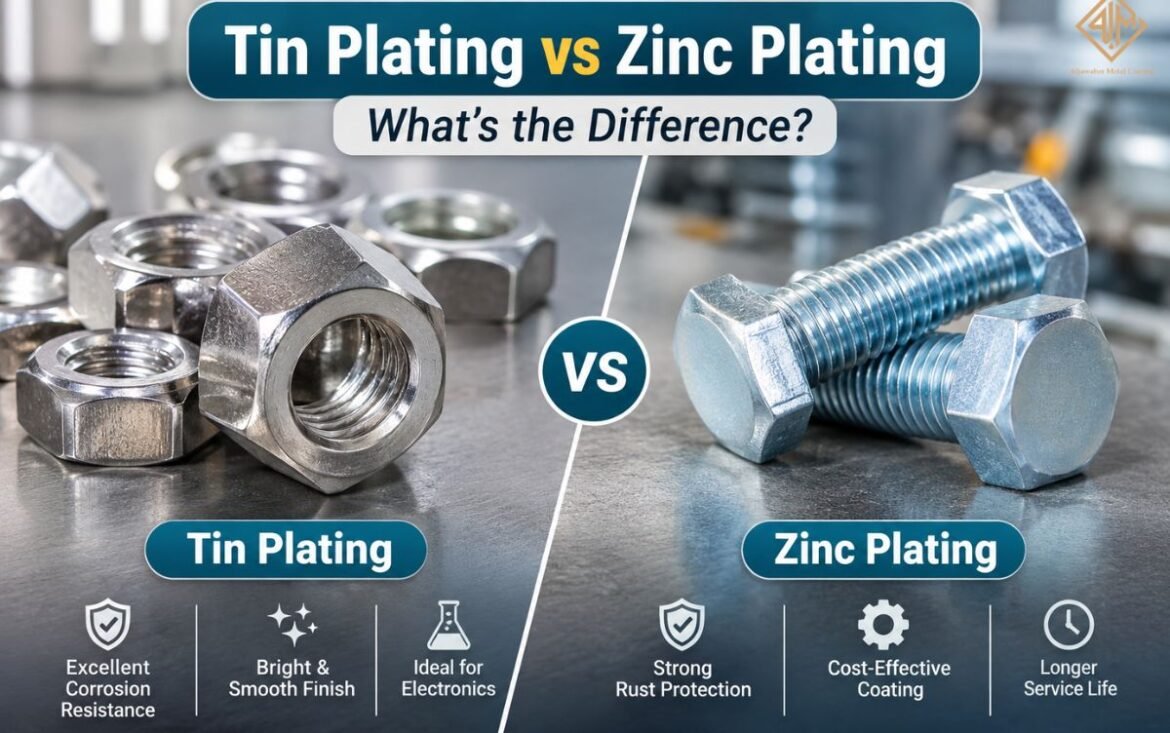
Tin plating and zinc plating are two types of electroplated coatings for protecting metals; however, their mechanisms differ slightly. A Tin Plating process applies a very thin coating on metal, which prevents rusting while also being good for connecting wires well. Zinc plating deposits a layer of zinc that corrodes first, so it sacrifices itself, protecting the steel underneath, making this an economical option for fasteners and brackets. Tin is good if conductivity matters, while zinc is better for a cheap protective coating on steel against moisture problems.
Having the incorrect finish may cause problems like early corrosion, weak solder joints, and needless expenses. It is common for many concepts and procedures to get mixed up, so this guide describes how these processes are performed, where the right place is for each finish, and what to consider when utilizing different parts in conditions that may be humid, dusty, and even filled with salt, which are quite common in the UAE.
Key takeaways
- Tin plating acts as an insulator, good for soldering and reliable electrical connection.
- Zinc plating is very good at protecting steel because it lasts long enough when there are scratches on top of it; also, it’s cheaper than other types of coatings.
- The high temperature, humidity levels and sea air here mean you need good quality paint for your project.
- If you share your base metal specifications, thickness targets and intended applications of an item with a supplier prior to placing an order then there will be no more issues later on.
What is tin plating?
Tin plating is an electrochemical method for plating a thin, even coating of tin onto a metal surface. The part is dipped into an electrolyte bath, and an electric current removes tin ions from the electrolyte and deposits them on the part. All of these variables (current, time, and bath chemistry) are controlled, and this allows platers to produce a thickness of precision for each job.
How does the tin plating process work?
The preparation, as much as the deposition itself, is important for a good tin finish. The typical sequence of steps is the following:
- Remove oils, scale, and handle residue from the part by cleaning and degreasing.
- Rinse and treat the surface with an appropriate acid dip to ensure proper bonding.
- Use a copper or nickel underlayer as necessary, particularly on steel, to increase adhesion and reduce diffusion between metal and tin.
- Place the tin in the electrolyte at the specified current density.
- Rinse, dry, and check the completed part before packing.
Each step matters. Therefore, one of the most frequent reasons for peeling and blistering is rushing through the cleaning step, and there is no way to adequately prepare a surface even with a great plating job. The processes used in our tin plating service are described on our tin plating service page.
What makes tin plating so widely used?
Tin has the properties of softness, ductility, and no tarnish. It is easy to solder and has been so used in electronics for decades as a result of which it remains useful even after storage. Tin is also commonly used for food contact applications, and the use of tin-coated steel has a long history.
The main advantages include:
- Solderability that is good for long-term use, even in storage prior to assembly.
- Low and stable electrical contact resistance for connectors and terminals.
- Excellent resistance to tarnish and to oxidation under atmospheric conditions.
- Surface that is smooth and malleable, withstanding bending or cracking.
- Suitability for food-related packaging when produced to the right specification.
However, there is one thing we know about tin. Tin whiskers are very fine hair-like projections that may form on the surface over time and lead to short-circuiting in sensitive electronics.
This is minimized by good process control, proper underlayer and reflow or annealing steps, but still not eliminated. Therefore, it is important for electronics purchasers to highlight the issue of whiskers to their supplier prior to purchase.
What is zinc plating?
Electroplating of zinc on a base metal, usually steel or iron. It is one of the most popular corrosion protection techniques for steel hardware, since it’s inexpensive, practical, and mass manufacturable.
How does zinc plating protect steel?
There are 2 ways that zinc will protect steel. Firstly, it provides protection from moisture and oxygen to the base metal. Second, more importantly, zinc is chemically more active than iron. Moisture that reaches a scratch or a cut edge will cause the zinc surrounding the damaged area to corrode first, and the corrosion of the zinc will help delay the corrosion of the steel. This is known as sacrificial protection and is the primary reason for the popularity of zinc fasteners, brackets, and exterior hardware.
Most zinc-plated parts are also passivated, a conversion coating. Passivates help to retard the corrosion of the zinc and are available in various colors, such as clear or bright, yellow, olive drab, and black. In recent years, trivalent passivates have been increasingly used due to their avoidance of some of the health and environmental issues associated with older hexavalent chromium passivates.
What Are the Limitations of Zinc Plating?
There are pros and cons to zinc that a buyer should be aware of. In general, it’s less solderable than tin, and it requires flux or special preparation. Under humid conditions in the absence of sufficient passivation or thickness, zinc can form white corrosion products, known as white rust. Many specifications also specify that the high-strength steel parts be baked after their electroplating process, because they are also susceptible to hydrogen embrittlement.
If a part requires greater wear resistance or a harder decorative finish than zinc, it may be advisable to use a nickel plating layer instead.
Tin plating vs zinc plating: key differences
The main difference is the way in which each coating safeguards steel. Tin is an impervious element. As long as the layer is not damaged, it will protect against corrosive agents affecting the base metal. However, once the coating is broken, the steel can rust, as the tin is more noble than iron and will not protect the iron. Zinc is different – it protects the steel regardless of where the coating has been scratched.
| Factor | Tin Plating | Zinc Plating |
| Protection mechanism | Barrier coating; protects steel only while intact | Sacrificial; protects steel even when scratched |
| Solderability | Excellent, and stable over time | Poor to fair; often needs flux |
| Electrical contact resistance | Low and stable | Higher and less consistent |
| Hardness | Soft | Harder than tin |
| Appearance | Bright or matte silvery-white | Bright, bluish, or colored by passivation |
| Relative cost | Generally higher | Generally lower |
| Typical base metals | Copper, brass, and steel with an underlayer | Steel and iron |
| Common uses | Electronics, connectors, busbars, food packaging | Fasteners, brackets, automotive hardware |
This is a starting chart and not an answer chart. Different passivation and bath control can result in very different performance of two parts with the same coating name; it is advisable to confirm the specification before ordering.
Which applications suit each coating?
When Should You Choose Tin Plating?
When the electrical performance and solderability are the main concern, Tin is the more suitable one. Common examples include:
- Electrical connectors or terminals that need to conduct well for many years.
- Any parts that will be soldered onto the PCB, such as bus bars.
- Containers and packaging for foodstuffs that are tin-coated steel.
- Components that need to remain clean and conductive in closed or interior applications.
When Is Zinc Plating the Better Option?
Zinc is the preferred material when the factors of cost, sacrificial protection, and steel compatibility are most important. Typical uses include:
- General construction and machinery steel fasteners, bolts, nuts, and washers.
- Brackets, hinges, and frames for outdoor or semi-exposed use.
- Components for the chassis and underside of cars.
- For high-volume runs, where the cost of each piece is key.
Certain assemblies are furnished with both finishes. A steel bracket may be zinc-coated, and a connector on the same assembly may be tin-coated. Functional finishes are often split in well-conceived designs.
Why does coating thickness and testing matter?
One of the most ignored specifications is thickness. Sometimes a thin tin or zinc coating will appear to be the same thickness as a thicker coating, but the thicker coating will generally give better protection and resist wear better in severe environments. The minimum thickness is usually specified in microns, and reputable manufacturers measure it, not estimate.
Why Does Coating Thickness Matter?
The more material that is used for a sacrificial layer, the longer it will last in corrosive environments, and this is the key aspect of increasing the thickness of zinc. When you need to cover more detail, thicker tin will provide better coverage and will reduce the risk of pinholes that allow the base metal to show through. Thickness should also be compatible with the part size, as putting too much may impact tight threads and precision fits.
How Is Plating Quality Tested?
Common checks include:
- X-ray Fluorescence (XRF) is a method used to determine the thickness of a coating without destroying the part.
- Comparing corrosion performance with salt spray testing, as per ASTM B117.
- To ensure the correct bonding of the coating, adhesion tests, such as bend or tape tests, are conducted.
- Visual coverage, color uniformity, and surface search.
The data from salt spray hours is insignificant without the additional context. Results must always be considered with the coating thickness and type of passivation that was applied to test samples.
How does Dubai’s climate affect your choice?
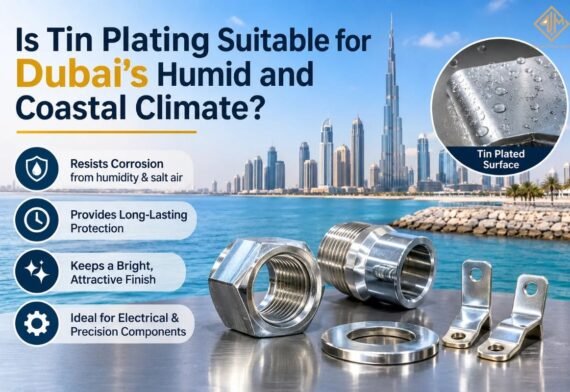
Metal parts face some challenging conditions in the UAE. High temperatures, high levels of humidity, dust depositing on surfaces, and coastal or industrial areas are all contributing factors to high summer temperatures. Another source of condensation is when parts are moved between the air conditioning system and outside areas where there is heat, resulting in accelerated corrosion on unprotected steel.
Any source of tin plating in Dubai should thus not only consider the name of the coating but also the part’s intended application. A clean connector is protected from the exterior by a tin finish that is good inside a sealed enclosure, but may not be adequate if the steel brackets are exposed and the tin surface is scratched by handling or installation.
| Environment | Usually Better Fit | Main Reason |
| Indoor, climate-controlled electronics | Tin | Solderability and stable contact resistance |
| Outdoor steel hardware near the coast | Zinc, with suitable passivation | Sacrificial protection against salt and moisture |
| Sealed enclosures with controlled humidity | Tin | Barrier protection without exposure to weather |
| Heavy-use parts exposed to dust and wear | Often a harder finish or a zinc system with added protection | Better wear and corrosion resistance over time |
Our guide to the life expectancy of tin plating goes into more depth on these factors. Thermal limits should also be included in the specification in conjunction with the coating requirements, as heat can also impact solder joints and plastic components in the vicinity of the coating.
Where to find reliable tin plating services?
A lot of buyers start looking only after a design is complete, but this can lead to issues that can cost them money. The performance of a coating depends on surface finish, hole geometry, masking requirements, and base material. An early drawing review by a provider can identify sections where coverage may be inconsistent or other underlayers could be required.
To compare tin plating services in Dubai, check if the team can provide documentation of the drawings, can explain the process, and can test the results. If a provider can answer these questions in a clear manner, they are likely to be easier to work with in the long term.
Tin plating is one of the plating services offered by Aljawaher Metal Coating, along with nickel, copper, chrome, gold, and silver plating. It’s more advantageous for teams that require more than one finish to use one provider who understands how all the layers work together. To find out more about our process of tin plating, read more here, or to find out more about our team and the way we approach each project.
If you’re still wondering about tin vs nickel, we’ve included our article on the strength of tin plating vs nickel plating in detail.
How to choose the right provider?
Selecting a provider isn’t simply a matter of getting the cheapest quote. There are a number of obvious indicators of a reliable partner. Before they quote, they ask about what it is going to be used for. They are able to demonstrate process control and bath maintenance with documentation, along with rinse quality. They offer measurement and inspection reports to your specification.
When you are looking for the best metal coating company in Dubai, you will get numerous options available, but the most suitable is the one that will align with your technical needs and production volume. Additionally, a good provider should be happy to advise the use of tin, zinc, or other finishes as appropriate for the job, not just for the job that runs the most for him.
Test sample parts for coverage and adhesion before committing to a production run. A small test batch will uncover issues that a quotation can’t anticipate, such as uneven coverage in blind holes or edge build-up on sharp corners.
What affects the cost of each finish?
The cost varies depending on a number of factors, and tin is typically costlier than zinc as it is a more expensive metal and process control is more challenging. The principal drivers of the costs are:
- The Metal or the surface condition of the metal before plating.
- The thickness desired and the need for an underlayer.
- Part size, shape, and any masking requirements.
- The volume and handling specifications.
- Other steps like passivation, baking, or sealing.
Moreover, a low-cost finish, which will fail early, will cost more over the life of the product than zinc will in the individual parts. Inquire about the cost versus the likely performance in addition to the unit cost. If you are also interested in surface preparation, our metal finishing page outlines all the steps to take, including those that may impact your project.
Common mistakes to avoid
Most of the issues with the tin plating service in Dubai and other finishes stem from choices made at the initial design stage. It’s generally much cheaper to prevent them than to deal with a bad batch.
- The lack of a description of the operating environment leaves the provider with no idea of the actual risk.
- Not considering the base metal, because steel and copper react differently to the same coating.
- Because the difference is seldom noticeable for months after exposure, it is assumed that a thin layer provides as much protection as a thick layer.
- Creating sharp edges and narrow, deep recesses where coverage is difficult, even with sharp edges.
- Forgoing testing of a new part design or new supplier.
By considering these factors at the drawing board stage, time and money during production will be saved.
Bottom line
The choice between tin and zinc depends on its purpose. Tin plating is an excellent choice for having good contacts and solid solder joints if you’re looking at reliability issues with your components. For cheap anti-corrosion of metals on iron and steel, zinc tends to be an appropriate choice first. When you are doing any kind of work related to tin-plating in Dubai, make sure your supplier knows about this process and its requirements for our environment.
When buying from the best metal coating company in Dubai like Aljawaher Metal Coating, you should look at how they ask questions before giving quotes; measure their products accurately so that they are truthful regarding which finishes work well on various applications.
Frequently asked questions
Neither are a universally better option. Tin provides solder-ability and conductivity where required whilst zinc provides a more cost effective sacrificial option.
Zinc plated items will generally provide better protection on steel as it will corrode first, whilst Tin only provides protection if the coating remains intact.
Yes, Tin provides excellent solder-ability and low contact resistance so is commonly used for connectors, terminals and PCB components.
The substrate material, thickness, environment and if you are going to solder the components. This will help to apply the correct finish.