-
aljawahermetalcoating
- November 23, 2026
- No Comments
Is Tin Plating Suitable for Dubai’s Humid and Coastal Climate?
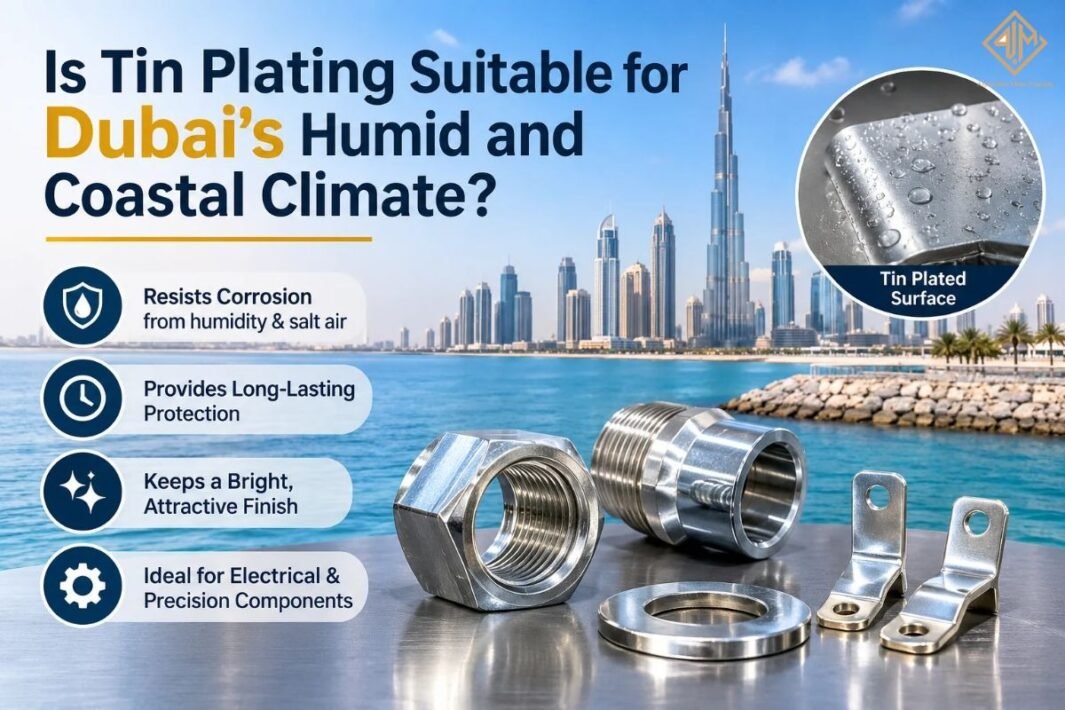
Tin plating is capable of performing well in the humid and coastal environment of Dubai; however, only when the local conditions are taken into account during specifications and application processes. Tin prevents tarnishing and maintains solderability of surfaces in humid air, which makes it suitable for use in electrical components or copper fittings.
Problems arise when plating is either too thin, contains pinholes, or is applied over steel that is exposed to salt air. Optimum thickness, underlayer, and sealing cause the difference between a plating that serves for many years and one that fails soon after application.
Key takeaways
- Tin plating is ideal for use when the base metal, thickness, and sealing are selected for coastal applications, as it is suitable for the humid climate.
- Most failures are due to pinholes, thin layers, and improper preparation, so quality control is more significant than the finish.
- The use of tin is good for copper parts and electrical contacts, whereas a duplex system, or zinc, may be better for steel in salt spray.
- The strongest indications of a successful coating partner are verified testing and transparent reporting and recommendations.
What makes Dubai’s climate so demanding for metal surfaces?
Dubai has high temperatures in the summer, high relative humidity, sometimes rapidly rising in the coastal months, and air loaded with fine salt particles from the Arabian Gulf. Each factor promotes corrosion uniquely. Combined, they form one of the harder environments in which to do metal finishes anywhere in the area.
- Humidity and condensation
Humid air is able to contain more water, and thin layers of water form on the surface of metals. The surface temperatures may fall below the dew point during the overnight hours when the air is still warm enough to produce condensation. This film of moisture is an electrolyte and corrosion reactions can start.
- Salt spray from the Gulf
Salt particles cling to surfaces and draw moisture towards them. When chloride ions are in contact with bare metal, they tend to destroy a protective oxide film, thus accelerating the pitting process. Close to the shoreline is the most exposed area, with wind being the biggest factor in carrying salt further inland than many buyers realise.
- Heat and temperature swings
The summer temperatures are 45°C and more, with sharp differences between outdoor and air-conditioned indoor temperatures. When coatings are repeatedly expanded and contracted, they are stressed, and heat increases chemical reactions. If a material is not chosen for these fluctuations, it will fail in Dubai.
How does tin plating perform in humid conditions?
Tin plating in Dubai is highly resistant to tarnish and oxidation, making it suitable for use in humid environments. It has long-term solderability and electrical conductivity in wet air. The performance is related to the continuity of the coating, the thickness of the deposition, and the presence of pores or scratches in the base metal.
Why does tin resist tarnish?
Tin will oxidize in air, forming a thin layer of tin oxide that will protect itself. It does not form flaky rust that continues to deteriorate the material underneath as do iron-based metals. Tin’s stability makes it a reliable option for connectors, fasteners, and copper-based parts that require a long lifespan.
Where tin plating can fail?
Tin is not as corrosion-resistant as some other alternatives and will not sacrifice itself to protect steel. When the coating has pinholes or scratches, the exposed base metal can corrode. Thin deposits also tend to wear out more quickly on frictional parts or parts that are subject to repeated assembly.
The most common failure causes include:
- Porosity: Moisture and chlorides get into microscopic holes in the base metal.
- Insufficient thickness: Deposits below the specified range wear through quickly in humid or abrasive conditions.
- Poor surface preparation: Oils, oxides, or residues do not allow for an even coating.
- Galvanic contact: For some assemblies, the corrosion rate of the exposed steel, due to damage to the tin, can be higher than that of bare steel.
Is tin plating suitable for coastal air and salt exposure?
Coastal air is appropriate for tin-plating on copper or brass or other non-ferrous alloys provided the base metal is sufficiently thick and properly sealed. Not so good for use as a single barrier to carbon steel in direct salt spray. In such instances, a zinc, nickel, or multi-layer system typically offers greater protection.
How tin compares with other finishes
The following table is for general guidance. Actual results will vary by thickness, sealing, and test standard.
| Finish | Salt Spray Resistance | Solderability | Typical Use in Coastal Dubai | Relative Cost |
| Tin plating | Moderate | Excellent | Electrical contacts, copper fittings | Low to moderate |
| Zinc plating | Good on steel (sacrificial) | Fair | Steel fasteners, brackets | Low |
| Nickel plating | Very good | Poor | Decorative and wear surfaces | Moderate |
| Tin-nickel alloy | Very good | Good | Connectors in harsh environments | Moderate to high |
| Hot-dip galvanizing | Excellent | Not applicable | Structural steel, outdoor frames | Moderate |
When is tin the right choice?
In some cases, the use of tin is still viable:
- Electronic components (more important than heavy corrosion protection)
- Plumbing, electrical boxes, and marine-grade assemblies made from copper and brass.
- Parts require low friction and easy assembly without galling.
Therefore, if steel parts are in direct contact with salt spray, consult with your coater about whether to use zinc or a duplex system before using tin.
Which factors decide tin plating performance in Dubai?
The factors determining the survival of the tin coating after coastal exposure can be summarized as follows: Thickness, material type, and finishes are more important than price to the buyer when considering the lifespan of the part.
- Plating Thickness
The thicker the deposits, the less the density of pinholes and the longer the service life. For humid or outdoor applications, a minimum thickness is often specified, but this will depend on the application and standard. Have your coater verify with records of thickness measurements, not assuming that the target was achieved.
- Base Metal and Underlayers
The nickel underlayer beneath tin results in better barrier properties and reduces the diffusion of copper into the surface of the tin over time. This is particularly useful in salt-laden air for many years. The surface finish of the base metal is also significant, as rough surfaces will contain contaminants and will form weak points.
- Sealing and Post-Treatment
Passivation and sealing treatments provide a thin protective film, which impedes tarnish and staining. It is advisable to talk about sealing in the quotation phase and not as an “after-thought” for installations on the coast. It is a cost effective solution as compared to replacing corroded parts.
What should you expect from professional coating providers?
The professional tin plating services in Dubai have a specific process, and each step plays its role in the process of adhesion and corrosion resistance. Good quality providers record the thickness, the process, and test results, allowing the buyer to check the finish prior to shipment.
The typical process
- Check incoming parts for damage, contamination, and proper base materials.
- Oil, fingerprints, and residue are removed by cleaning and degreasing.
- Controlled acid dip to activate surfaces for better adhesion.
- If required per specification, apply nickel underlayer.
- Thinning of plate under controlled current and bath chemistry.
- Rinse, dry, and apply sealing or passivation where needed.
- Take measurements and perform adhesion tests prior to dispatch.
Quality checks that matter
Consider the following, and look for providers that can demonstrate evidence of each of these:
- Thickness measurement using recognized methods such as X-ray fluorescence, with records for each batch.
- Salt spray testing performed to a recognized standard, with results you can review.
- Surface adhesion testing to ensure that the coating will adhere correctly to the surface.
- Traceability of each batch with bath parameters and inspection data.
How do you choose the best metal coating company?
The best metal coating company in Dubai has a proven process control system, an in-house testing facility, experience in coastal projects, and clear communication. Request thickness reports, salt spray records, and references for comparable environments. A provider who openly discusses the pros and cons of a project is more likely to be reliable than a provider who guarantees the same result for all projects.
Questions to ask before you order
- What base materials do you plate, and have you been working with our particular alloy?
- Are there thickness measurement reports for recent batches available?
- For coastal installations, do you use an underlayer or a sealant?
- What kind of tests do you use, and could I please see some sample results?
- What do you do with parts that don’t meet the standard?
Warning signs to avoid
- Uncommitted promises about “lifetime protection” and no data or conditions.
- Avoids revealing thickness measurements or process information.
- One coat recommended for all applications, on all bases and in all exposures.
- Prices that are lower than usual with no details about surface preparation or inspection requirements.
How should you maintain tin-plated parts in the UAE?
Maintenance is a proper way to make any finish last longer, particularly in coastal areas. Daily maintenance can prevent salt deposits from beginning localized attack, and simple habits can have a significant impact over time.
Rinse off parts that are close to the shoreline with regular freshwater. In humid environments, the salt residue will accumulate rapidly and can be easily washed away before attracting moisture to the surface. Don’t use abrasive cleaners or steel wool because it will scratch the coating and reveal the underlying metal.
Moreover, check parts following dust storms or extended periods of high humidity or heavy rain. Watch for dulling, discoloration, or dark spots and treat them promptly. If moisture is present, keep storage areas dry, and, if they must be stored with moisture, separate tin-plated parts from dissimilar metals, as contact between metals in a wet environment can accelerate galvanic corrosion.
Wrapping up
With careful planning, tin plating in Dubai can prove to be a reliable process in humid and salty environments. The choice of finish will rely on a match-up with the base metal, on using the correct thickness, and on enclosing the coating in the correct environment. There may be a need for a different system if parts are directly exposed to salt spray.
If you’re ready to place your order, ensure that you pick a provider who will keep a record of each action. Tin plating in Dubai is robust when it is process-controlled, measured, and when it provides good guidance on trade-offs. A good metal coating company in Dubai will not hesitate to respond to questions and put on display the test results. Early decisions are your best safeguard for equipment, cost savings, and a smooth flow of projects through all seasons.
Frequently asked questions
Tin plating will not rust, but will corrode if thin or damaged.
Zinc typically offers greater corrosion protection of steel in salt spray applications, sacrificing itself to the corrosion process; tin can be used to protect copper components and electrical contacts.
The thickness varies depending on the standard and application, but in humidity use a minimum thickness is generally required, which has to be ascertained from the thickness measurements.
Light freshwater cleaning every 1-3 months prevents the build-up of salt deposits and is more often done closer to the shoreline.