-
aljawahermetalcoating
- May 12, 2026
- No Comments
Silver Plating vs Nickel Plating: Which One is Better for Your Industry?
Table of Contents
- Key Takeaways
- What makes silver plating useful?
- Why do many industries prefer nickel plating?
- Silver vs Nickel: main differences
- Which industries use silver plating more?
- Where is nickel plating a better choice?
- How to choose the right plating solution?
- Final verdict
- Frequently asked questions
Key Takeaways
- Silver plating is a good conductor of electricity.
- Nickel plating will offer greater corrosion protection.
- Electronics and precision systems are silver-plated.
- Nickel plating is ideal for machinery and heavy industries.
The selection of the appropriate metal coating is directly related to the product life, performance, and maintenance cost. Both silver plating and nickel plating are popular in the production of industrial equipment, automotive, aerospace, and electronics. But each coating has different characteristics. So industries need to choose the best one according to their conditions, budget, and durability.
In industries, these two plating methods are usually looked at first before determining the requirements for their production. While silver plating is known for excellent conductivity, nickel plating is preferred for corrosion resistance and surface hardness. It will depend on how and where the component will be used.
What makes silver plating useful?
Silver plating is primarily used in applications where high electrical conductivity is required. As silver is one of the most conductive metals, it allows for signals and current to pass through electrical parts more quickly. Furthermore, silver-metallized surfaces are less lossy during operation.
Silver plating is generally used in industries for:
- Electrical connectors
- Switch contacts
- Circuit breakers
- RF components
- Aerospace electronics
One of the biggest benefits of silver plating service in Dubai is the increase in conductivity in high-performance industrial systems. Moreover, the silver-plated material is easy to solder, facilitating the manufacturing process for electronic components.
But there are some drawbacks to silver plating. May be tarnished in sulfur-rich environments over time. Tarnishing may not affect conductivity, but it can impact appearance and surface quality.
Silver plating is typically chosen over performance rather than for surface hardness.
Why do many industries prefer nickel plating?
The primary reasons for nickel plating are durability and corrosion resistance. It forms a protective surface that makes it easier to use and maintains the durability of metal parts. Additionally, nickel plating prevents friction and chemical and moisture damage to lessen wear.
Nickel plating is widely used in many industries due to its ability to provide the following:
- Better corrosion resistance
- Higher surface hardness
- Longer component life
- Improved wear protection
- Better appearance finishing
In today’s world, numerous manufacturers are looking for dependable nickel plating services in Dubai to safeguard equipment used in heavy industries, vehicles, and industrial machinery.
Nickel plating is also a common process that is carried out prior to painting or further coating, as it produces a smooth and stable surface. Compared to silver plating, nickel coating usually requires less maintenance in industrial applications.
Nickel plating is a more viable solution in the long term for industries in humid or chemical-heavy environments.
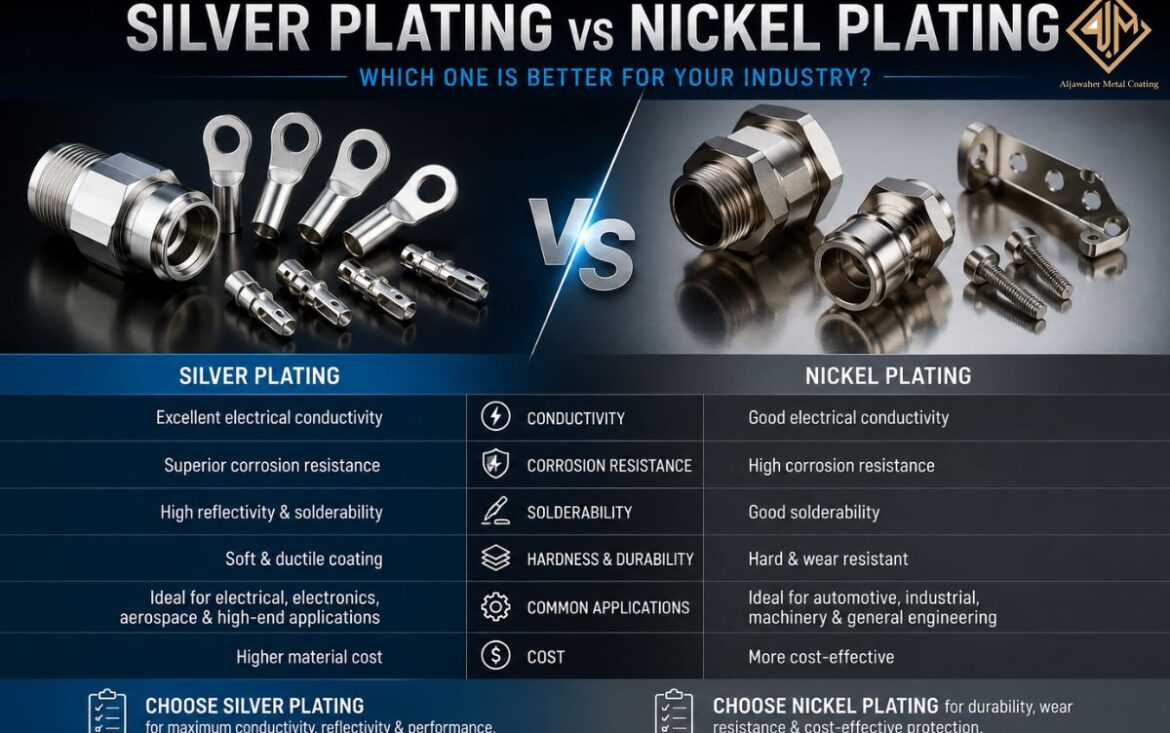
Silver vs Nickel: main differences
Each plating method has a different function in industry. Hence, when knowing the exact difference is the basis of the problem, it would be better for the business to not have to spend money on repairs and replacements in the near future.
| Feature | Silver Plating | Nickel Plating |
| Conductivity | Very high | Moderate |
| Corrosion Resistance | Good | Excellent |
| Surface Hardness | Lower | Higher |
| Wear Resistance | Moderate | Strong |
| Appearance | Bright metallic finish | Smooth silver-grey finish |
| Cost | Usually higher | More economical |
| Common Use | Electronics | Industrial machinery |
Silver plating is better suited for electrical applications, and nickel is better suited for physical protection and durability.
This is where companies that perform coating services such as Aljawaher Metal Coating come in.
Which industries use silver plating more?
Silver plating is primarily used in industries where a transfer of signals and electrical efficiency is crucial. System performance can be impacted by even the smallest loss of conductivity. Hence, it is used in precision equipment frequently as being silver-coated.
Common industries that use silver plating are the following:
- Electronics manufacturing
- Aerospace systems
- Telecommunications
- Power distribution
- Medical devices
Silver plating is also used in aviation-based electrical connectors for the most part because the conductivity must be stable for proper functioning of communications.
Moreover, silver plating is suitable for components that will be subjected to a high temperature since it doesn’t affect their conductivity under thermal stress.Although silver plating may cost more initially, industries needing reliable electrical performance usually consider it a long-term investment.
Where is nickel plating a better choice?
Nickel plating is suitable for the industries where mechanical strength is a more important consideration than conductivity. Nickel is an excellent coating for components that come in contact with moisture, friction, or chemicals.
Electroless nickel plating services in Dubai are one of the many evolving industrial solutions, particularly for those components that need uniform thickness. Electroless nickel plating is a coating process that does not require electric current to cover complex surfaces with an even coating, unlike traditional electroplating.
The industries that use nickel plating include the following:
- Automotive manufacturing
- Oil and gas products and equipment.
- Industrial machinery
- Marine components
- Construction hardware
Additionally, nickel plating helps to reduce the frequency of maintenance. This assists businesses in cutting down on replacements and operating costs down the road.
For industries operating in coastal or chemical environments, nickel plating usually provides better long-term protection than silver plating.
How to choose the right plating solution?
The industry’s actual working conditions will determine the best coating. Focusing on performance needs, environmental exposure, and product lifespan is more important than choosing a product based on price alone.
A few industry questions to ask about it are:
If you prefer silver plating, select it:
- The conductivity of the electric wire is important.
- Signal routing is processed by components.
- The material needs to be heat resistant.
- A low contact resistance is important.
Choose Nickel Plating If:
- The main focus of the corrosion protection.
- Surface hardness is important.
- The parts are subjected to frequent rubbing friction.
- There is a need for long-term durability.
By collaborating with the best metal coating company in Dubai, businesses can ensure that they do not suffer from coating failures due to poor material selection. There is always a technical application analysis that needs to be taken into consideration to determine a coat that is appropriate, not just aesthetically pleasing.
For this reason, it is best for the industries to consult experienced specialists before choosing any plating process.
Final verdict
The purpose of the silver plating and nickel plating varies for different industrial requirements. Silver plating enhances electrical conductivity, and nickel plating provides greater durability and corrosion resistance. The presence of trusted companies such as Aljawaher Metal Coating in the industry helps to choose the appropriate coating solution to enhance performance, ease maintenance, and extend component life.
Frequently asked questions
Yes, silver plating is a technique that makes the electrical conductivity much higher, and the electrical resistance is much less.
Yes, nickel plating does help to protect the surface of metal from corrosion and moisture.
The nickel plating tends to last longer in harsh industrial and chemical environments.