-
aljawahermetalcoating
- August 11, 2026
- No Comments
How to Increase the Lifespan of Nickel-Plated Parts
Table of Contents
- Key Takeaways
- Why do nickel-plated parts fail early?
- How does electroless nickel plating improve durability?
- Choosing the right plating thickness for your application
- Post-plating handling and storage mistakes
- Environmental factors that shorten coating life
- Maintenance practices that actually work
- When to re-plate vs. repair?
- Finding a reliable metal coating partner
- Bottom line
- Frequently asked questions
Key Takeaways
- The durability of plating can be largely influenced by the base metal surface preparation and thickness of coating.
- Electroless nickel plating guarantees the process is carried out completely without regard to the part’s shape, ensuring that fatigue does not occur prematurely.
- Minimizing coating defects that can occur during the transport process by proper storage and transportation of the coated product may help.
- Frequent inspections of the coated surfaces will give the opportunity to detect pitting and micro-cracks before the expensive re-coating is needed.
When a part leaves the shop, most people think that the nickel-plated surface will take care of itself. No, it’s not like that. The plating quality depends on the preparation of the part, the environment in which it is mounted and the handling after that. An 18-month-old part that was produced at the best facility in the world may fail if it is stored in a damp warehouse, or if it is assembled by an individual using greasy hands.
This guide will explain what really affects the life of a nickel plate, the areas where most failures begin, and some steps you can take before, during and after plating to make the most of your nickel plate.
Why do nickel-plated parts fail early?
It’s not always a problem with nickel. It’s just a matter of what is under it.
If the base metal is not cleaned correctly, if there is oxide on the surface or if there is micro pitting on the surface caused by previous corrosion, the plating will bond to a weak base. It may appear perfect the first day. Within six months, you will notice blistering or flaking at these weak spots.
Other common early-failure causes:
| Cause | What Happens | Typical Timeframe to Failure |
|---|---|---|
| Poor surface prep | Adhesion loss, flaking | 3–8 months |
| Incorrect plating thickness | Wear-through in high-friction zones | 6–12 months |
| Hydrogen embrittlement (untreated) | Cracking under stress | Days to weeks |
| Contaminated plating bath | Uneven coating, porosity | Immediate to 2 months |
| Poor rinse cycles | Chemical residue corrosion | 2–6 months |
A shop that skips baking cycles after plating high-strength steel components is setting itself up for hydrogen embrittlement failures that show up under load, sometimes catastrophically. It’s one reason experienced platers treat this as metallurgy, not a dip-and-coat job.
How does electroless nickel plating improve durability?
Electrolytic nickel plating relies on electrical current, which means coating thickness varies across a part’s surface: thicker on edges and corners, thinner in recesses and internal bores. For simple flat parts, that’s rarely a problem. For parts with threads, blind holes, or complex machined features, it creates weak spots exactly where stress concentrates.
Therefore, electroless nickel plating services in Dubai use a chemical reduction process instead of electrical current, depositing a genuinely uniform layer regardless of geometry. That uniformity is the real durability advantage. It’s a physical property of how the coating forms, not a sales line.
Practical benefits worth knowing:
- Consistent thickness on internal diameters, threads, and irregular shapes
- Better corrosion resistance in one continuous barrier layer
- Higher hardness values achievable through post-plate heat treatment
- Better wear resistance for components exposed to sliding contact.
When it comes to parts such as valve bodies, pump housings, or precision-engineered components with internal parts, electroless nickel plating near me typically leads to specialist shops offering this service, rather than general players who just offer it as an additional service.
Choosing the right plating thickness for your application
Thicker doesn’t mean better. It’s a balance among wear resistance, dimensional accuracy, and cost.
A part with tight tolerances, say a shaft that needs to fit a bearing within a few micrometres, can’t take a heavy plating buildup without throwing off the fit. A part exposed to constant abrasive contact needs enough thickness to survive years of wear, not months.
Rough guidelines used across industrial applications:
- Decorative or mild corrosion protection: 5–15 microns
- Moderate wear and corrosion environments: 15–25 microns
- Heavy wear, high-corrosion, or marine environments: 25–50+ microns
Engineers designing for tight tolerance stacks should specify plating thickness on the drawing itself instead of leaving it to the plater’s default. That one step prevents a lot of the fit-and-finish disputes that come up after a batch gets delivered.
Post-plating handling and storage mistakes
This is where a lot of otherwise good plating jobs go wrong, and it has nothing to do with the plating shop.
Common mistakes after parts leave the facility:
- Stacking freshly plated parts directly on top of each other, scratching the surface before installation
- Storing in humid or poorly ventilated warehouses, which invites oxidation at the coating’s microscopic pores
- Handling with bare hands, transferring skin oils that speed up localized corrosion over time
- Using standard packing materials that trap moisture against the metal surface
Furthermore, none of this shows up right away. It shows up eight or ten months later as spotting or early corrosion, and by then it’s easy to blame the plating quality instead of the storage conditions.
Environmental factors that shorten coating life
Dubai’s climate adds a layer of complexity that cooler, drier regions don’t deal with. High humidity combined with salt-laden coastal air speeds up corrosion on any exposed metal, plated or not.
Parts used near coastal facilities, desalination plants, or marine equipment need thicker coatings and, often, a sealed or passivated finish on top of the nickel layer. Skipping that step because a part “looks fine” in dry storage is a common shortcut, and a costly one.
However, indoor industrial environments aren’t automatically safe either. Chemical exposure, temperature cycling, and contact with dissimilar metals (which can trigger galvanic corrosion) all shorten expected service life if nobody accounted for them at the specification stage.
Maintenance practices that actually work
Nickel plating doesn’t need constant attention, but ignoring it entirely shortens its life significantly.
A short, realistic maintenance routine:
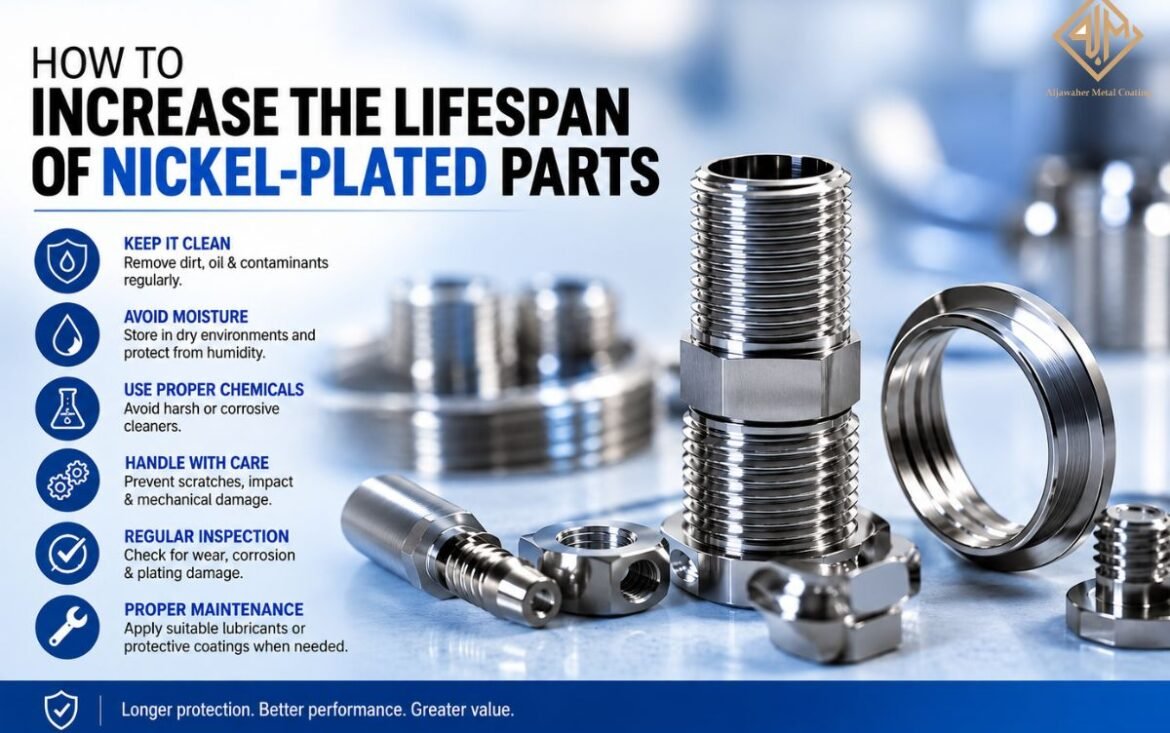
- Wipe down parts periodically to remove dust, grease, and chemical residue buildup
- Inspect visually every few months for pitting, discoloration, or flaking at edges
- Apply a light protective oil on parts stored long-term or exposed to humidity
- Avoid abrasive cleaning tools that scratch through the coating and expose base metal
Moreover, catching a small patch of pitting early and dealing with it is far cheaper than waiting until corrosion has spread under the coating, where nobody sees it until the plating starts lifting.
When to re-plate vs. repair?
Not every damaged coating needs a full strip-and-replate. Localized touch-up plating can handle small areas of wear or scratching if the damage hasn’t reached the base metal extensively.
| Situation | Recommended Action |
|---|---|
| Small surface scratches, no exposed base metal | Light polish, monitor |
| Localized pitting on a small area | Spot repair plating |
| Widespread flaking or blistering | Full strip and re-plate |
| Coating intact but part redesigned/re-machined | Full re-plate |
Trying to spot-repair a part with widespread adhesion failure usually wastes money. The underlying bond problem is still there, and the repair fails just as fast as the original coating did.
Finding a reliable metal coating partner
Coating longevity starts before the part ever touches a plating bath. It starts with a shop that controls bath chemistry, surface prep, and thickness consistency, not one racing through volume.
Aljawaher Metal Coating works with clients across automotive, industrial, and precision manufacturing sectors, and the gap in longevity between a rushed job and a properly controlled process is big enough that clients usually notice it within the first year of use.
When you’re weighing who counts as the best metal coating company in Dubai for your application, ask about their bath maintenance schedule, their hydrogen embrittlement relief process for high-strength steel, and how they verify thickness. Turnaround time is the easy question. Ask the harder ones.
Bottom line
Getting long-term value out of nickel-plated parts comes down to decisions made before, during, and after the plating process, not luck. Surface prep, the right thickness specification, and sensible storage account for most of the gap between a coating that lasts years and one that fails within months.
If you’re evaluating nickel plating services in Dubai for parts that need to hold up under real operating conditions, Aljawaher Metal Coating can walk through the right specification for your application before the first part ever goes into the bath.
Frequently asked questions
Anywhere from 3 to 15+ years, depending on thickness, environment, and handling. Coastal or high-wear environments cut that range down fast if the specification wasn’t right to begin with.
Usually, yes. The chemical process and materials cost more, but it’s often worth it for parts with complex geometry or internal features that need uniform coverage.
In most cases. The base metal just needs to not be significantly compromised by prior corrosion, and each strip-and-replate cycle should start with a fresh surface inspection.
Usually surface oxidation, chemical exposure, or heat beyond what the coating can tolerate. Treat it as an early warning sign, not just a cosmetic issue.
Yes, especially with added passivation or sealing. Untreated electroless nickel on its own won’t hold up to prolonged saltwater exposure.
It comes down to wear exposure, tolerance requirements, and corrosion risk. Have a plating engineer look at the application itself, not just the material spec.
Hard chrome tends to be harder on the surface. Nickel plating tends to resist corrosion better and cover complex parts more evenly. Which one you want depends on the specific failure mode you’re trying to prevent.
No. Worn or damaged coating has to be stripped first. Plating over compromised layers traps contamination underneath and leads to failure that’s harder to diagnose later.
It usually comes down to surface prep quality, bath chemistry control, and post-plating handling, not the nickel itself. Two parts plated identically can end up with very different lifespans depending on how they’re stored and used afterward.
Every 3 to 6 months is a reasonable baseline for industrial-use parts. Adjust based on how harsh the environment is and how critical the component is.