-
aljawahermetalcoating
- September 23, 2026
- No Comments
Hard Chrome Plating vs Decorative Chrome: What Is the Difference?
Table of Contents
- Key takeaways
- What hard chrome and decorative chrome actually are?
- The core difference: thickness and purpose
- How does each process work?
- Hardness, durability, and where each one belongs
- Corrosion resistance and the Dubai climate factor
- Cost and maintenance considerations
- Common mistakes when choosing between the two
- Final thoughts
- Frequently asked questions
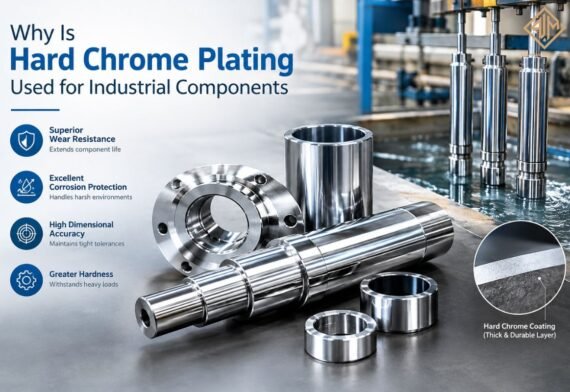
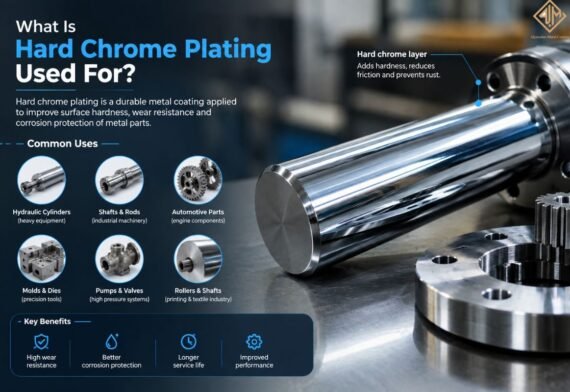
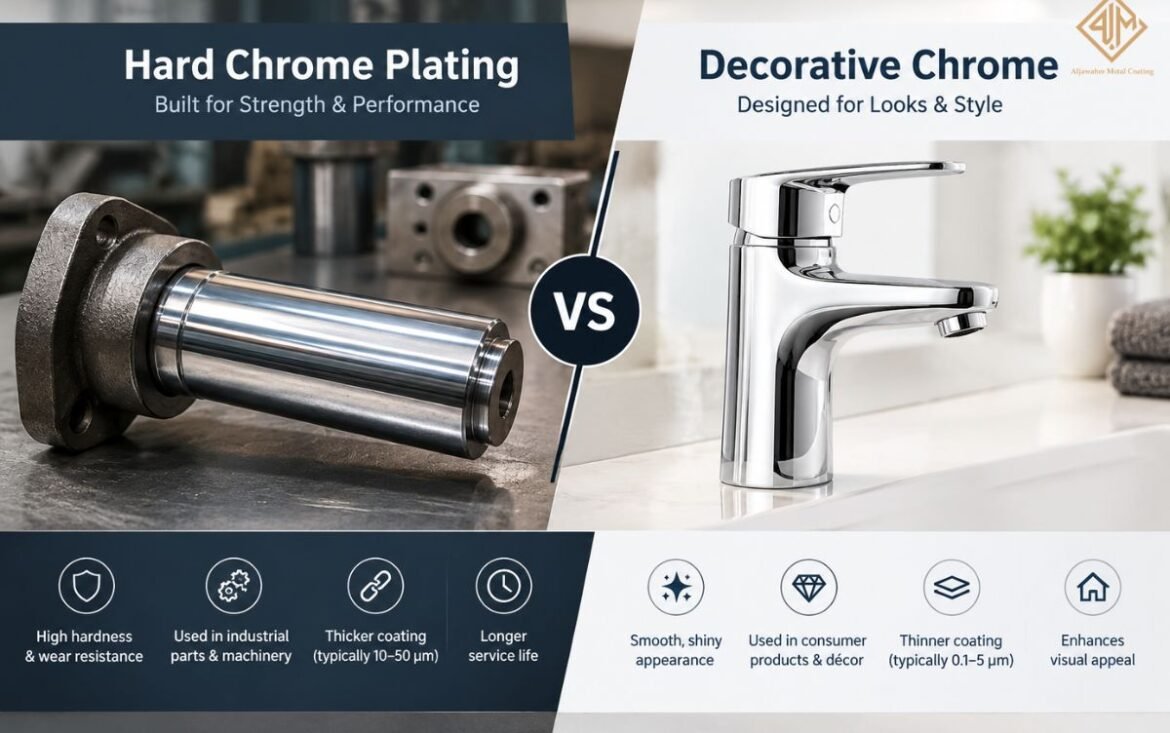
The differences between hard chrome and decorative chrome plating can sometimes be hard to tell apart, especially since they come out of the plating process looking virtually identical. Hard chrome is heavy-duty plating that is applied directly to the base metal surface to help minimize wear and friction, along with other damage, on items such as hydraulic cylinders, shafts, and molds.
Therefore, decorative chrome is a light cosmetic coating that sits on top of nickel to give the products a superior shiny decorative finish without durability. Do you need a component to handle mechanical stresses? Hard chrome is your option. Do you prefer aesthetics and minimal wear? Decorative chrome is the one for you, and it is way cheaper too.
Key takeaways
- Hard chrome deposits the coating directly on the base material, with a nominal thickness between 0.0002 and 0.02 inches.
- Hard chrome is concerned with performance, while decorative chrome focuses more on aesthetics.
- Both processes utilize chromium but differ greatly when it comes to preparation, thickness, and finishing processes.
- If chosen incorrectly, the finish may fail within a few months in the UAE.
What hard chrome and decorative chrome actually are?
Chrome plating is an electroplating process. A chromium layer gets deposited onto a component using electric current run through a chromic acid bath. That’s about where the resemblance between the two types stops.
- Hard chrome, sometimes called industrial or engineering chrome, goes directly onto the base metal in a thick layer. It’s not there to shine, though it can be polished if needed. Its job is to change how the surface holds up under stress: less friction, more abrasion resistance, and often the ability to rebuild a worn part back to its original size.
- Decorative chrome takes the long way around. Copper first (sometimes skipped), then nickel, and only at the very end a thin flash of chromium. The nickel does most of the actual protective work, smoothing the surface and resisting corrosion. Chrome on top just adds the brightness, that cool blue-white tone, and a bit of scratch resistance, but it’s too thin to count as a wear coating on its own.
The core difference: thickness and purpose
Thickness is the whole story here. Nearly everything else follows from it.
| Factor | Hard Chrome | Decorative Chrome |
| Typical thickness | 0.0002 to 0.02 inch (5 to 500 microns) | A few microns, often under 1 micron of chrome itself |
| Applied over | Base metal directly | Nickel-plated substrate |
| Main purpose | Wear resistance, friction reduction, dimensional repair | Visual appeal, mild corrosion protection |
| Typical hardness | Around 65 to 72 HRC | Similar chemical hardness, but too thin to matter structurally |
| Common uses | Hydraulic cylinders, engine components, molds, industrial tooling | Car trim, bathroom fittings, furniture hardware, kitchen fixtures |
Therefore, if a part is described only as “chrome plated” with nothing else specified, it’s almost certainly decorative. Nobody has to explicitly ask for that one. Hard chrome, on the other hand, gets called out by name because someone made an engineering decision, not a style choice.
How does each process work?
Hard chrome plating starts with cleaning, then masking off anything that shouldn’t get coated, then the part goes into a chromic acid electrolyte where chromium ions bond to the base metal under controlled current. Because the layer can be built up fairly thick, shops often grind or hone it afterward to hit exact final dimensions. That’s actually one of the more underrated things about hard chrome: a worn shaft that’s gone undersized can be built back up and reground to spec instead of machined from scratch. Cheaper, usually faster too.
Furthermore, decorative chrome starts with cleaning and buffing, moves to copper plating on rougher base metals for extra smoothness, then bright nickel, and finishes with a quick chrome dip. The nickel stage exists to level out imperfections before the reflective top layer goes on. Chrome won’t hide surface flaws the way nickel does.
Neither process touches the base metal’s core mechanical properties. Hard chrome is applied at fairly low temperatures on purpose, so the hardness and dimensional stability elsewhere on the part stay exactly where they started. Matters a lot for precision components.
Hardness, durability, and where each one belongs
Chromium itself is hard, somewhere around 65 to 72 on the Rockwell C scale, whichever type you’re talking about. The difference is thickness: hard chrome has enough of it to actually deliver that hardness under real load, while decorative chrome’s thin layer wears through the moment it hits anything beyond light contact.
That’s why a decorative chrome bumper cracks and exposes bare metal in a minor fender bender, while a chrome-plated hydraulic rod on a construction machine can run for years under constant friction. Decorative chrome isn’t a bad coating. It just wasn’t built for that kind of duty.
A few situations where the choice pretty much makes itself:
- Hydraulic and pneumatic cylinder rods: hard chrome, no question. Constant sliding contact with seals demands real wear resistance.
- Bathroom taps, shower fixtures, cabinet handles: decorative chrome. The main threats are humidity and handling, not mechanical friction.
- Printing rollers and die-casting molds: hard chrome, since dimensional accuracy and surface durability both matter here.
- Automotive trim, non-structural wheel rims, furniture legs: decorative chrome, for the shine plus moderate rust protection.
Corrosion resistance and the Dubai climate factor
Dubai’s heat, humidity, and salt-laden coastal air are genuinely rough on untreated metal. Leave a component unprotected and surface oxidation can show up within weeks, not months, especially anywhere near the coast or exposed outdoors.
- Hard chrome does offer corrosion resistance, mostly as a byproduct of its thickness and density, and it holds up reasonably well around oils, hydraulic fluids, and some corrosive chemicals in industrial settings. It just wasn’t engineered as an anti-corrosion coating first. It’s a wear coating that happens to shrug off rust fairly well too.
- Decorative chrome, oddly enough, can hold up fine against corrosion for its intended use, because the nickel underneath is doing the heavy lifting. Fixtures and consumer-facing parts sitting indoors or in covered areas are usually fine with that. Parts facing direct sun, sand, and salt air year after year are a different problem, and neither plating type substitutes for choosing the right base metal and checking on it regularly.
Moreover, that’s part of why hard chrome plating services in Dubai will often ask about a part’s actual working environment before quoting a finish at all. Two components that look identical can need completely different plating strategies depending on whether one sits indoors and the other sits outside getting rained on twice a year and baked the rest of the time.
Cost and maintenance considerations
- Hard chrome costs more upfront. Longer bath time, thicker deposits required, and post-plating grinding or honing add labor on top. For industrial clients, that extra cost usually pays for itself through longer part life, especially on components that would otherwise need full replacement every year or two.
- Decorative chrome is cheaper and quicker to apply, which tracks given the thinner layer and simpler quality requirements. It needs gentler, non-abrasive cleaning so you don’t scratch through that thin top layer, while hard chrome can take much rougher handling without much concern.
Worth knowing: hexavalent chromium, used in traditional hard chrome baths, is a regulated substance and needs proper waste treatment and emission controls. Reputable platers handle this as a matter of course, but it’s a fair question to ask any shop, whether you’re chasing down hard chrome plating near me for a one-off job or lining up a long-term supplier.
Common mistakes when choosing between the two
A handful of patterns keep showing up when this choice goes wrong:
- Specifying decorative chrome on a part that’s going to see real mechanical friction, then expecting industrial wear resistance from a coating a few microns thick.
- Over-speccing hard chrome on something purely cosmetic and paying industrial pricing for a job decorative plating would’ve handled fine.
- Assuming “chrome finish” means the same thing on two different shops’ quotes. Confirm thickness and application method, not just the word chrome.
- Skipping inspection of the base metal before plating. Porosity, pitting, or contamination will telegraph through either coating and shorten its life no matter how thick you go.
- Ignoring where the part will actually live. Outdoor exposure is a different conversation than an enclosed cabinet.
Getting the base metal prep right matters just as much as picking the coating itself, arguably more. Aljawaher Metal Coating typically walks through the part’s actual use case, load, and exposure before recommending which process fits, rather than defaulting to one option for everything that comes through the door.
However, that kind of environment-first thinking is a decent way to tell the best metal coating company in Dubai apart from a shop running the same process on everything regardless of use.
Final thoughts
Hard chrome and decorative chrome solve two different problems, and mixing them up rarely ends well. Need a part to survive friction, load, or repeated mechanical contact? Hard chrome plating is really the only option, and thickness plus base metal prep will matter more than anything else in how long it holds up. Need a bright, attractive finish with reasonable corrosion protection?
Decorative chrome over nickel gets there for less money and less lead time. Whether you’re comparing hard chrome plating services in Dubai for a batch of hydraulic components or just wondering why your trim keeps flaking, match the coating to what the part will actually face rather than the word “chrome” on a quote. When you’re searching for hard chrome plating near me, checking how a shop evaluates the base metal and the working environment is a better filter than price alone.
Frequently asked questions
Thickness and purpose. Hard chrome is thick and goes straight onto the metal for wear resistance. Decorative chrome is thin, sits over nickel, and exists mainly for appearance with light protection on the side.
Not for anything load-bearing or high-friction. The layer’s too thin and wears through fast under real mechanical stress.
Generally, yes; longer processing and grinding both add cost. It tends to pay for itself over time through fewer replacements, though.
Hard chrome usually falls between 0.0002 and 0.02 inches. Decorative chrome’s chromium layer is often under a micron, sitting on top of nickel.
Depends more on the part’s environment than the climate alone. Outdoor or exposed parts lean toward hard chrome or extra protection. Indoor fixtures do fine with decorative chrome.
Yes. It can be ground and polished to a high shine, which is exactly why some manufacturers use it on visible parts that need both strength and looks.
Function versus form, basically. Friction, load, or dimensional restoration means hard chrome. Appearance and mild protection mean decorative.
Whether they inspect the base metal first, how they handle chromium waste, whether they’re specific about thickness, and whether they ask about the part’s working environment before quoting a finish. That’s usually the tell for a shop worth trusting over one just running a standard process.