-
aljawahermetalcoating
- July 4, 2026
- No Comments
Common Nickel Plating Defects Explained
Table of Contents
- Key Takeaways
- Why do nickel plating defects happen?
- Explain nickel plating defects and how to fix them
- How can you prevent nickel plating problems?
- Benefits of high-quality nickel plating
- How did proper process control prevent costly rework?
- Expert Insight
- Conclusion
- Frequently asked questions
Key Takeaways
- The key to successful nickel plating is surface preparation.
- Process control can prevent most plating defects.
- Good coating quality and consistency are achieved with regular maintenance and filtration.
- Hiring professionals helps minimize production defects and product life.
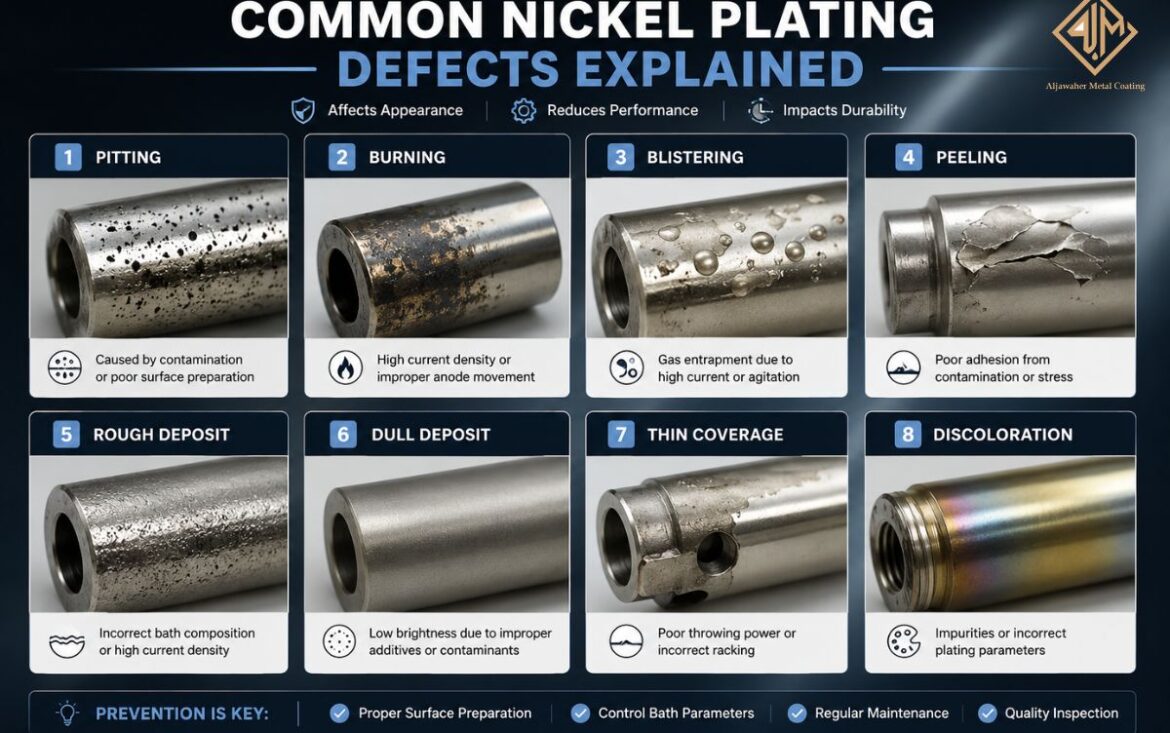
Nickel plating defects or failures typically occur when the plating process is not adequately controlled and comprise pitting, peeling, blistering, rough surfaces, and burning. Sub-optimal surface preparation, contaminated chemicals, improper current settings, and inadequate filtration may all lead to sub-optimal coating quality. Hiring the services of a professional nickel plating service in Dubai will help reduce these problems and provide a long-lasting finish that will resist corrosion.
From producing auto parts to industrial equipment or decorative metal products, knowing about these defects can help boost product quality, minimize rework, and decrease production expenses.
Why do nickel plating defects happen?
Nickel plating is an electroplating process of accuracy. A minor change in cleaning, bath chemistry, or electrical current can produce visible defects.
The most frequent ones are:
- Poor surface cleaning
- Contamination by dust or oil.
- Incorrect bath chemistry
- Improper current density
- Inadequate filtration
- Poor process monitoring
Furthermore, controlled plating parameters and careful quality checks by an experienced provider like Aljawaher Metal Coating can minimize variations in the quality of the products.
Explain nickel plating defects and how to fix them
1. What Causes Pitting in Nickel Plating?
Pitting is a defect that manifests itself as small pits or pinhole defects on the surface of the plating.
Common causes:
- Hydrogen gas that is captured on the surface
- The particles of dust in the plating bath
- Oil contamination
How to fix it:
- Improve solution agitation
- Install continuous filtration
- Maintain clean plating baths.
- Regularly inspect chemicals.
2. Why Does Nickel Plating Peel or Blister?
Peeling and blistering occurs when the nickel coating comes loose from the base metal.
Normally occurs when the metal surface is not adequately cleaned prior to plating.
Common causes:
- Grease or oil residue
- Rust or oxidation
- Poor cleaning process
Solutions:
- Thorough degreasing
- Proper acid activation
- Surface treatment prior to plating
- Strict cleaning procedures are to be followed.
However, the plating process does not begin the adhesion process; it starts before that.
3. Why Does Nickel Plating Look Burnt?
Plated parts will have dark, rough, or brittle edges if they are burned.
When too many electrical currents flow around corners and sharp edges.
How to prevent burning:
- Reduce current density
- Improve part positioning
- If necessary, use current robbers.
- Observe the electrical parameters during production.
4. Why Does the Surface Feel Rough?
A rough nickel finish often feels like sandpaper.
The debris gets caught in the coated layer, rather than forming a smooth film.
Typical causes include the following:
- Dirty plating solution
- Damaged filters
- Chemical sludge
- Metal particles
Recommended solution:
- Replace worn filters.
- Clean tanks regularly.
- Maintain bath cleanliness.
- Remove accumulated sludge.
How can you prevent nickel plating problems?
It is always cheaper to prevent defects than to repair them.
| Best Practice | Why It Matters |
| Proper surface cleaning | Improves coating adhesion |
| Regular bath testing | Maintains chemical balance |
| Continuous filtration | Removes contaminants |
| Controlled current density | Prevents burning |
| Routine equipment maintenance | Ensures consistent coating quality |
| Quality inspections | Detects issues before delivery |
Moreover, professional nickel plating services in Dubai implement these quality control measures to ensure that their products are consistent and durable.
Benefits of high-quality nickel plating
If properly managed, businesses can benefit from a number of things during the plating process.
Key benefits include the following:
- Better corrosion resistance
- Higher wear resistance
- Improved surface appearance
- Longer component life
- Reduced maintenance costs
- Improved performance in tough conditions.
- Lower production rework
Therefore, a number of companies seeking the best metal coating company in Dubai may focus on quality control, as it bears directly on that of their products and customer satisfaction.
How did proper process control prevent costly rework?
A steel machine component manufacturer experienced multiple cases of peeling following plating. They first thought it was due to bad chemicals.
But a close examination showed that the surface cleaning prior to the plating was not uniform. The rejection rate reduced considerably after upgrading the degreasing process, replacing clogged filters, and adjusting current density. Production was made more efficient, and the number of customer complaints decreased.
Furthermore, this example shows that identifying the root cause often solves multiple quality issues at once.
Expert insight
It is well known to plating engineers that many defects in their nickel-plated products can be avoided. In many cases, it’s not a nickel problem; it’s a process control problem. Preventative maintenance and regular monitoring and inspections work better than production defect cures. That’s why trusted providers such as Aljawaher Metal Coating concentrate on quality at all stages of the plating process and not just final inspections.
Conclusion
When properly controlled, nickel plating enhances corrosion protection and durability and enhances the appearance of the product. Typical problems such as poor cleaning, contamination, and/or improper electrical settings are typically the root cause of defects such as pitting, peeling, burning, or rough surfaces.
By partnering with a seasoned expert such as Aljawaher Metal Coating, you can rest assured that each step of the plating process adheres to quality standards. When you’re seeking a consistent performance and reliable metal finishing solution, you’re better off investing in professional plating services.
Frequently asked questions
One of the most frequently occurring defects is called pitting. Most often it is caused by hydrogen bubbles or contamination in the plating solution.
Peeling is caused by lack of cleanliness and preparation of the base metal prior to plating, causing poor adhesion.
Yes. After the cause of the rough coating is discovered and corrected, the coating can be polished or stripped and replated with the correct material.
Most defects can be prevented by proper cleaning, bath maintenance, filtration, current control, and regular quality inspections.
Controlled processes, advanced equipment, and stringent quality controls are used by professional providers to ensure consistent, durable coatings that have fewer defects.