-
aljawahermetalcoating
- October 24, 2026
- Comment (1)
Tin Plating vs Nickel Plating: Which Is Better?
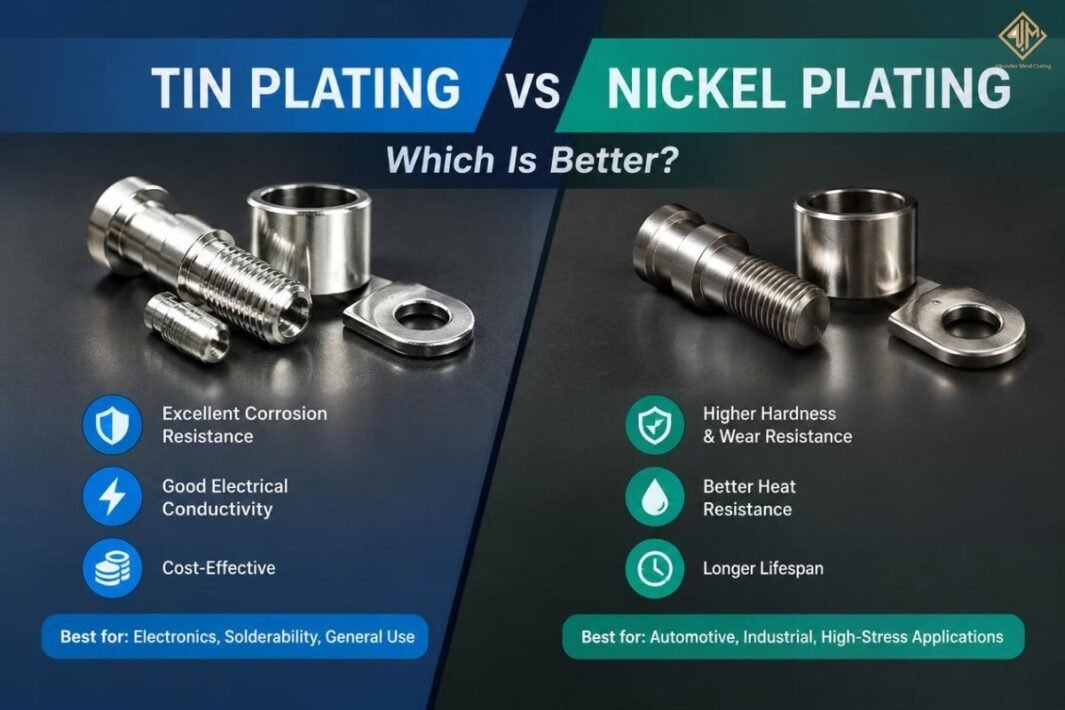
Tin plating and nickel plating are two of the most popular finishes for metal parts, but they are not always the best option. Tin plating is typically the more appropriate coating for electrical connections and parts that require high-solderability characteristics and is more cost-effective, conductive, and reliable.
Nickel plating is the choice of metal finish when a part requires hardness, wear resistance, and good corrosion protection, particularly on complex geometry. The proper answer will change according to the job it performs, the location where it works, and your budget.
Key takeaways
- Tin plating is ideal for electronics, solderable items, and low-cost projects.
- Nickel plating has better hardness, wear resistance, and corrosion resistance.
- Nickel is used in components for outdoor and marine equipment due to Dubai’s humid, salty climate.
- Test samples before full production to choose the best option depending on function, environment, and budget.
What is tin plating and how does it work?
Tin plating is an application used to apply a thin layer of tin to a metal surface, typically steel, copper, or brass. The typical thickness of the layer is a few microns. It helps to prevent the base metal from corrosion, and facilitates soldering. It is commonly used in electrical or electronic devices by engineers.
When searching for tin plating in Dubai, businesses often prioritize cost-effectiveness and conductivity. Tin is a soft nontoxic metal, which does not tarnish in normal use. This is usually accomplished by electroplating a coat of tin onto the part by passing an electric current through it, but other methods are used for certain parts.
Main advantages of tin plating
- Good solderability: parts are easily connected using standard soldering techniques, important for circuit boards and terminals.
- Low friction: The surface is smooth, aiding in sliding contacts and fasteners.
- Low cost: The tin is less expensive than the nickel, and for many part types the process is relatively simple.
- Excellent electrical contact: Tin provides long-lasting low contact resistance.
- Non-toxic: Tin can be used in many applications where its use in materials is allowable.
However, there are limits to the use of tin. It is fairly soft and thus will wear out if the friction is too great. It can also form very small projections called “tin whiskers” under certain circumstances, which can lead to electrical shorts in delicate electronics. This risk can be mitigated with good process control and an appropriate underlayer.
What is nickel plating and why do manufacturers use it?
Nickel plating is a process that involves applying a coating of nickel to a metal base material to enhance its hardness, resistance to wear and corrosion. It can be applied by electroplating (electrically) or electroless (chemically). Finish is applied in the automotive, industrial, marine and hydraulic equipment industry.
Nickel is a tough, shiny metal that is resistant to rust and chemicals. Nickel layers can be thick and dense, and more likely to resist harsh usage than tin. Nickel is used by many manufacturers in pumps, valves, gears and tools.
Why choose electroless coating for complex parts?
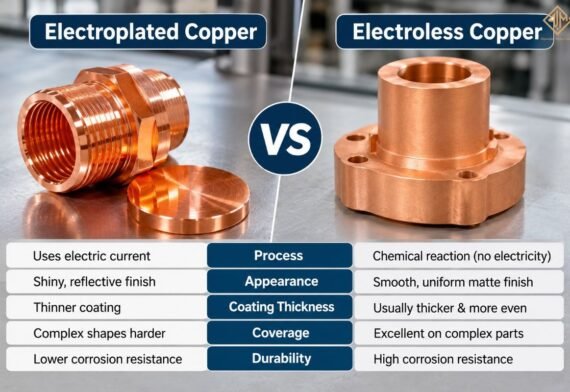
When it comes to parts that have complex shapes, internal bores or fine threads, electroless nickel plating services in Dubai have a clear advantage. Since it is not based on an electrical current, deposits are uniform, even on recessed areas and corners. The thickness remains uniform and prevents components from changing size after coating if they are required for tight tolerances.
Electroless deposits are also more uniform on parts with sharp edges that can have a tendency to form uneven electroplated deposits. The method is therefore a popular choice for precision moulds and fittings, as well as hydraulic components.
Tin plating vs nickel plating: side-by-side comparison
The table below is a succinct comparison of the two finishes on some of the key factors of interest to engineers and buyers.
| Factor | Tin Plating | Nickel Plating |
| Hardness | Soft | Hard |
| Corrosion resistance | Good in mild or indoor conditions | Excellent, including salt and humidity |
| Solderability | Excellent | Fair, usually needs extra preparation |
| Wear resistance | Low to moderate | High |
| Friction | Low | Moderate |
| Electrical contact | Stable, low contact resistance | Good, depends on thickness and deposit type |
| Relative cost | Lower | Higher |
| Typical uses | Connectors, PCB terminals, solderable parts | Pumps, valves, gears, tooling, marine hardware |
To put it simply, solderability and cost are the areas in which tin has won. Nickel outperforms in harsh environment conditions in terms of hardness, usage and corrosion resistance.
Which finish resists corrosion better in Dubai’s climate?
Nickel plated items are more corrosion resistant than tin plated items, particularly in humid, salty and high temperature applications. The high humidity and salty atmosphere of the coast line can increase the rate of rusting of exposed steel in Dubai. Tin is ideal for indoor or mildly corrosive parts, and nickel is ideal for outdoor, marine and industrial parts exposed to the elements.
Dubai has a high humidity level, salt from the air of the Gulf and extreme heat in the summer time. There are also many industrial facilities that are likely to be exposed to salt spray regularly in the neighborhood of the coast. Under these circumstances, corrosion is a serious problem for equipment that is outside or in poorly ventilated areas. This has led to many project specifications that require a nickel layer or multi-layers if durability is most critical.
Can tin plating be used outdoors?
Tin plating is suitable for outdoor applications for sheltered areas or applications with moderate exposure, but it is seldom the first choice for extended outdoor exposure in salt air. The thin layer of tin can eventually be worn through exposing the underlying base metal. These are commonly used in a combination with a protective topcoat where outdoor durability is crucial.
Which is better for electronics and solderability?
Tin plating is more commonly used in electronics applications due to its good solderability and ability to form a good electrical contact. The standard material for connectors, terminals and printed circuit board parts. In electronics, nickel is also frequently used as an underlayer, as it will inhibit diffusion of copper into tin.
Clean and new tin surface is essential to solderability. However, with time, a tin layer may not adhere well to soldering, so manufacturers may regulate storing time and handling. Nickel oxidizes more slowly but is more difficult to solder without using the correct flux and preparation.
Tin plating works best in these situations:
- Electrical terminals and connectors which are to be soldered during assembly.
- Printed circuit board components with low contact resistance
- Moderate production runs in which environmental exposure is acceptable and the budget cannot be exceeded.
Which is harder and more wear-resistant?
Nickel is much harder than tin and therefore is the better material to use for moving parts. Heat treatment can be used after plating to give improved hardness, and is often used to make the plated deposit more resistant to abrasion. Tin is soft and will easily come off and smear or rub off when rubbed, particularly if two surfaces rub against one another.
The thickness of the coating is also important. The thicker the nickel layer, the longer the wear life, and the tin layer can be thin for low friction contacts that do not move much. The secret is fitting the finish to the application, not the metal.
How do cost and lead time compare?
The cost of tin plating is generally lower due to the ease and cost of the process for many part types. Nickel plating is more expensive, especially electroless nickel, which utilizes unique chemistry and process control. Final pricing is dependent on part size, thickness requested, surface preparation, and order quantity.
The lead time will depend on the process and workload. Scheduling is influenced by batch size, masking requirements, and pre-treatment steps. To obtain the most precise numbers, present your sketches, specifications for thickness and quantities to your coating supplier and ask them to quote you on your parts.
How to choose the right finish for your project?
When it comes time to make your final selection, it’s easier to choose a finish if you go through a few questions step by step:
- Identify the purpose of the part: Determine the need for electrical contact, wear resistance, corrosion resistance, or all three.
- Inspect the operating environment: Take into account humidity, salt exposure, temperature, and whether the part is installed outside.
- Confirm assembly requirements: When soldering is the only option, use of tin or a tin-based system is typically the first step.
- Check budget and volume: Consider the material costs, complexity of process, and the quantity of products.
- Test until available before running in full production: Coating trials are performed to detect thickness, adhesion, and appearance problems early.
How to pick a reliable coating partner
The quality of the finished product is as much due to process control as to the type of metal used. Having the best metal coating company in Dubai means that you will have consistent thickness, proper surface preparation, and quality checks that are documented.
Aljawaher Metal Coating offers both tin and nickel finishes and can assist you in attaining a finish that corresponds to the function of your part. Don’t place a large order without samples, test reports, and process documentation.
Bottom line
The option between tin plating in Dubai and nickel is not a simple choice of one metal over the other. Tin is the best material for electrical contact and soldering, and nickel adds durability in extreme environments.
A plating process is the best long-term protection that can be offered for many industrial projects, and that is the reason why it is a process that is offered by nickel plating services in Dubai. First, establish the role and context of your part, and then decide on the appropriate finish.
Frequently Asked Questions
In the electronics sector, tin plating is typically preferred over other tin alloys due to its excellent solderability and its ability to provide good electrical contact at a lower price.
Yes. Nickel is more resistant to corrosion and salt air than tin, thus making it suitable for outdoor and marine uses.
Electroless nickel provides uniform plating in recesses and threads and is ideal for complex parts, making electroless nickel plating services in Dubai suitable for intricate parts.
Search for documented procedures, thickness verification, and testing of samples; the due process in selecting the best metal coating company in Dubai begins here.

1 Comment
Tin Plating vs Zinc Plating: What's the Difference?
[…] still wondering about tin vs nickel, we’ve included our article on the strength of tin plating vs nickel plating in […]