-
aljawahermetalcoating
- October 10, 2026
- No Comments
How Long Does Copper Plating Last in Dubai’s Climate?
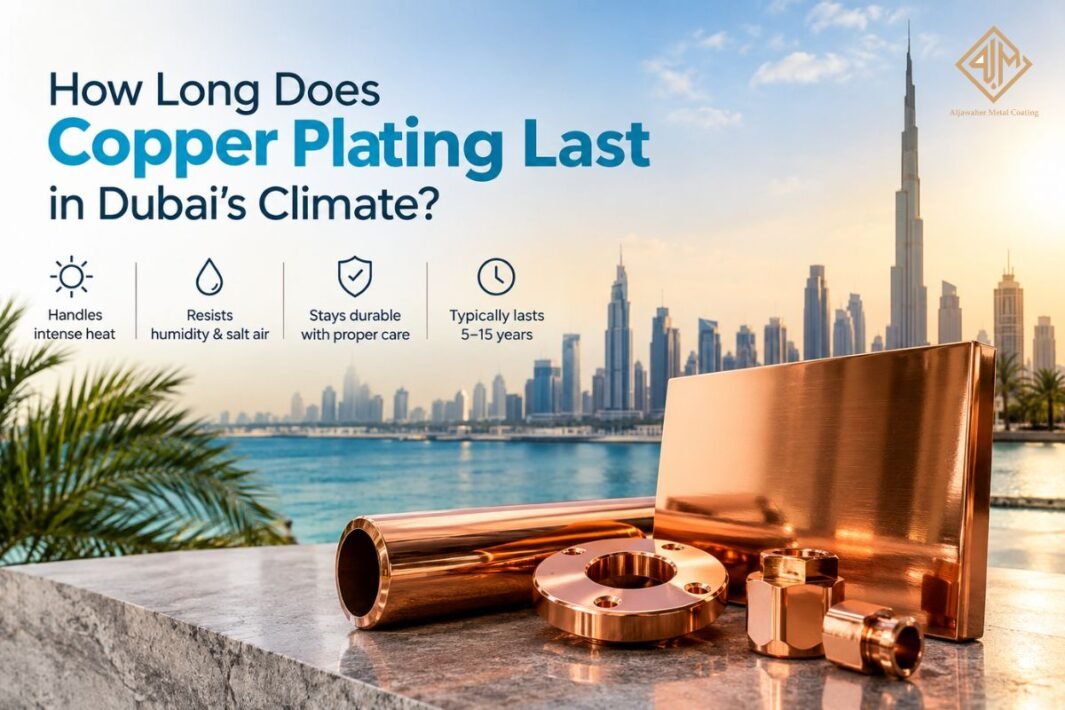
Table of Contents
- Key takeaways
- What is the typical lifespan of copper plating?
- Why is Dubai’s climate hard on copper surfaces?
- How does coating thickness affect durability?
- Why surface preparation and application quality matter?
- Protective topcoats and overlayers
- How to extend the life of copper plating?
- When does replating become necessary?
- Final thoughts
- Frequently asked questions
Copper plating in Dubai can provide years of durability if applied correctly, sealed properly, and maintained. The lifetime of copper plating depends on various aspects, including the object, thickness of the plating, coating type, and exposure to temperature, sand, and salt. Dubai’s climate is harsher than in many other regions; thus, one should pay more attention to the plating process in this area compared to other mild and dry areas.
Aljawaher Metal Coating in Dubai has experienced this trend many times: plating is not the only consideration that matters. The way the copper plating holds up depends on other factors as well, including advanced preparation and plating thickness.
Key takeaways
- For longevity, ensure the environment, thickness, and topcoat are right for the job.
- Salt, humidity, dust, and heat from Dubai accelerate tarnishing and corrosion.
- Surfaces that are clean and properly prepared stick better and are less likely to peel.
- Regular cleaning and timely repair are cheaper than replacing your jewelry prematurely.
What is the typical lifespan of copper plating?
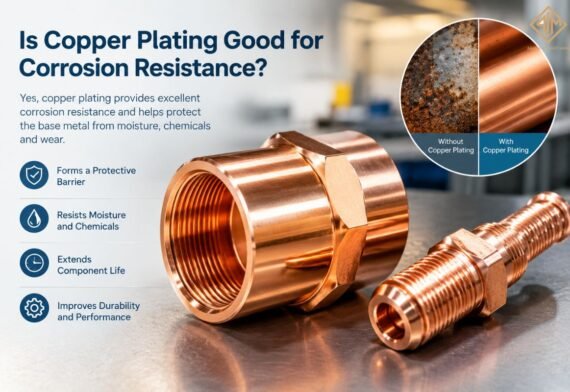
Copper plating isn’t made to last forever. Its lifespan will vary depending on the copper item and your protection. Copper which is used as an ornamental surface indoors will likely last much longer before corrosion begins compared to a copper surface outdoors. Copper oxidises when exposed to air and will tarnish more quickly in the humid, salty weather of Dubai’s coast.
Hence, copper is frequently a base coat, instead of a final coating. Often, industrial parts are coated with a layer of nickel or chrome over the copper to enhance its wear- and corrosion-resistant properties.
Therefore, indoor copper-plated items that stay dry can hold their color for years. Outdoor items can become tarnished and develop spots more quickly if not properly coated and maintained. How long it lasts really depends on the environment, protective coating, and how it is taken care of. Copper plating services in Dubai can guide you better.
Why is Dubai’s climate hard on copper surfaces?
Dubai has more than one condition that takes a toll on exposed metal. They all attack copper differently.
- Heat and Temperature Swings
During the day, high temperatures make the metal and its coatings expand and contract. If this cycle repeats enough times, the bond between the copper and the base metal can become weakened in areas where the copper and base metal have different rates of expansion. Heat can accelerate any chemical reaction that causes tarnishing.
- Humidity and Condensation
Humidity comes in at number one. Morning condensation on cool surfaces, especially in air-conditioned spaces next to humid outdoor air, leaves moisture behind. The water on copper promotes oxidation and tarnishes uneven spots.
- Coastal Salt and Chlorides
Dubai’s coastal setting indicates the presence of salt-drenched air in most of the buildings and equipment. In the case of copper alloys and thin plating, chlorides are very corrosive. Salt deposits do not cause corrosion directly. When it comes to cleaning, items outside of workshops and closer to the ocean need to be cleaned much more often than those inside the workshop.
- Dust and Sand
Dust and sand are two phenomena in the Emirates. Dust settles on the surface and retains humidity, which allows the chlorides to stay in contact with the metal. Blowing sand also creates micro-scrapes that eventually wear off the surface layer.
| Environmental Factor | Effect on Copper Plating | Practical Response |
| High heat | Faster tarnish, thermal stress at the bond | Use suitable topcoats, avoid trapped heat |
| Humidity and condensation | Oxidation, dull or uneven patches | Improve ventilation, dry surfaces after cleaning |
| Coastal salt | Pitting, spotting, accelerated corrosion | Rinse regularly, use protective overlayers |
| Dust and sand | Abrasion, trapped moisture | Clean on schedule, use wipe-down routines |
How does coating thickness affect durability?
Thickness is one of the most critical plating durability factors. A thin layer of copper may be good when new, but will have less material to wear away before the base material is exposed. When the base is exposed to air, corrosion can migrate under the coating.
Moreover, thickness should be determined by the application of the part and should not be based on tradition. Any part subject to sliding contact, abrasion, or outdoor exposure will have to be thicker than an ornamental part which is not exposed to these conditions. It is always important to discuss the desired service environment with the client prior to setting the plating specification. This is not always the case, however, when it comes to “thicker.” If not controlled correctly, too thick may also add to the cost, the size, and sometimes result in poor adhesion.
Why surface preparation and application quality matter?
The majority of the plating failures in early life are not due to the copper. Their beginnings are poor. Oil, oxide, or polishing residue left on the surface will prevent a good bond with the copper. The outcome can be peeling, blisters, or even coverages that seem to be good at first and break down over the months.
For successful preparation, the following is typically included:
- Careful degreasing of oils and handling residue
- Care should be taken to clean and pickle the materials to remove oxides.
- If the bath is not activated correctly before it is used, the layer will not form properly.
- Controlled rinsing with no carry-over of contaminants between stages.
The quality of the application is of equal importance. All parameters of bath chemistry, current control, temperature, and rinsing should remain within specification. Small deviations can create an acceptable surface, but with poor adhesion or with uneven deposits. This is the reason: Process Control and Inspection are more important than speed.
Protective topcoats and overlayers
In most outdoor and industrial environments, copper must be protected. There are two typical ways of doing this.
- One is a layer placed on top of the copper, such as nickel or chrome. This provides hardness, wear resistance, and greater surface stability. These finishes are often applied to a layer of copper, which is used as a levelling and bonding layer beneath them in many industrial components.
- The second is a clear protective transparent overcoat, such as an appropriate lacquer set on the finished copper. Topcoats help to delay tarnish and protect the surface from moisture and salt. They do not last, however. These break down when cleaned, from the sun, and by abrasion and must be checked and reapplied as necessary.
- The right choice depends on the part. Frequently used decorative pieces may require a different solution than a structural component in place to withstand the weather. The topcoat should also be compatible with the copper and the temperature at which it is expected to be used.
How to extend the life of copper plating?
Often the most economical solution to protect copper plating is to keep it in good condition. There are obvious differences in the conditions in Dubai that can be achieved by simple habits.
- Use a pH-neutral detergent and clean water to clean surfaces regularly.
- Wash off salt deposits, particularly from sea air or sea spray.
- Dry surfaces after washing to minimize water spots and condensation effects.
- Don’t use abrasive pads, strong acids, or harsh chemicals that will remove the finish.
- Look for signs of initial tarnish, spotting, or wear, especially at edges and contact points.
- Wherever possible, avoid prolonged contact with wet surfaces.
The best metal coating company in Dubai, like Aljawaher Metal Coating, also suggests a basic inspection plan for industrial components. It’s a good idea to inspect a few parts each quarter to find small issues before they become major repairs.
When does replating become necessary?
Sometimes replating is the proper course of action, but it should be done after a check, not an educated guess. Common signs include:
- Underlying materials that are exposed in areas where the original surface has been abraded.
- Blistering, flaking, or peeling of the coating
- Pitting or corrosion spots that are seen throughout the sample
- Uneven, dull, or stained, which does not respond to cleaning
- Dimensional inaccuracies of precision parts
The cause of failure would be determined before replating. The problem could be either inadequate preparation or application of an improper topcoat, and it may be necessary to replate the part without correcting the source of the problem to get the desired and satisfactory results. A good coating provider will analyze the part, discuss what happened, and decide the correct coating process for the next part.
Final thoughts
It is possible for copper plating in Dubai to be successful in the climate, but only when planned for that environment. The combination of heat, humidity, salt, and dust reduces the service life of an unprotected surface. The greatest benefit of all is the application of the correct thickness, process control, and surface preparation, plus the addition of an overlayer or topcoat as necessary for the application.
Therefore, the regular cleaning and inspection process helps to prevent small issues from becoming large failures. Combined, copper plating can provide years of reliable, attractive, and functional performance. In Dubai, having a conversation with a more experienced coating provider early can help to get the finish right for what the working environment will look like, and there is no better place to gauge the durability of a project.
Frequently asked questions
It is dependent on thickness, topcoat, use and exposure. In coastal areas, indoor parts will last much longer than outdoor parts. The term of use cannot be guaranteed without knowing the environment.
Yes, copper does tarnish in the presence of humidity and air. In addition, regular cleaning and application of an appropriate protective topcoat significantly slow this process.
The most commonly occurring cause of peeling is inadequate surface preparation, contamination during processing, or improper bath control. Thermal stress may also be a factor if the coating system is not appropriate for the application.
Copper may be used outdoors, but typically requires an overlayer or topcoat. It will most likely tarnish and corrode at a much faster rate in Dubai’s salty and humid environment without protection.
Not always. The thickness should be the same as the function of the part. Unless controlled, excess thickness can cause increased cost, dimensional issues, and adverse adhesion.
Regular cleaning is essential for outdoor and coastal sections, and may be more frequent than for indoor sections. The simplest way to go is with a simple schedule based on exposure.