-
aljawahermetalcoating
- October 8, 2026
- No Comments
Why Is Hard Chrome Plating Used for Industrial Components?
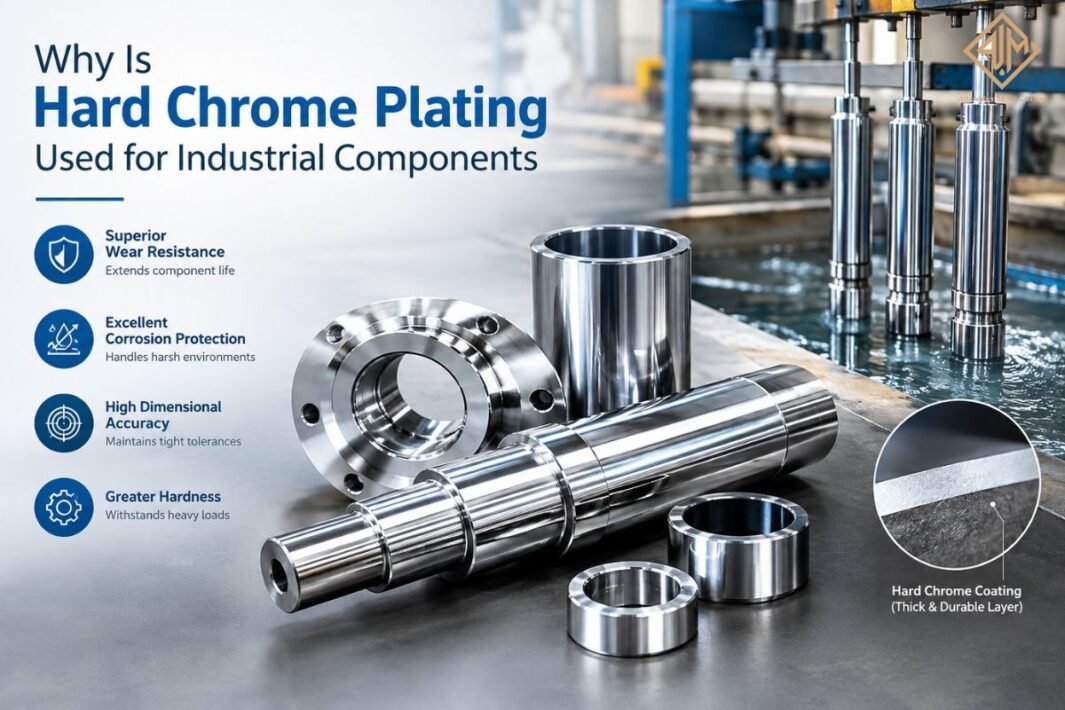
Table of Contents
- Key takeaways
- What is hard chrome plating?
- Why do industries choose hard chrome for components?
- Where is hard chrome plating used in industry?
- How durable is hard chrome plating?
- What should you check before plating a component?
- When is hard chrome not the right choice?
- How to choose a hard chrome plating provider?
- Bottom line
- Frequently asked questions
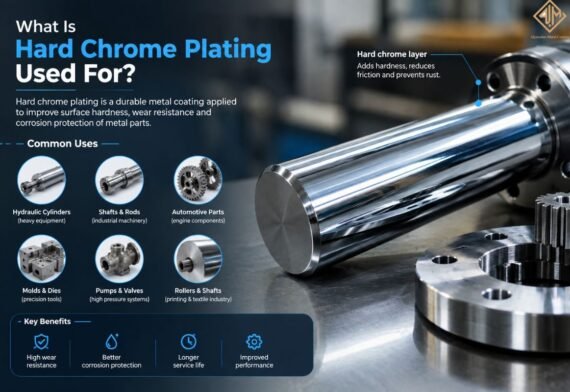
Hard chrome coating is a popular application of industrial coating because it deposits a thin, very hard, low-friction, wear-resistant layer that also protects against corrosion and galling and can restore worn parts to size. Aljawaher Metal Coating offers hard chrome plating in Dubai for other metals like rollers, shafts, piston rods, and moulds.
Scoring hydraulic rods, wearing rollers flat, sticking moulds- if they fail, most failures happen on the surface and not within the part. Hard chrome manages the surface. This article explains the process, where it has an advantage, and what to check before parts go for plating.
Key takeaways
- Hard chrome provides a smooth, hard surface to slide, rotate, or rub on steel components.
- Worn shafts, rods, and rollers can be restored using chrome rather than replaced.
- Results are based on surface preparation, thickness, and finish, not just the plating bath.
- Test every part first to make sure it is suitable. For the base material or the working conditions.
What is hard chrome plating?
Hard chrome plating is an electroplating process also known as industrial or engineering chrome. The part is prepared or cleaned, then immersed in a chromium plating bath and used as the cathode. Electricity is passed through the part, depositing chromium.
It’s different from decorative chrome. Decorative chrome is very thin and has a layer of nickel and copper underneath it for looks. Hard chrome is a heavier deposit and, in most cases, is applied directly onto the substrate because the item is use-related. Hard chrome plating services in Dubai will be helpful.
Thickness depends on the task. A light layer of protective wear may be just a few tens of microns. Restoring a worn shaft journal might require hundreds. The final layer usually is somewhere in the order of 800-1,000 HV (Vickers scale), depending on bath and process parameters, and is substantially harder than most steels used for shafts and rods.
Why do industries choose hard chrome for components?
Engineers seldom specify hard chrome for one reason only. It tends to solve several surface problems at once, which is why it has stayed in use for so long.
- How does it improve wear resistance?
Sliding between sealing rings, bushings, or other metal surfaces wears material away by scraping and adhesion at a much slower rate. A hard surface effectively opposes both modes of wear. In Dubai, fine grains of sand and dust penetrate just about everything, and a smooth, hard rod sliding through a seal scores far less than an uncoated one.
- What does it do for corrosion resistance?
Chromium generates a thin, corrosion-resistant oxide film that withstands many chemicals as well as general atmospheric attack. However, hard chrome has fine microcracks. A thin layer over plain steel does not fully seal the surface, and protection against salt or humidity attack is related to thickness and sometimes relies on a nickel undercoat.
Never specify full marine-grade protection with chrome alone. When parts are to be exposed to salt spray, consider the environment with the plater before making the specification.
- Why does lower friction matter?
Chromium also has a low friction coefficient and high resistance to galling and seizure. For a hydraulic rod, that results in less seal wear and smoother movement. It eases moulded part release and reduces buildup on the cavity surface for plastic and rubber moulds.
- How does it restore worn dimensions?
This is where hard chrome can really make economic sense. A shaft which is ground 0.1mm oversize can be plated, then ground or lapped back to the original size tolerance, restoring the original core and fit, and saving the cost and lead time of new components.
Restoration has its limits. Bent shafts, cracked sections, and heavy section loss are not problems that can be plated, and a good plater will tell you so right away.
Where is hard chrome plating used in industry?
Hard chrome appears in applications where a steel surface interfaces with another surface or needs to be particularly resistant to wear for many hours of use.
| Component | Why hard chrome is used | Problem it addresses |
| Hydraulic and pneumatic piston rods | Hard, smooth surface that protects seals | Scoring, oil leaks, seal wear |
| Cylinder liners and bores | Wear resistance with low friction | Bore wear, loss of sealing |
| Rollers and calender rolls | Durable, polishable surface | Surface wear, product marking |
| Moulds and dies | Release properties and wear resistance | Sticking, edge wear |
| Shafts and journals | Dimensional rebuild, wear resistance | Undersize, scoring |
| Valve stems and spools | Smooth, hard sliding surface | Galling, leakage |
| Automotive and machinery parts | Wear protection on moving components | Premature wear, rebuild cost |
Practical examples
The following are examples of scenarios, not projects.
- Cylinder Rod of an excavator or loader: The rod is ground down and begins to leak oil around the rod seal. The chrome is removed, and the rod is re-plated, re-ground, and repolished to the proper size. The cylinder is returned to use.
- Packaging or printing roller: After years of contact, some surface wear is inevitable, and the quality of print or sealing is not consistent. Plating and polishing does not replace the roller body, it provides a uniform surface.
- Plastic injection mould: The parts start to cling, and edges of the cavity begin to wear. The hard chrome helps prevent sticking and prevents damage to the steel surface below, which is important for long production runs.
- Pump or machinery shaft: Bearing Seat is worn out. The seat is raised using chrome and then ground to nominal measurement, rather than being machined down and being fitted with oversized parts.
How durable is hard chrome plating?
Hard chrome, when properly applied, will last a long time in service but cannot be given a single value for each part. Load, lubrication, contamination, surface finish, and how well the plating bonded to the base metal in the first place are all essential to life.
Moreover, the vast majority of early failures are due to the preparation and not the chrome itself. Roughing or activation is poor, resulting in poor adhesion and the layer flakes. When the damage exposes the steel through the microcracks, the corrosion can work its way under the steel.
A few habits extend plating life:
- Maintain clean rods and avoid impact and weld spatter.
- Replace worn or hardened seals before they cause damage to the surface.
- Properly store long rods to prevent bending or knocking.
- Regularly check plated surfaces, not just after failure.
What should you check before plating a component?
There are a few decisions you make before plating that save lots of trouble afterwards.
- Base material: Carbon or alloy steels are used. Plating can be done on stainless steel, cast iron, and aluminium; however, different material preparation is required for each type of material, and the plater must be aware of the type of metal.
- Plating thickness: Set a part that requires grinding and indicates its desired requirement. The thinner, the more likely to wear out. Too thick results in cost and may crack or chip at edges.
- Final tolerance and surface finish: Determine the desired size and grain of the finished product. The thickness of the plating and the process of grinding, lapping, or polishing are usually combined, as they are frequently done after plating.
- Hydrogen embrittlement: Very high strength steels may be subject to embrittlement after plating. These parts are typically baked shortly after plating to drive out any trapped hydrogen. Indicate steel grade and hardness to ensure correct procedure is followed.
- Condition of the part: Inspect prior to plating for cracks, deep pitting, heavy corrosion, and straightness. Damage to the structure will not be hidden by Chrome.
- Edges, threads, and keyways: Chrome builds up on sharp edges and corners. Mask areas not to be plated.
- Inspection and documentation: Request thickness measurements and a record of what was performed, particularly on safety-critical and high-value parts.
When is hard chrome not the right choice?
Hard chrome is a great choice, but not for all.
- Upon severe impact, hard, thin layers can chip off.
- The high operating temperatures can cause softening in chrome and diminish its benefit.
- If a constant salt-water immersion is required, a different coating system may be called for.
- Many local areas have strict regulations on the use of hexavalent chromium, and therefore the process needs to be conducted under strict environmental and safety controls. In some applications, other alternatives like thermal-spray carbide coatings are available.
Furthermore, a good plater will know whether there is another coating that will suit your component better and will tell you so, and it is good to know that suppliers will be honest.
How to choose a hard chrome plating provider?
Many buyers begin their search for the best metal coating company in Dubai first and foremost. In practice, the key is the one that’s suited to your part: a plater who asks questions about the base material, tolerance, and working environment before quoting a price rather than sending a price off a photo.
Questions worth asking any supplier:
- Do they have experience with your type of component, such as long rods, large rollers, or moulds?
- Will they be able to accommodate your part’s length and weight?
- How do they measure and record the thickness of plating?
- In-house grinding and finishing, or sent out?
- How do they proceed in cases of strong steels?
- How do they deal with the stripping and replating of chrome on used parts?
- How long do you think it will take you to work out your job?
Additionally, proximity matters too. For heavy shafts and long cylinders, freight, handling and downtime are real costs and a search for hard chrome plating near me makes sense. The ability to have access to visit, discuss the job, and inspect parts before and after plating is a practical benefit.
Because Aljawaher Metal Coating provides all kinds of chrome, nickel, gold, silver, and brass plating, they can advise on which type of coating is suitable for a component and not just assume. Send a drawing or sample, the base material, the working conditions, and a description of the failure for a worn part. That’s all that’s needed for a helpful first discussion.
Bottom line
Hard chrome plating is still a good choice because it addresses the surface problems that make industrial parts wear out: abrasion, friction, corrosion, and lost dimension. It prolongs the life of components and, in many instances, restores worn parts to serviceable condition instead of replacement.
It is most effective when the base material, thickness, finishing, and operating conditions are taken into account. For Dubai companies seeking a sensible discussion on their parts, Aljawaher Metal Coating is an easy way to get started.
Frequently asked questions
For use in the protection and restoration of industrial components like piston rods, shafts, rollers, moulds, and valve components which are exposed to wear, friction, or corrosion.
No. Decorative chrome is thin and for appearance. Hard chrome is thicker and used for wear resistance, low friction, and dimensional rebuild.
This depends on the job. Light wear protection could require a few tens of microns, whereas rebuilding worn areas could require rebuilding to several hundred microns prior to finishing.
Often yes. The shafts, rods, and journals can be rebuilt and ground back to size if they are straight, sound, and free of deep cracks.
It is not completely resistant to corrosion, but it also contains microcracks that eliminate the barrier effect when used alone. Thickness and underlayers are important in harsh and salty environments.