-
aljawahermetalcoating
- September 28, 2026
- No Comments
Copper Plating vs Nickel Plating: Which Is Better for Your Metal Parts?
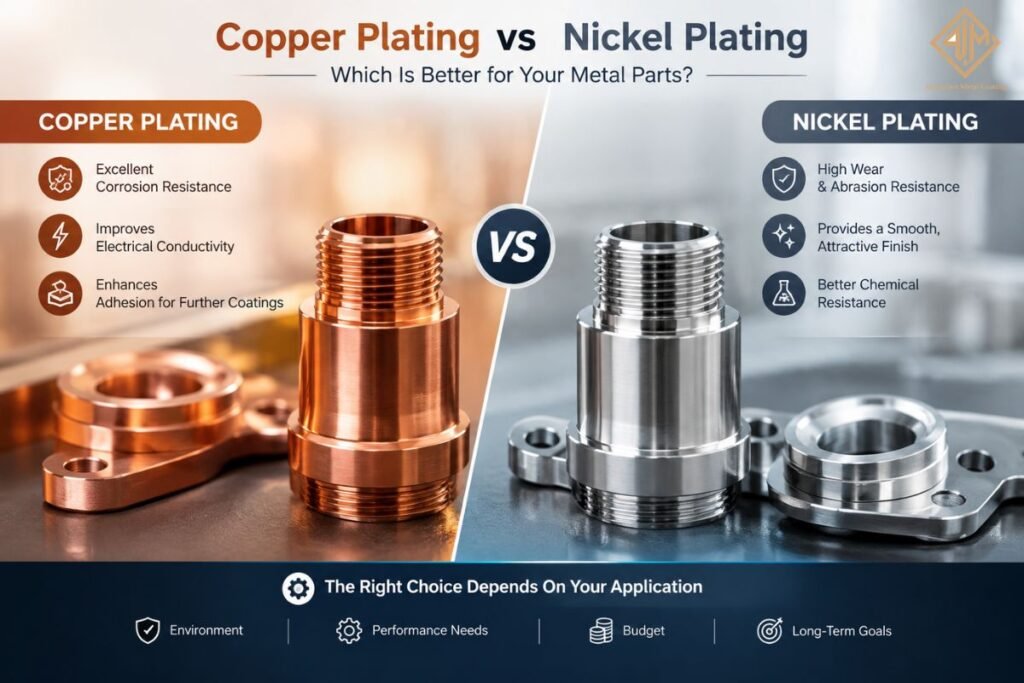
Table of Contents
- Key takeaways
- What is copper plating?
- What is nickel plating?
- Copper plating vs nickel plating: feature-wise comparison
- What are the typical applications for each?
- How do the costs compare?
- Which metal parts suit each process?
- What is electroless nickel plating?
- Copper plating vs nickel plating: comparison table
- How to choose the right plating for your application?
- Final word
- Frequently asked questions
When you need conductivity or a smooth underlayer for any subsequent coatings, copper is the answer. If you need a high resistance to moisture, wear, and longevity, thanks to nickel. Most industrial components actually use the two materials together, with a copper base and a nickel coating on it, meaning that it is possible to get both properties without compromise.
Key takeaways
- Copper is a good conductor of electricity and bonds well to many substrate metals but has a tendency to tarnish.
- Nickel is known for its good corrosion and wear resistance properties in tough working conditions.
- Electroless nickel adheres to holes and intricate areas evenly, as it does not need an electrical current for the plating process.
- Making the right choice depends on the purpose the part needs to serve, its environment, and how well it should work.
What is copper plating?
Copper plating is an electrochemical process that coats the base metal with a thin film of copper. The part is placed in a copper sulfate bath, and current is passed into the solution, which removes copper ions from the solution and deposits them on the surface of the part.
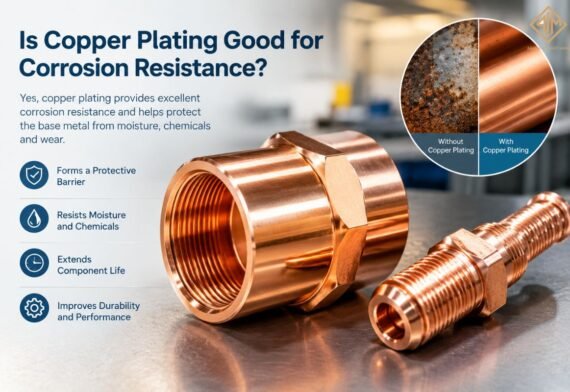
However, it is a soft metal, has high conductivity, and is easily welded to steel, brass, and zinc die-cast parts. It is a lousy finish because copper will tarnish in just a few weeks when exposed to air. That is why it is often observed as a base coat, as it will smooth out any small surface imperfections and provide something for the top coat to adhere to.
People usually request copper plating services in Dubai for electrical components, as a decorative base coat or to prepare something for additional finishing.
What is nickel plating?
Nickel plating can be done either electrically or without any electric current (more on that later). In any case, nickel is harder than copper, and it is much more resistant to corrosion and chemical attacks.
Two common finishes:
- Bright nickel – shiny and decorative, which is usually under a chrome layer.
- Bright or shiny nickel – shinier and with higher reflection, used more on the decorative parts
Moreover, automotive garages, machinery manufacturers, and structural engineering companies have regular demands for nickel plating services in Dubai, primarily because they use components that are regularly subjected to friction and moisture.
Copper plating vs nickel plating: feature-wise comparison
- Which has better corrosion resistance?
Nickel, by a wide margin. Copper rusts rapidly and loses its luster and color, becoming greyish-green in a few weeks after exposure. What it is, though, is a stable layer of oxide, which is why it’s typically the outer layer of a multi-layer system as opposed to copper.
- Which is harder and more wear-resistant?
Nickel again. Nickel does not scratch or wear away when rubbed; copper does. That is why parts which are stressed mechanically, like gears, are not copper-coated but nickel.
- Which has better electrical conductivity?
Copper, no contest. It is one of the best conductors used in the plating process, and it is still being used in connectors and busbars, although it requires protection from the elements.
- Which looks better?
Depends on your intent. Bright nickel finishes with a silver, shiny appearance that will maintain it. Copper is warm and reddish in its natural state and will lose its color without being lacquered or plated.
- Which has better adhesion?
Copper. It has good bonding properties with steel, zinc alloys, and brass, which is why it is used as a strike layer underneath nickel or chrome. It provides a firm base for the layers underneath.
What are the typical applications for each?
Copper is commonly found in:
- Connectors and busbars (electrical).
- Before nickel or chrome plating, as an undercoat.
- Printed circuit boards
- Antique red items for decoration
Nickel is present more in:
- Exposed automotive parts to road conditions.
- Machinery components
- Fasteners, brackets, structural hardware.
- Base layers under chrome
How do the costs compare?
Copper is less expensive on its own, but is not usually used on its own for any practical purpose. Nickel, particularly electroless nickel, is more expensive due to the requirement for more stringent control of the chemical bath. Still, the added corrosion or wear resistance typically outweighs the part’s working life.
Which metal parts suit each process?
Copper can be used on steel, brass, and zinc die-cast, and it’s particularly good for conductivity or a smoother undercoat, more than toughness. Nickel is more versatile with steel, aluminum, and copper alloys, and is the more recommended option when the part is likely to experience friction or repeated handling.
What is electroless nickel plating?
Electroless nickel plating does not require any electrical current. The reaction is instead driven by a chemical reducing agent, which allows for an even nickel coating over the entire part, including recessed areas, threads, and shapes that are not typically coated even by electroplating.
The actual selling point is the even coverage. It is crucial for:
- Parts that have irregular shapes, deep recesses, or blind holes
- Items that require uniform hardness throughout, not just on flat surfaces
- Jobs where appearance is not as important as uniform corrosion protection
Furthermore, the use of electroless nickel plating services in Dubai is typically requested by manufacturers who are creating precision components and valves, as dimensional accuracy is more important than the finish appearance.
Copper plating vs nickel plating: comparison table
| Property | Copper Plating | Nickel Plating |
| Corrosion resistance | Low (oxidizes easily) | High |
| Hardness/wear resistance | Soft, low wear resistance | Hard, good wear resistance |
| Electrical conductivity | Excellent | Moderate |
| Appearance | Reddish, dulls over time | Bright, silver, holds shine |
| Adhesion to base metals | Very strong | Good, often applied over copper |
| Typical use | Undercoat, electrical parts | Functional and decorative outer layer |
| Relative cost | Lower as standalone process | Moderate to higher |
| Best suited for | Steel, brass, zinc die-cast | Steel, aluminum, copper alloys |
How to choose the right plating for your application?
- Carrying current? Copper’s the answer.
- Sitting outdoors or near chemicals? Nickel protects better over time.
- Got a complicated shape, threads, or deep recesses? Electroless nickel coats evenly no matter what the part looks like.
- Appearance matters and needs to last? Bright nickel holds its shine longer than copper does.
- Multiple coats going on? Copper first, nickel on top is a common combination, since you get copper’s grip and nickel’s durability in one part.
Therefore, Aljawaher Metal Coating works with manufacturers, automotive workshops, and industrial businesses across Dubai, considering the base metal, what the part will face day to day, and the finish it needs.
Final word
Copper and nickel plating solve different problems. Copper gives you conductivity and strong adhesion, which makes it useful for electrical parts and as an undercoat. Nickel gives you corrosion resistance and hardness, which is why it holds up on functional and decorative parts alike. Plenty of parts end up with both, layered to cover each other’s weak points.
If you’re not sure which one fits your part, Aljawaher Metal Coating, the best metal coating company in Dubai and plating provider, can help you work through it based on the base metal, what the part needs to survive, and how it’s used. They handle copper, nickel, and electroless nickel processes, so there’s room to match the coating to the job rather than the other way around.
Frequently asked questions
Not universally. Nickel wins on corrosion and wear resistance; copper wins on conductivity and adhesion.
Yes, and it’s common. Copper goes on first as an undercoat, then nickel on top.
Nickel. It resists oxidation and moisture much better than bare copper.
Usually, yes, but the even coating thickness on complex parts often makes up for the cost difference.
Yes, noticeably so, which is why electrical components almost always use copper.
It can, but aluminum’s natural oxide layer gets in the way of adhesion, so it needs a pretreatment step first.
Nickel. It’s harder than copper and holds up better to everyday handling.
Generally yes, though it depends on exactly which chemicals and at what concentration.
Even thickness everywhere on the part, regardless of its shape, since there’s no current distribution to worry about.
It comes down to function, environment, and base metal. Talking it through with a metal coating provider who knows your industry helps narrow it down.