-
aljawahermetalcoating
- September 11, 2026
- Comment (1)
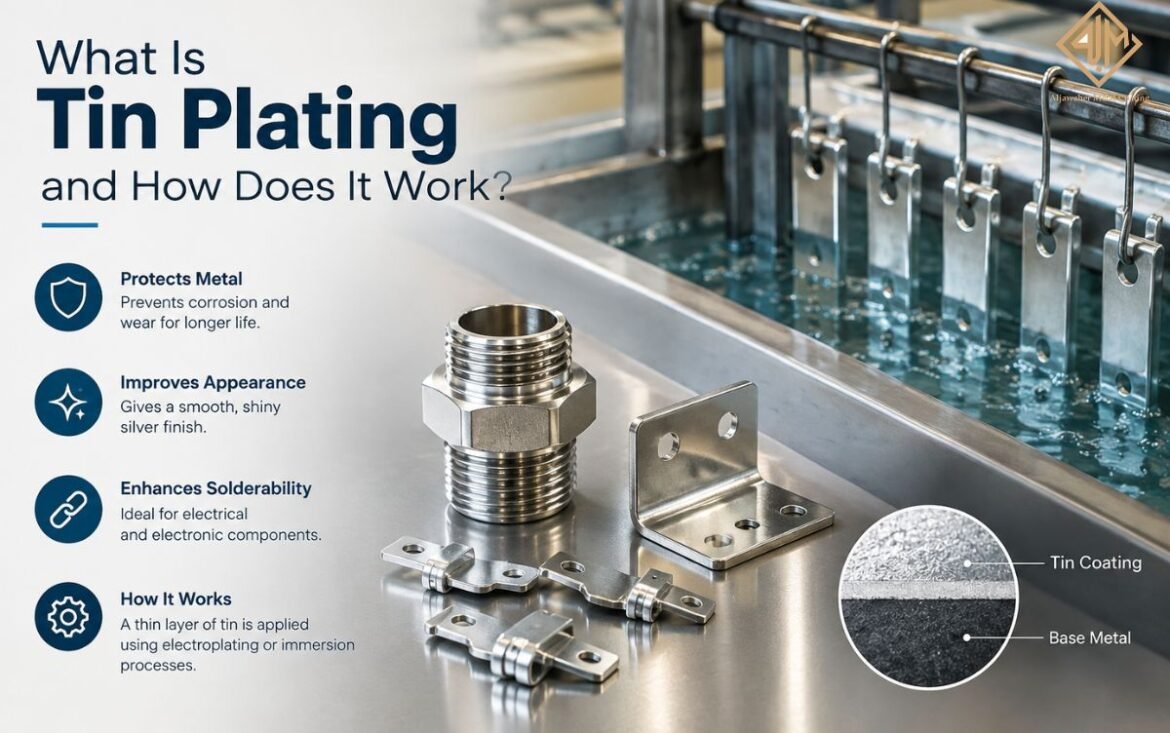
What Is Tin Plating and How Does It Work?
Table of Contents
- Key takeaways
- What exactly is tin plating?
- How does the tin plating process work?
- Why do manufacturers choose tin coatings?
- Where is tin plating commonly used?
- Tin plating vs other metal finishes
- What affects the quality of a tin coat?
- How to choose a metal coating company?
- Final thoughts
- Frequently asked questions
Tin plating is the process of depositing a thin layer of tin on a different metal to improve corrosion resistance and increase solderability. Tin coating provides a protective surface on exposed metals against moisture, oxygen, and chemicals that can cause rust formation and deterioration of the metal. Electrolytic tin plating is the principal method of tin plating used in the industry.
Businesses in need of reliable tin plating services in Dubai often prefer this method when it comes to electrical equipment, food packaging products made from food, and connection devices, since both electrical conductivity and protection against corrosion are required in such appliances.
Key takeaways
- Tin coating protects against corrosion and helps in the easy soldering of metals.
- Electroplating is the most common method, while hot-dip tinning can be used in food-related applications, such as tin cans.
- The thickness, current density, and the cleaning post-process determine the life of tin plates.
- Tin plating services are utilized in various industries in Dubai, including automotive, electronics, marine, and food.
What exactly is tin plating?
Tin Plating is the process of depositing a thin film of an element (tin) onto a substrate (metal). The base metal or substrate maintains the same strength, weight, and cost profile as the original, and the tin layer is responsible for resisting corrosion.
One of the earliest metals to be used for plating was tin, and it dates back to the iron food cans coated in tin from the early 1800s. It’s not because of any fondness for the past that it has survived 200 years. Tin is non-toxic, does not react with most food, does not react with oxygen at room temperature, and will solder cleanly. This is difficult to come by, even with the newer coating technology that is currently available.
Moreover, pure tin plating normally comes in the range of 2.5 to 15 microns, based on the application. The thickness of the coating required for electronic connectors may only be a few microns, whereas parts that are going to be exposed to salt water or industrial chemicals may require a thicker coating for the actual corrosion protection.
Is tin plating the same as galvanizing?
No. Galvanizing is with zinc, and it is intended primarily for structural steel in the outside environment. Tin plating is not used to protect steel for heavy duty outdoors, but for its soldering properties, food-safe qualities, and a smoother plating job for smaller steel components.
How does the tin plating process work?
Nowadays, most tin plating is done by an electrochemical process, which is a controlled chemical and electrical process. The typical flow of the workshop is as follows:
- Surface preparation: The part is treated to remove the oil, followed by acid or alkaline cleaning to remove oxide and contaminants. This is the biggest reason for plating failure regardless of the quality of the equipment.
- Rinsing: The part is cleaned in several rinse baths to wash away the cleaning chemicals that may get into the plating bath.
- Electroplating bath: The cleaned part is dipped in a tin salt solution (usually stannous sulfate or stannate) with a tin anode. DC can be used to deposit tin ions on the part’s surface.
- Thickness control: By changing the current density and the time of immersion, the desired thickness of the coating, typically in microns, can be achieved.
- Rinsing and drying: The plated part is rinsed once again, dried, and may be subjected to a reflow or brightening process to further enhance the appearance and solder wetting.
- Quality inspection: The thickness testing, adhesion testing, and visual inspection are performed to ensure the coating is within spec before the part ships.
What’s the difference between hot-dip and electroplated tin?
Hot-dip is used for thicker, less uniform tinning of parts, such as food cans, which are immersed in molten tin. Most precision parts are electroplated to achieve a smoother and more uniform surface, and to control thickness to within a micron.
Can tin be applied without electricity?
Yes, with the use of a chemical reducing agent (electroless plating). It is slower and often more costly, but it will provide a more uniform coating on complex shapes that electroplating can’t evenly coat.
Why do manufacturers choose tin coatings?
Tin is not the lowest-cost metal or the easiest to plate, but some practical advantages continue to make it a popular choice of plating
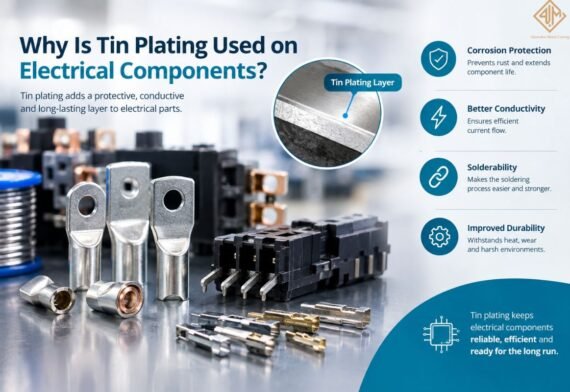
- Corrosion resistance- Tin oxidizes readily to a protective film that prevents further corrosion by moisture and most acids.
- Excellent solderability- Soldering is very easy on parts that are tin-plated, crucial for PCB production and electrical connectors.
- Non-toxic and food-safe- Tin-plated steel is still used in canning because the acidity of most foods will not react with tin.
- Good electrical conductivity- Not as conductive as silver or gold, but still good enough for most connectors and much less expensive.
- Ductility- Tin is pliable enough to bend and shape without cracking, which is necessary for parts that are crimped and/or folded after plating.
Furthermore, when businesses are shopping for tin plating in Dubai, they may consider these aspects in addition to the cost of the material, as tin is also in the middle price range between zinc and gold and silver plating, and compromises between protection and conductivity for parts that require both.
Where is tin plating commonly used?
There are more industries that use tin plating than one might think.
- Electronics and electrical: Tin plating is essential to ensure solderability and corrosion resistance in wet or marine humid atmospheres in connectors, terminals, PCB components, wire leads etc.
- Food and beverage: Tin-coated steel cans are still used for packaged foods, particularly acidic foods such as tomatoes and citrus that do not react with the tin and would not contaminate the food.
- Automotive: Vehicles have electrical contacts and fasteners that are often coated with tin to prevent corrosion from road salt and moisture.
- Marine and industrial hardware: Hardware subject to saltwater spray is protected by the corrosion properties of tin, but in certain marine applications, thicker coatings or other alloys may be used.
- Plumbing and food processing equipment: The tin layer is used to protect items that come in contact with food from leaching tin into the food, such as tin-lined copper pots.
Therefore, the demand for tin plating services in Dubai remains relatively stable in the metal finishing industry throughout the UAE, driven by various sectors such as construction, automotive servicing, marine activities, and electronics manufacturing.
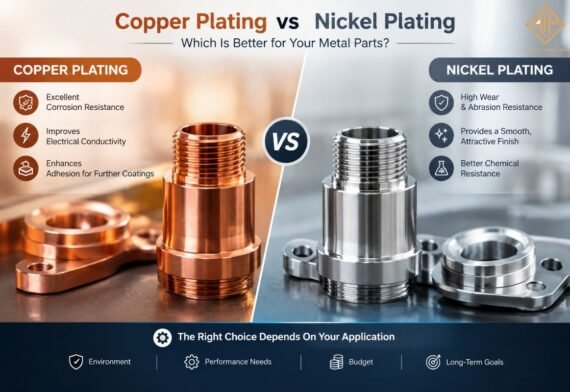
Tin plating vs other metal finishes
| Feature | Tin Plating | Zinc Plating | Nickel Plating | Chrome Plating |
| Primary use | Solderability, food safety | General corrosion protection | Wear resistance, base for other finishes | Hardness, decorative shine |
| Typical thickness | 2.5–15 microns | 5–25 microns | 5–25 microns | 0.25–1 micron (decorative) |
| Cost | Moderate | Low | Moderate | Higher |
| Food-safe | Yes | No | Limited | No |
| Solderability | Excellent | Poor | Fair | Poor |
| Best suited for | Electronics, cans, connectors | Fasteners, structural steel | Machine parts, undercoats | Automotive trim, tools |
Each finish exists for a reason, and picking the wrong one usually shows up as premature corrosion or failed solder joints within months, not years.
What affects the quality of a tin coat?
Several variables separate a tin finish that lasts from one that flakes or discolors within a year.
- Does Surface Preparation Really Matter That Much?
Yes, more than any other single factor. Oil, oxide layers, or old plating residue left on a part will prevent proper tin adhesion, leading to blistering or peeling even if the plating bath itself is perfectly balanced.
- How Does Coating Thickness Affect Durability?
Thicker coatings generally resist corrosion longer, but there’s a tradeoff. Excess thickness on connectors can interfere with fit tolerances or increase the risk of tin whisker formation, a known issue in pure tin plating where microscopic tin filaments grow over time and can cause short circuits in dense electronics.
- What Is Tin Whisker Formation?
Tin whiskers are thin, hair-like crystal growths that can form spontaneously on pure tin surfaces, particularly under mechanical stress. This is why many electronics manufacturers specify tin-lead alloys or add whisker-mitigation steps, especially for aerospace and high-reliability applications.
- Does Base Metal Change the Outcome?
Yes. Copper and brass generally plate well with tin, but steel needs a more thorough pre-treatment and sometimes an intermediate nickel strike layer, so the base metal’s iron content doesn’t migrate into the tin layer over time and discolor or weaken the coating.
How to choose a metal coating company?
Not every plating shop handles every substrate or application equally well, so a few questions are worth asking before committing:
- Do they test coating thickness after plating, not just before?
- Can they show adhesion test results or provide a quality certificate?
- Do they have experience with your specific base metal (steel, copper, brass, aluminum)?
- What turnaround time can they realistically commit to for your volume?
- Do they handle both small precision parts and larger industrial components?
Aljawaher Metal Coating handles tin, chrome, nickel, gold, and silver plating across a wide range of part sizes and industries in the UAE. Manufacturing, automotive, and electrical clients keep coming back largely because of consistent thickness control and adhesion, which is why many consider it the best metal coating company in Dubai for jobs where precision matters more than speed.
However, when a project specifically calls for tin, Aljawaher Metal Coating’s tin plating in Dubai service covers everything from small connector batches to larger industrial runs, with thickness testing built into the process rather than treated as an afterthought.
Final thoughts
Tin plating isn’t flashy, but it solves specific problems that matter: corrosion, solderability, and food safety, without introducing toxicity concerns of its own. Getting a good result depends less on the metal itself and more on how carefully the process is run, from surface prep to thickness control to post-plating inspection.
If you’re sourcing tin plating services in Dubai for a production run, connector batch, or one-off industrial component, it’s worth working with a shop that treats quality testing as a standard step, not an add-on. Aljawaher Metal Coating handles this kind of work daily across electronics, automotive, and industrial clients, and can walk you through the right thickness and finish for your specific part before any metal goes into the plating bath.
Frequently asked questions
Yes. Tin is non-toxic and doesn’t react with most food acids, which is why tin-coated steel has been standard for food cans since the 19th century.
It depends on thickness and environment, but a properly applied tin coat can last 5 to 15 years indoors, and less in harsh, humid, or saline conditions.
It’s difficult without a specialized pre-treatment, since aluminum forms an oxide layer that resists direct tin adhesion. Most shops use an intermediate zincate or nickel layer first.
Tinning wires is a specific application of tin plating, applied to bare copper wire ends to improve solderability and prevent oxidation before assembly.
Tin itself doesn’t rust, but if the coating is scratched or too thin, the base metal underneath can corrode, especially on steel substrates.
Neither is universally better. Tin suits food-safe and solderable applications, while zinc is more cost-effective for general corrosion resistance on structural steel.
This usually points to oxidation from environmental exposure, or occasionally the early stages of tin pest, a phase change that can occur at very low temperatures, though it’s uncommon in normal use.
Yes. Old plating can be stripped chemically, and the part can be re-cleaned and re-plated, which is common for refurbishing connectors or reusable industrial fixtures.
Most shops use X-ray fluorescence (XRF) testing or a magnetic thickness gauge, both of which give a non-destructive reading of the tin layer’s microns.
It offers moderate protection but isn’t always the first choice for heavy saltwater exposure, where thicker or alternate coatings sometimes perform better long-term.
1 Comment
Tin Plating: Uses, Benefits and Industrial Application
[…] a real part of why demand for tin plating in Dubai has climbed alongside construction, signage, and industrial work here. A fastener that would last a […]