-
aljawahermetalcoating
- September 1, 2026
- Comment (1)
Brass Plating on Steel, Copper, and Zinc Alloys: A Complete Guide
Table of Contents
- Key takeaways
- What is brass plating actually?
- How does the brass plating process work?
- Brass plating on different base metals
- Where is brass plating used?
- Common mistakes in brass plating
- Choosing the best metal coating company
- Expert insights
- Final verdict
- Frequently asked questions
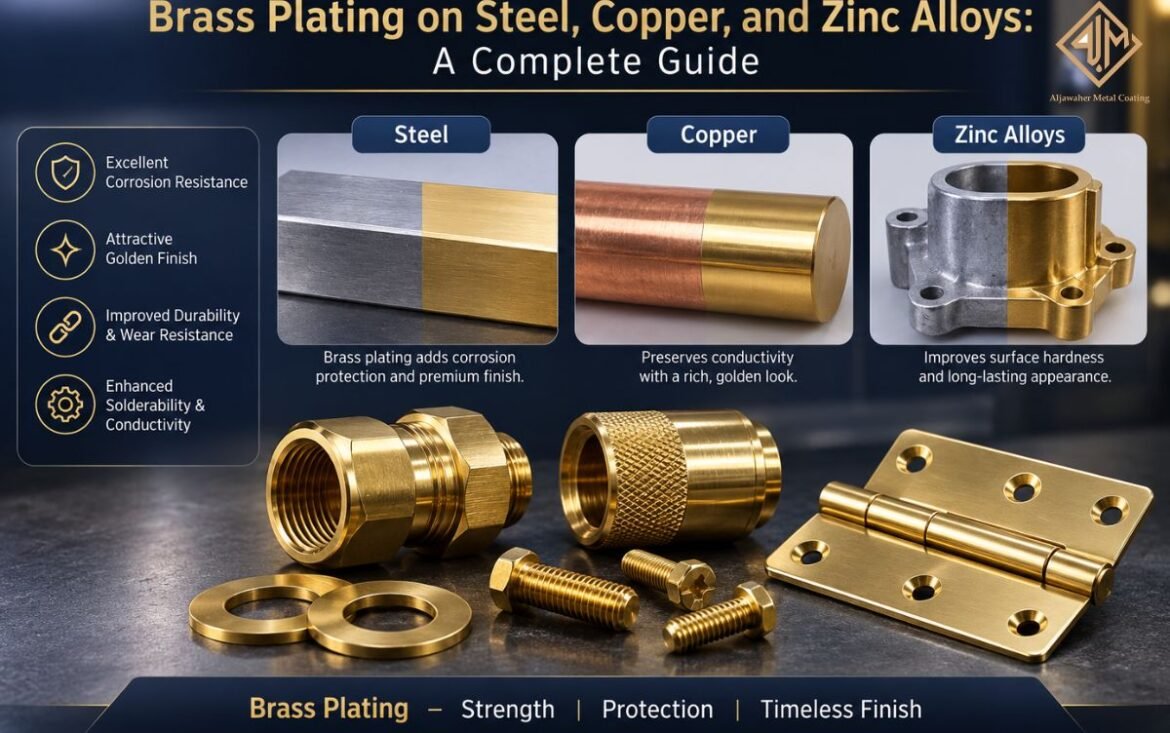
Brass plating involves placing a thin layer of copper and zinc (about 65-80% copper and 20-35% zinc) on metals such as steel, copper, or zinc alloy. Most shops apply coatings of 2-15 microns, with thinner coatings for decorative applications and thicker ones for situations where the plating must withstand rubber bonding or mechanical stresses.
Steel requires the application of a copper strike first to avoid peeling of the finish within months, whereas copper and other brass-coated metals do not require this treatment. If comparing brass plating options in Dubai, consider asking first about the degree of control exerted over the bath chemistry before considering the price.
Key takeaways
- The thickness of brass plating ranges from two to fifteen micrometers depending on the level of hardness that is required.
- Before applying brass plating, steel needs to have a copper layer applied to avoid any extensive peeling.
- Application of brass plating enables the rubber parts and components to stick better.
- When choosing a brass plating service in Dubai, make sure to check the maintenance of the tank and quality of rinsing.
What is brass plating actually?
Brass plating occurs in an alkaline bath, which can be either cyanide or non-cyanide, and that contains dissolved copper and zinc salts. The metals are deposited on the surface of the piece in one process; therefore, the temporary layer appears to be made of solid brass.
This is important for the following reason: brass creates a bond with rubber, which cannot be achieved using bare steel or zinc alloys. That is why brass acts as an interface in parts that have rubber and metal in them, such as engine mounts, bushings, and vibration isolators. Otherwise, the rubber-metal bond will be unreliable.
When it comes to color, brass is another indication of its composition. The color gets warmer when the amount of copper in the alloy reaches 70 percent, and the color starts turning pale when more zinc is added. Therefore, the resulting color indicates the level of bath control in the plating process. The best metal coating company in Dubai gives the best advice.
How does the brass plating process work?
- Surface Preparation
Any surface that’s dirty or has an oxidized surface will not bond. Equipment parts are processed for removal of any grease, rust, or scale by degreasing, acid pickling, and, if needed, ultrasonic cleaning.
- Strike Layer (Where Needed)
This is where shortcuts take place and where they will have the most costly results. Wire must get a thin layer of copper first; the deposit requires little current and is not time-consuming, but gives a good surface for bonding to the brass layer.
- Electroplating Bath
The piece enters the brass solution. Current density governs the deposition of the copper-zinc alloy. Bath temperature and pH are also crucial factors. Most industrial uses fall within the 2 to 15 micron range, while decorative applications tend towards the lower end and functional bonds towards the higher end.
- Rinsing and Passivation
During the rinsing process, the residual chemicals from the bath are washed off before the part can advance to the next step. Some tasks begin the process by applying a clear shellac coating since brass, whether plated or solid, tarnishes with air and moisture. While this coating serves its purpose, it is not something that will create permanent protection against tarnishing of brass.
- Quality Inspection
Adhesion is evaluated by doing the tape or bend tests, and thickness is measured either using X-ray fluorescence or a micrometer. Additionally, if the parts are to be used in a humid climate, some of these parts may undergo salt spray testing, which is more critical in a place like the UAE, where humidity destroys fittings faster than in most of the other places.
Brass plating on different base metals
| Base Metal | Adhesion Challenge | Typical Pre-Treatment | Common Use Case |
| Steel | Poor direct adhesion; risk of peeling | Copper strike layer required | Rubber-bonded automotive parts, hardware |
| Copper | Good natural adhesion | Minimal, light cleaning usually sufficient | Decorative fittings, electrical components |
| Zinc Alloy (die-cast) | Porous surface, risk of gassing or blistering | Nickel or copper undercoat often used | Furniture hardware, decorative fixtures |
- Steel
Steel is the difficult one. Beyond the copper strike, hardened steel fasteners carry a real risk of hydrogen embrittlement, which is why they get baked after plating to release trapped hydrogen before it becomes a cracking problem down the line.
- Copper
Copper is the easy substrate. Since brass is copper-based to begin with, the two take to each other without much fuss. This is common ground for architectural fittings and instruments that already start with a copper base.
- Zinc Alloy
Die-cast zinc is porous by nature, so plating straight onto it can trap gas under the brass layer. That shows up later as small blisters, sometimes not until the part’s already in use. A nickel or copper undercoat usually heads this off.
Where is brass plating used?
- Automotive components. Engine mounts, bushings, and other rubber-bonded parts where brass is the adhesion layer between metal and rubber.
- Decorative hardware- Door handles, cabinet fittings, light fixtures, anywhere a brass look is wanted without solid brass pricing.
- Musical instruments- Wind instrument parts often use brass plating over a base metal to shape tone and finish.
- Electrical connectors- A moderate conductivity boost plus corrosion resistance on contact surfaces.
- Marine and coastal fittings- Untreated steel corrodes fast in salt air, and this is one of the more common fixes.
Common mistakes in brass plating
Most failures trace back to one of a handful of things:
- Skipping the copper strike on steel- The most common cause of adhesion failure, full stop. It looks fine the day it’s delivered and starts lifting a few months in.
- Letting the bath ratio drift- Copper and zinc don’t deplete at the same rate during a production run. Shops that don’t test and rebalance regularly end up with color that shifts batch to batch.
- Under-rinsing between steps- Leftover chemicals from one bath carry into the next and quietly weaken the final finish.
- Skipping hydrogen bake-out on hardened steel- This one’s more than cosmetic. It can lead to embrittlement and eventual cracking under load, which is a real safety issue on structural or automotive fasteners.
- Guessing at coating thickness instead of matching it to the part- A decorative doorknob and a rubber-bonded engine mount have nothing in common, spec-wise. Treating them the same wastes material on one and under-protects the other.
Choosing the best metal coating company
Plating shops don’t all run the same quality controls, and the gap usually shows up months after the part’s been picked up, not at the counter. A few things are worth checking before you commit to any best metal coating company in Dubai:
- Ask how they manage bath chemistry- Shops that test the copper-zinc ratio regularly turn out more consistent color and adhesion than ones running on fixed time cycles alone.
- Ask about pre-treatment for your specific metal- If your parts are steel, the copper strike should be standard, not something they try to upsell you on.
- Ask for adhesion test results– particularly on functional parts like rubber-bonded mounts, not just anything decorative.
- Factor in where the part will live- Coastal humidity in the UAE speeds up tarnishing on unprotected brass, so a protective topcoat is worth asking about.
- Watch the turnaround time- Rushed cycles are one of the quickest ways to compromise thickness and uniformity.
A shop that answers these in specifics, rather than talking around them, is usually the one keeping tighter control over its process. That’s generally a better signal than anything on a brochure, and it’s the kind of thing that separates a decent brass plating service in Dubai from one you’ll be calling back in a year.
Expert insights
The biggest quality gap I’ve seen isn’t equipment; it’s bath discipline. Two shops running identical tanks can turn out noticeably different results, and the difference usually comes down to one testing and adjusting chemistry daily while the other doesn’t bother.
However, one thing worth knowing going in: brass plating doesn’t make a part more corrosion-resistant than the metal underneath it. It’s a thin functional and decorative layer, not a substitute for choosing the right base metal in the first place. If a part is going to see heavy wear or constant moisture, the plating needs to be paired with the right substrate and topcoat. On its own, it’s not enough.
Final verdict
Brass plating sits somewhere between decorative finishing and functional engineering, relevant to a door handle and an engine mount for very different reasons. Chemistry isn’t complicated in theory. Getting consistent results across steel, copper, and zinc alloy is what takes real discipline, bath control and the right pre-treatment for whichever metal you’re starting with.
If you’re sourcing brass plating in Dubai, decorative or industrial, ask about bath chemistry and substrate-specific pre-treatment before you start comparing quotes. Aljawaher Metal Coating works across all three base metals with that level of process control, worth a look if you’re weighing options for your next plating job.
Frequently asked questions
Decorative finishing, rubber-to-metal bonding in bonded components, and a measure of corrosion resistance on metals like steel and zinc alloy.
Not reliably. Steel needs a copper strike layer first, since brass doesn’t grip bare ferrous metal well on its own.
Usually 2 to 15 microns, depending on whether the job is decorative or functional.
Yes, same as solid brass. A clear lacquer topcoat slows the tarnishing but won’t stop it for good.
No. It’s a thin layer over a different base metal, so durability comes down to both the plating quality and the substrate holding it up.
It comes down to the copper-to-zinc ratio in the bath. Without regular testing and rebalancing, that ratio drifts and the color shifts with it.
Die-cast zinc is porous, so gas can get trapped and cause blistering under the brass. A nickel or copper undercoat usually prevents this.
Look for a shop that tests bath chemistry regularly, applies the right pre-treatment for your base metal, and can actually show adhesion test results on functional parts.
Yes, but hydrogen bake-out afterward is non-negotiable. Skip it, and you’re risking embrittlement and cracking under load.
It can work well, provided there’s a protective topcoat, and the base metal itself was chosen with the coastal environment in mind.
1 Comment
Brass Plating Services: Industries That Benefit the Most
[…] corrosion of uncoated metals. This is one of the reasons behind the constant high demand for brass plating in Dubai in numerous […]