-
aljawahermetalcoating
- August 22, 2026
- No Comments
Custom Gold Plating Solutions: Thickness, Finish & Applications Explained
Table of Contents
- Key takeaways
- What does gold plating actually involve?
- Thickness options and what they mean for durability
- Choosing the right finish for your application
- Where is gold plating used across industries?
- Common mistakes businesses make when ordering plating
- What to ask before you commit to a provider?
- Conclusion
- Frequently asked questions
The gold plating service in Dubai places a fine layer of gold that is generally between 0.5 and 5 microns on a base metal that can be brass, copper, or silver using a process called electroplating. The thickness needed depends on how the item of jewelry will be put into use. Everyday jewelry requires higher thickness because it requires about 2.5 microns, while decorative jewelry can go by with a thickness of only 0.5 to 1 micron.
Therefore, purity is another measure beyond thickness, and it is measured in karats, where 24k is pure gold. A quality gold plating jewelry service in Dubai will use metal testing and extensive cleaning of the base material before matching the specification for plating to the way the jewelry will be used. The work cannot comprise merely spraying the golden coating and declaring it done.
Key takeaways
- The thickness of the plating, which is measured in micrometers, determines its longevity but not its karat rating.
- Remember that jewelry worn every day needs thicker plating than jewelry shown in showcases.
- More people than you might think realize how important the base metal preparation is for the quality of adherence of the plating.
- However, a genuine gold plating company in Dubai will make sure to explain the importance of the thickness of the plating and the finish you get before giving you a quote.
What does gold plating actually involve?
Gold plating is an electrochemical operation. The item that is to be plated, a ring or a decorative panel, is placed in an electrolyte solution which contains the gold ions. Then an electric current passes through the unit, causing the ions to be deposited on the object being plated, creating a layer of metal in the process.
Moreover, base metal is more important than we think. Brass and copper are good for plating as they are conductive and easy to prepare. Silver needs some barrier layer first, usually nickel or palladium, because silver atoms can migrate into gold over time and cause changes to the surface of the plated object. This process is known as “silver migration” among players and can cause a great deal of trouble if barriers are omitted. Steel and aluminium require more serious surface preparation because these metals do not bond with gold in the same way as brass does.
This is why a universal technique of gold plating in Dubai does not bring good results. A sterling silver ring and an aluminium advertising panel will need completely different pre-treatment processes even if the result looks the same.
Thickness options and what they mean for durability
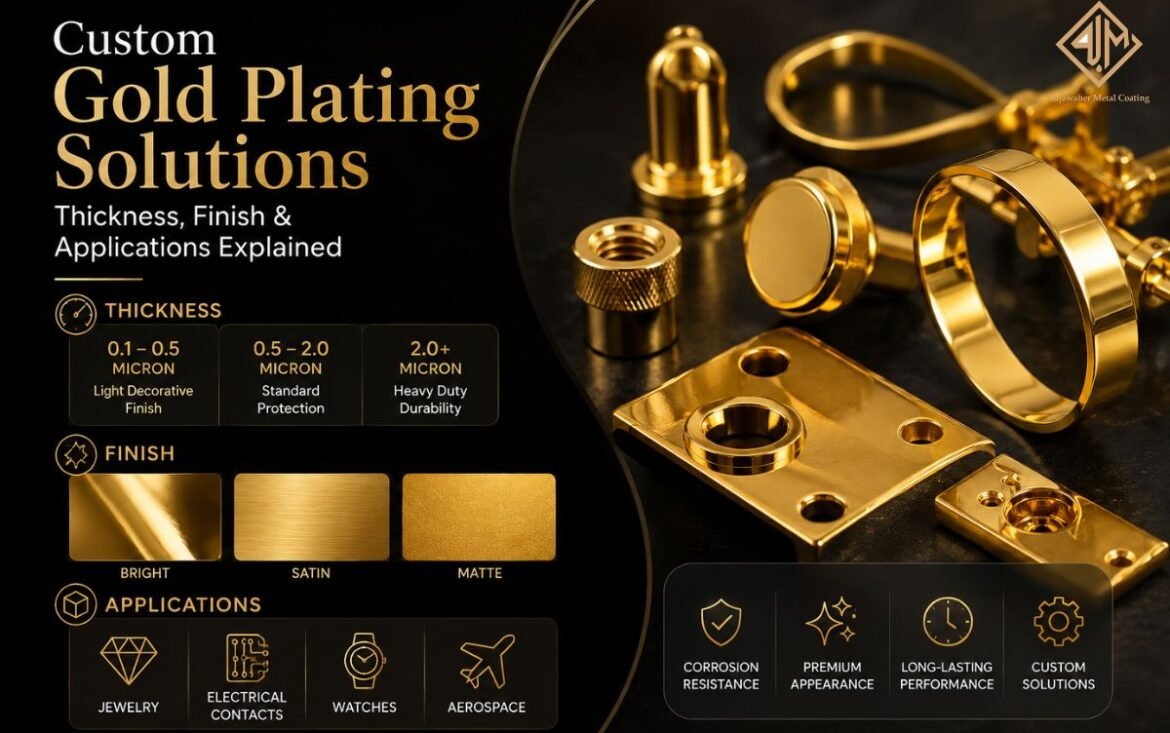
Thickness is where the real quality differences show up. It’s measured in microns, and commercial work ranges from around 0.175 microns on the low end up to 5 microns or more for heavy industrial jobs or fine jewelry.
Roughly how it breaks down:
- Flash plating (0.05–0.5 microns)- A thin cosmetic layer for decorative items that won’t see much handling. Wears off fast once daily contact starts.
- Standard plating (0.5–1.5 microns)- Typical for costume jewelry and fashion accessories with moderate use.
- Heavy plating (1.5–2.5 microns)- For jewelry worn regularly, rings, bracelets, watches, where skin contact and friction never really stop.
- Industrial or technical plating (2.5 microns and up)- Applied to electrical contacts and connectors, where conductivity and corrosion resistance matter more than looks.
The U.S. Federal Trade Commission sets a minimum of 0.175 microns of 10-karat or finer gold before an item can legally carry the “gold plated” label. It’s a useful benchmark even outside the U.S., partly because formalized thickness standards are hard to come by in this industry.
Furthermore, thickness and karat purity get confused a lot, but they’re separate specifications. A 24k gold-plated item with only 0.3 microns of coverage will wear out faster than an 18k item plated at 2 microns, despite 24k being the purer gold. If durability matters more to you than the karat number on paper, tell your provider to prioritize thickness.
Choosing the right finish for your application
Finish is how the gold surface looks and feels once plating is done, and it’s a decision separate from thickness entirely.
- Polished or mirror finish gives a bright, reflective surface. It’s the default for jewelry and decorative fittings, though it shows scratches and fingerprints more readily than other options.
- Satin or brushed finish has a soft texture created by brushing the surface before or after plating. It hides minor wear better, and it’s caught on with modern jewelry and architectural fittings over the last few years.
- Antique or oxidized finish darkens recessed areas on purpose, adding contrast and depth. It shows up most on decorative hardware and statement jewelry.
- Matte finish skips the shine altogether for a flat, understated look. Less common, but it fits certain industrial and design jobs where glare is a problem.
None of these is objectively “better.” It comes down to how the piece gets used and shown off. A showroom fixture under bright lighting looks best polished. A piece that gets handled constantly might actually hold up better visually with a satin texture, since it doesn’t broadcast every small scratch the way a mirror finish does.
Where is gold plating used across industries?
Jewelry is the most visible use case, but it’s not the only one. A capable best metal coating company in Dubai usually fields requests from several sectors at once:
| Industry | Common Application | Typical Thickness |
| Jewelry & fashion | Rings, chains, bangles, watches | 0.5–2.5 microns |
| Interior design | Fixtures, handles, decorative trim | 0.3–1 micron |
| Automotive | Emblems, trim, custom detailing | 0.5–1.5 microns |
| Electronics | Connectors, contacts | 2.5+ microns |
| Signage & branding | Letters, plaques, display elements | 0.3–0.8 microns |
| Religious & ceremonial items | Statues, ornaments, ritual objects | 1–3 microns |
Therefore, interior designers often request plating on door handles, faucet fittings, and decorative trim as part of a broader gold-accented scheme. The specific there usually leans toward appearance over heavy wear resistance, since these surfaces get touched occasionally rather than subjected to the constant friction a daily-wear ring goes through.
Common mistakes businesses make when ordering plating
- Assuming karat purity guarantees durability is probably the most common one. As covered above, it’s thickness, not karat, that determines how long plating survives daily wear.
- Skipping base metal disclosure causes problems too. Providers need to know the exact base alloy to choose the right pre-treatment, and leaving this out tends to surface as peeling or discoloration weeks later.
- Choosing thickness by budget alone is tempting, especially with flash plating priced so much lower. But for anything with regular contact- jewelry, fixtures, handles- that usually means a shorter lifespan and a repeat job sooner than planned.
- Not asking about barrier layers rounds out the list. Silver and certain alloys need a nickel or palladium barrier before gold plating goes on. Skip that step to save time, and you’ll likely see discoloration within months rather than years.
What to ask before you commit to a provider?
Before hiring a gold plating service in Dubai, a handful of direct questions tend to reveal how experienced a provider actually is:
- What thickness, in microns, do you recommend for this specific item, and why?
- What preparation does the base metal need?
- Is a barrier layer required, and is that already in the quote?
- What happens if the plating discolors or peels? Is there a warranty?
- Can I see examples of similar work on the same base metal?
A provider that answers these plainly, without hedging or vague reassurance, is usually one that actually understands the technical side rather than just the finished look.
Conclusion
Gold plating looks simple from the outside. What separates a finish that lasts years from one that flakes within months is a set of decisions most customers never think to ask about: base metal preparation, barrier layers, micron thickness. If you’re weighing options for jewelry, fixtures, or branded pieces, it’s worth spending a few extra minutes on the specifications before placing an order.
For businesses and individuals in the UAE looking for a gold plating jewelry service in Dubai that lays out these trade-offs upfront, Aljawaher Metal Coating works across jewelry, interior fittings, and industrial applications, matching plating specifications to how each piece will actually be used.
Frequently asked questions
With proper thickness (1.5 to 2.5 microns) and base metal preparation, plated jewelry usually lasts 1 to 3 years under regular wear before needing a re-coat.
Yes, but it needs a barrier layer first, usually nickel or palladium, to stop silver migration from dulling the gold over time.
Gold plating is a thin electrochemical layer, often under 2.5 microns. Gold-filled items carry a much thicker, mechanically bonded layer, which costs more but lasts longer.
Not on its own. Karat measures purity, not thickness. A thicker lower-karat layer often outlasts a thinner high-karat one in everyday use.
It depends on what’s underneath. A nickel base under thin plating can trigger reactions once the gold wears through, so ask about base metal composition beforehand.
Skip harsh chemicals, take pieces off before swimming or showering, and store them separately so they don’t scratch against other jewelry.
Yes, through stripping processes that dissolve the gold layer. This usually only happens when re-plating with a different finish or thickness.
Industry guidance generally sets 0.175 microns of 10-karat or finer gold as the baseline for a “gold plated” label.
It varies by item size, base metal, and thickness requested. Small jewelry pieces cost far less than industrial-scale or interior fixture plating jobs.
Yes. Many providers handle bulk orders for signage, corporate gifts, and branded hardware, with pricing typically scaled by volume and thickness specification.