-
aljawahermetalcoating
- November 20, 2026
- No Comments
Electroplated Copper vs Electroless Copper: What’s the Difference?

Electroplated copper is deposited using external electricity, while electroless copper is a result of a chemical reaction without the help of electric power. The key difference in these processes is the manner in which metal appears on the surface. Electroplating is much faster and more effective when it comes to depositing thick and strong coatings on electrically conductive objects.
Therefore, electroless plating is capable of producing a thin and uniform covering even on electrically non-conductive objects, such as plastic and circuit boards. The process you will need to choose depends on the type of material you need, the shape of the object, as well as the thickness of the coating and your budget limits.
Key takeaways
- Electroplated copper is the use of an electric current and is great for application of copper onto conductive components, thick, fast and economical.
- Electroless copper is a chemically based process that provides a uniform thickness of copper on complex geometries and non-conductive substrates.
- The type of substrate, the shape of the parts, and the thickness needed should be the criteria that determine the selection instead of price.
- The importance of verified testing and a clear quality process is as significant as the coating method itself.
What is electroplated copper?
Electroplated copper is a copper coating that is applied to a component as a result of passing current through a copper solution. The part is the cathode, and the copper ions in the bath migrate to the part surface and are deposited as a solid, uniform coating.
How does the electroplating process work?
This is done in a tank containing an electrolyte, usually copper sulfate and sulfuric acid. In the bath, there are two electrodes. The anode is usually made of copper, and the object being coated is the cathode. Copper dissolves from the anode and deposits on the cathode as it does its work, replenishing the solution as it goes.
The final thickness is controlled by the operators via current density and plating time. The thicker the layer, the more current it will have, or the longer it will be exposed, but the current must be within a certain range and the exposure time must not exceed a certain limit so as not to cause the deposit to become rough. The result is also affected by the temperature, the agitation, and the chemistry of the bath, which are all controlled by the skilled operator during each run.
A typical production sequence follows these steps:
- Thoroughly clean and degrease the part to remove oils, dirt, and oxides.
- An acid dip is necessary so that the copper will bind correctly.
- Dip the part in the copper bath and attach it as the cathode.
- Apply and hold for the time calculated to obtain the desired thickness.
- Before going to the next step, rinse, dry, and check the coating.
Key advantages of electroplated copper
The use of electroplated copper is widespread for several practical advantages:
- Thick layers and high production demands can be accommodated at low cost because of the high deposition rates.
- It produces ductile, bright coatings that suit both decorative and functional applications.
- The process is known, and equipment and chemistry are well understood, allowing most industrial operators to manage it.
- With very strict control of parameters, consistent results can be achieved in high-volume orders.
What is electroless copper?
Electroless copper, a copper deposit, is one that is produced by a controlled chemical reaction in a bath, without the use of external electric current. The solution has copper ions and a reducing agent, and the metal deposits on surfaces are catalysed. The reaction is autocatalytic; that is, it proceeds spontaneously after initiation.
How autocatalytic deposition works
The part needs to be prepared by applying a catalyst prior to the deposition, typically palladium or tin. This catalyst provides a starting point on the surface for the reaction. Electroless plating is very useful for non-conductive materials like plastics, ceramics, and resin-based circuit boards.
Therefore, traditional copper baths use a reducing agent, usually formaldehyde, to provide electrons that reduce the dissolved copper ions to solid metal. The solution is prevented from spontaneous decomposition by stabilizers and complexing agents. It is not dependent on the current flow, which allows each surface to be coated to the same thickness, even sharp corners in holes and similar openings.
The primary problem is the management of baths. The concentrations of chemicals, pH, and temperature must not go out of range, and over time the bath undergoes a gradual change due to metal deposits and byproducts. The deposit is carefully monitored and replenished periodically to maintain a consistent deposit throughout the batches.
Key advantages of electroless copper
The metal of electroless copper is respected due to its accuracy and depth. Its major benefits are:
- Easy to make uniform thickness on complex shapes, recesses, and blind holes.
- Coating of non-conductive substrates after appropriate activation.
- No racking, no electrical contact points, thus minimizing handling marks.
- Through-hole plating for printed circuit boards that is reliable.
Electroplated vs electroless copper: key differences
Both processes vary from each other in terms of power, substrate, speed, and cost. A quick summary of these differences is shown below.
| Factor | Electroplated Copper | Electroless Copper |
| Power source | External electric current | None (chemical reduction) |
| Substrate requirement | Must be electrically conductive | Works on conductive and non-conductive surfaces after activation |
| Deposition speed | Fast | Slow to moderate |
| Typical thickness | Thick layers easily achieved | Thin to moderate layers |
| Thickness uniformity | Varies with geometry and current distribution | Highly uniform |
| Bath chemistry | Simpler, copper sulfate-based | More complex, requires stabilizers |
| Operating cost | Lower per unit thickness for bulk work | Higher due to chemicals and control |
| Common uses | Decorative finishes, thick functional coatings, bus bars | PCB through-holes, plastics metallization, precision parts |
Which process gives better thickness uniformity?
This is where electroless copper comes in handy. The current deposits itself on the edge or wherever there is less resistance, meaning that edges and protrusions may be over-plated with metal more than recessed areas. This is referred to as current distribution and may result in appreciable variation on complex parts.
The electroless deposition is not field-strength dependent. Consequently, the coating is evenly distributed even within blind holes and narrow channels. This predictability is a huge benefit for parts where dimensional tolerance is important.
How do costs compare?
Usually, electroplating is less expensive per kg of copper deposited, particularly for large quantities. The process is low in chemical cost and high in deposition rates, so it has low labor and energy requirements.
Chemical cost and control of the bath are higher for Electroless plating. Electroless, however, is often the only feasible solution for a part that cannot be electrically connected or where a uniform coating is required. The correct comparison is not the lowest price but the one that is capable of meeting the specification with the least number of rejects.
Which process suits which application?
There are different options depending on the part, the operating conditions, and the performance required. The common scenarios of each method are described below.
Applications best suited to electroplated copper
There are several common situations where electroplating can be applied:
- A thick layer of copper is required on steel, brass, or other conductive parts.
- Nickel or chrome may not be applied until a decorative base layer is first applied.
- Constructive parts, such as electrical bus bars, require a strong and economical coating.
- When it is a high-volume production with speed and cost per part being most important.
Applications best suited to electroless copper
Electroless plating is the better choice in other situations:
- Reliable through-hole connections are required for printed circuit boards.
- Plastic housings must be made electromagnetically shielded, or made to be surface conductive.
- Precision parts are parts that have deep holes, threads, or complex internal structure.
- During processing, there is no room for electrical connection of the components.
When deciding between copper plating services in Dubai, many buyers are faced with the choice of whether to opt for bulk thickness or consistent coverage. Either way, a good supplier will check your drawings before giving you an estimate; if the process is not right, then rework and delays are going to occur.
Where does local copper coating fit your project?
Coating decisions are not made in a vacuum. The appropriate specification will depend on the environment, the service life you want, and the regulatory standards your industry requires.
What local factors matter in Dubai?
When looking into copper plating in Dubai, begin by inquiring about its performance in your surroundings. Coastal Dubai’s hot, humid weather and salty air tend to speed up corrosion rates, making the selection of coating important in this market compared to many other inland markets. Exposed components are also impacted by heat, dust, and sand, particularly in industrial, automotive, and marine applications, as well as in construction environments.
A local expert can suggest the appropriate thickness, pretreatment, and sealing for these situations. Further, they can also give recommendations regarding lead time and logistics, which is relevant if projects are conducted under a tight timeline. It’s important to ask these questions early to avoid identifying a coating that works well in the lab and may fail in the field.
Choosing copper plating services
While assessing a provider, go beyond the price that is quoted. Inquire about their process capabilities, monitoring of the bath, quality checks, and turnaround times. A competent team will be able to advise you about whether you should have electroplated or electroless copper for your part before giving you an estimate, and will record the parameters that they would be using.
As much as possible, ask for samples or references from projects that are like yours. Finished parts and test data provide a clearer representation of quality than marketing does. At this point, transparency in communication typically foreshadows the rest of the project’s progress.
How to choose the best metal coating company?
The choice of coating partner is a big decision. The right company should be able to blend technical knowledge, consistent quality control, and effective communication.
When it comes to choosing the best metal coating company in Dubai, having a checklist can help you make the process easier. Verify the processes that they provide, and explore the ways they record and check their processes. Those companies that provide electroplated and electroless options may be better suited to making recommendations about the best process to use for your part than to “sell” or strongly advocate for one process.
Questions to ask before you hire
When planning to undertake a purchase from a supplier, the following questions are worth considering:
- Have electroplated or electroless copper processes in-house?
- Are there thickness reports and test certificates per batch?
- What do you do to modify the surface?
- How do you handle samples, design revisions, and rework if a coating fails inspection?
- How long would it take you to make prototypes and production orders?
Red flags to watch for
Some indicators can indicate that a supplier may not be consistent:
- Vague answers about bath chemistry or process controls.
- Quotes that don’t consider part geometry or part coating thickness.
- Difficulty in giving samples or previous test results.
- There is no apparent quality control or inspection process.
Quality testing and industry standards
Quality Checks assure that a coating fulfills its design specifications. Even a good process can generate parts that do not meet service requirements without them. Testing also provides a documented record of the work that corresponds to the specification for the buyer.
Common tests for copper coatings
There are a few common tests that are used to check the copper coating:
- Thickness measurement by X-ray fluorescence or magnetic measurement depending upon the substrate.
- Adhesion testing, including tape or bend testing to ensure the coating will adhere.
- Corrosion resistance testing of components in salt spray as per ASTM B117.
- Checking for uneven coverage, burning, and pitting by visual and microscopic inspection.
Each test is used for a specific purpose, and for each specific purpose, the appropriate set of tests is used. For a decorative bracket, detailed visual inspection might be necessary, and for an electronic component, detailed cross-sectional analysis may be required.
Common defects to watch for
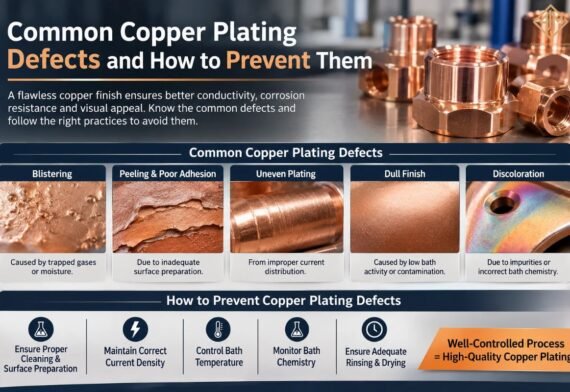
Burning in electroplating is from the application of too many amperes per square centimeter, leading to the formation of rough or powdery deposits. When activation is poor, or contamination has occurred, the adhesion of electroless baths can be poor.
However, the two problems are preventable if the process is controlled and the bath is analysed regularly and appropriate pretreatment is used. Consistent monitoring by suppliers results in a decrease in defects over time.
Common mistakes when choosing a copper coating process
Frequently, coating issues start at specification and not on the production floor. It can save time and money to understand some of the common mistakes.
Many buyers who are looking for copper plating services in Dubai tend to compare prices rather than assessing the suitability of the processes. This way, sometimes components appear to be ok but are unable to adhere or resist corrosion. With the lower quote comes rework, delays, and field failures, and that is not worth it.
Other frequent errors include:
- Selecting a process due to the cost of the work only.
- Failure to consider if the substrate is conductive when choosing a method.
- Thickness without taking into account uniformity due to part geometry.
- Failure to prepare the surface, causing the majority of adhesion failures.
- Not asking the coating supplier to submit test reports.
Collaboration between the design team and the coating supplier from the beginning is essential to avoid these pitfalls. Sharing drawings early means that problems can be identified before production starts.
Bottom line
There are two types of copper, electroplated and electroless copper; both have their uses, but none is better. Electroplating is suitable for bulk, thick, and conductive parts, whereas electroless plating is ideal for uniform coating on complex and non-conductive parts. The optimum selection begins with a thorough knowledge of your material, geometry, and performance needs.
Whenever you are considering copper plating in Dubai, present drawings and performance requirements to a copper plating supplier at the beginning of the process. Working together early minimises changes and prevents expensive errors. For more information on the process options and consultation, please visit Aljawaher Metal Coating.
Frequently Asked Questions
Not always. Both processes can be effective when the chemistry, thickness, and heat treatment of the bath are managed.
Yes, but the plastic has to be conductive first, typically by a coat of electroless copper, and then electroplated, before electroplating can proceed.
Electroplating is generally less expensive for covering large amounts of surface area on conductive parts. Electroless has higher costs because of chemicals and controlling the bath.
Look for their expertise in the process, whether they offer transparent testing, and whether they can provide samples. Find out how they compare the technique to the size of your parts.