-
aljawahermetalcoating
- November 16, 2026
- No Comments
Common Copper Plating Defects and How to Prevent Them
Copper plating is an electrochemical method in which copper is applied to a metal surface to achieve better conductivity, corrosion resistance, and appearance. If carried out properly, copper plating leaves the coating layer smooth and well adhered for many years. On the contrary, if done improperly, the surface will have issues like blistering and peeling, and so the copper plating may be removed and done again.
In this guide, we will look at the most common defects, their causes, and the strategies to avoid them. You may be interested in copper plating for decorative purposes or for industrial equipment, and thus knowing these aspects will help you to assess copper plating projects with confidence.
Key takeaways
- Controlling these three factors, such as cleaning, bath contamination, and current, will eliminate most defects in copper plating.
- Each type of pitting, blistering, burnt deposits, roughness, uneven thickness, and porosity can be identified by distinctly different appearances and causes, making it possible to detect them early in the process.
- Since the temperature, humidity, and salt exposure in Dubai severely impact long-term performance, it is critical to prepare well and use the right coating thickness.
- By providing regular monitoring, filtration, and documented testing, failure is averted and becomes a predictable procedure instead of a crisis.
What is copper plating and why does quality matter?
Copper Plating is a process in which a part is dipped in an electrolyte bath, and an electrical current is fed through the part. The ions of copper migrate toward the surface of the part and form a solid layer of copper on the surface. Copper’s value comes from its ability to carry heat and electricity, as well as providing a foundation for other layers like nickel or chrome.
Therefore, many copper coatings are a few microns thick, so if they are not prepared correctly or if there is an error in the bath chemistry, it will be evident within a few minutes. A seemingly inconsequential defect on day one can become corrosion or failure of the coating after months of service.
How does the copper plating process work?
The process of copper plating involves the electroplating of a conductive part with copper. The part is cleaned, activated, and placed in a copper bath where it is made the cathode. The direct current draws the copper ions to the surface, and the thickness of the layer is determined by the current density and the duration of plating.
Every stage is important to the end result. Cleaning eliminates oils and residues; activation eliminates thin oxide films to allow proper bonding of the copper. The chemistry of the bath and current control determine the manner in which the copper grains deposit, and thus the smoothness, hardness, and adhesion of the deposit.
Why do Dubai projects face unique challenges?
Plated components are at a higher risk due to the climate in the UAE. Near the coast, high humidity, high temperature, and salt in the atmosphere can speed up the corrosion process if there are any weak points in the coating. Dust and sand can cause abrasion, which can lead to the exposure of the base metal over the years.
Therefore, copper plating service in Dubai should take into consideration actual exposure, rather than laboratory specifications. Those familiar with the area can suggest the appropriate thickness, sealing, or even protective surface layers if necessary for the environment.
What are the most common copper plating defects?
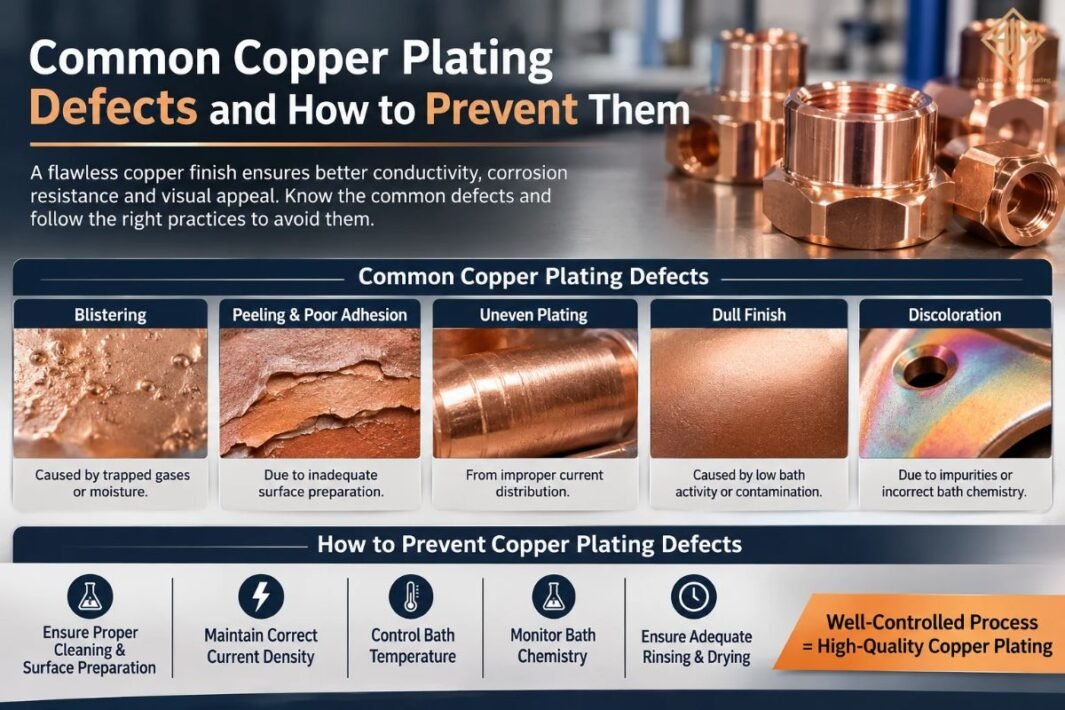
The majority of copper plating problems are either noticeable from a distance or can be felt when touched. Recognizing them early, you help you identify the cause and correct the process instead of treating symptoms over and over again. Below are the 6 most common defects.
What is pitting and how does it appear?
Pitting is small holes or depressions formed on the surface of the copper. Typically develops when hydrogen gas bubbles attach themselves to the part during plating or when particles in the bath attach themselves to the surface. Pits create corrosion protection problems since they allow the underlying metal to be exposed.
Why do blistering and peeling happen?
Blisters and peeling are signs of poor adhesion of the copper to the substrate. The most common reason is that the surface is not cleaned properly, and the oil, oxide, or residue is left there. High temperatures due to fast heating or cooling can also cause the coating to curl up with time.
How do burnt and dark deposits form?
The burnt deposits are dull, dark, or powdery in color and are found at high-current edges or in recessed areas. These are caused by excessive current density for the bath conditions. The problem is exacerbated by low concentrations of Cu and by inadequate agitation.
What causes roughness and nodules?
Rough surfaces and nodules are rough and uneven. They are likely to be from solid particles in the solution or from copper precipitates that can be caused by contamination of the bath. These problems are kept under control by continuous filtration and regular bath analyses.
Why does plating thickness vary?
Current is not evenly distributed on complex shapes, so the shape may have different thicknesses. Corners and edges are thickly plated, and recesses and inner surfaces are less. The use of thieving tools, correct rack design, and placement of anodes can help to even out the deposit.
How do porosity and discoloration affect performance?
Porosity is the minute openings present on the coating that give moisture and chemicals access to the base metal. If the metal is yellow, brown, or has other discolorations, it may be contaminated or because of inconsistent rinsing. Both defects shorten service life, even if they appear acceptable on the surface at first sight.
The table below summarizes these defects for quick reference.
| Defect | Typical Appearance | Main Cause | Prevention Focus |
| Pitting | Small holes or pinholes | Hydrogen bubbles, bath particles | Wetting agents, filtration, agitation |
| Blistering and peeling | Lifted or bubbled coating | Poor cleaning, thermal stress | Thorough degreasing and activation |
| Burnt deposits | Dark, dull, or powdery areas | Excess current density | Correct current settings, bath balance |
| Roughness and nodules | Gritty, uneven texture | Suspended particles, contamination | Continuous filtration, bath analysis |
| Uneven thickness | Thin recesses, thick edges | Poor current distribution | Rack design, anode placement, thieving |
| Porosity and discoloration | Tarnish, pale or patchy color | Contamination, incomplete rinsing | Clean rinses, controlled chemistry |
What causes these defects?
The majority of the defects are related to a small number of process variables. If one of these drifts out of its normal range, various defects may manifest simultaneously. The primary reasons are:
- Poor cleaning: Oils, oxides, or polishing compounds remain on the surface, blocking the copper from adhering to it.
- Bath contamination: Metal impurities, organic breakdown products, and suspended solids contaminate the bath and interfere with smooth deposition.
- Excessive current density: Burning occurs when excessive current is used; slow growth occurs when too little current is used.
- Temperature drift: Grain structure and deposit quality are affected when the temperature of the bath is not within the recommended range.
- Inadequate stirring and filtering: Potentially causes hydrogen bubbles to adhere and particles to settle.
- Poor rack design: Bad contact points and unbalanced rack positions result in uneven current paths.
Additionally, many stores fail to connect the two sets of causes and their business practices. A weekly check bath will drift much further than an hourly check bath. It is important to be consistent in monitoring, or there can be a recurring problem or a stable process.
How can you prevent copper plating defects?
The key to prevention is to control each step and ensure the results of each step prior to the movement of parts out of the shop. The following sequence is how a disciplined plating operation works generally:
- Clean thoroughly: Remove oils, dirt, and polishing residue with alkaline degreasing and mechanical cleaning.
- Rinse between stages: Cleaning chemicals should not be carried over into the plating bath by using clean and controlled rinses.
- Activate the surface: Use the proper acid dip to remove the oxide films and allow the copper to bond with fresh metal.
- Control the bath: Keep copper, acid, and additives within the recommended ranges.
- Adjust the timer and time setting: Compare the current density of the part geometry to the target current density, then time the plating to achieve the required plating thickness.
- Inspect and test: Check thickness, adhesion, and appearance prior to the next process step or to the customer.
Why is surface preparation so important?
There is no such thing as a good copper coating without surface preparation. Adhesion can’t be achieved even if the bath is balanced perfectly on a contaminated surface. The copper surface is fully degreased, mechanically prepared as necessary, and activated.
How should bath chemistry be monitored?
The chemistry of the bath should be determined on a regular basis and documented. The quality of deposits is affected by the concentration of copper, the acid content, the levels of chloride, and the level of additives. Periodic analysis enables technicians to make corrections before noticeable defects appear.
However, the same is true for filtration. Particles that would form nodules and roughen the product surface are removed by continuous filtration. Activated carbon treatment can also be used to remove organic breakdown products that can cause a dull or streaky deposit.
Which tests confirm coating quality?
Testing makes prevention tangible. There are several ways to test the copper coatings:
- Visual inspection: Indicates uniformity of appearance under good lighting, including burning, discoloration, and pitting.
- Adhesion testing method: A bend test or tape test is used to determine if the copper is securely attached to the substrate.
- Thickness measurement: A magnetic gauge or X-ray fluorescence instrument verifies that the deposit is within specification.
- Porosity testing: Specialized tests identify minute spaces which may trap corrosion.
- Salt spray testing: An accelerated corrosion exposure demonstrates the coating’s performance in severe conditions.
How do you choose a reliable coating partner?
It is much easier to avoid problems if you select the right supplier from the beginning. A good partner records its process, test results, and is clear about what it can and cannot do.
What should you look for in a provider?
You should consider a plating supplier’s capabilities, not promises. Good providers typically exhibit many of the following:
- A written procedure for cleaning, activation, plating, and rinsing.
- Thickness, adhesion, and appearance tests performed in-house.
- Knowledge of the requirements of the local climate and application for coatings.
- Ensure quality procedures are clear, and records are traceable for each batch
- Appropriate willingness to describe specifications and suggest appropriate thickness
- Referrals from customers in the same sector
Moreover, when it comes to selecting the best metal coating company in Dubai for your project, you will need to consider more than just the bottom line. A lower price may be misleading in that it may feature some shortcuts to cleaning, bath control, or inspection, which will typically result in rework and delays later.
What questions should you ask before ordering?
Prior to placing an order, ask questions that will show how a provider manages risk. Useful questions include:
- What are the steps you take before copper plating?
- How many times a year do you test and tweak your bath chemistry?
- What tests do you do before sending parts?
- What to do with complex shapes with changing thickness?
- Are there any test records or certificates available for each batch?
- What is the best way to protect parts that are subjected to heat, moisture, and salt?
The responses to these questions will indicate if a provider is following a controlled process or just going through the motions. When searching for copper plating services in Dubai, take into account how they respond to you, as well as the charges they ask.
You can read about Aljawaher’s metal coating services and compare its process with other metal coating companies using the checklist below.
Conclusion
When it comes to copper plating, it’s not always a random defect. Each relates to a particular cause in the cleaning, chemistry, current, or handling process, which can be controlled and tested. When long-lasting finishes are required for a project, it’s important to know these particular details so that you have realistic expectations and do not expect to experience rework that will cost you more money.
Use this checklist guide when planning a new component or when assessing an existing supplier. Reliable copper plating in Dubai work that will work under challenging conditions is grounded in solid preparation, regular checking, and confirmed outcomes.
Frequently asked questions
Pitting is one of the most frequent defects, which are typically due to the presence of hydrogen bubbles or particles on the surface during the plating process.
The blistering, peeling, or lifting following light bending or heating is, in most cases, a result of poor adhesion and is usually the result of insufficient surface cleaning before plating.
Thicker plating provides greater corrosion protection, but does not eliminate defects. Good cleaning, bath control, and up-to-date management are essential for quality.
Most stores will check the bath chemistry at least every shift or daily and after any significant production increase or deposit quality change.