-
aljawahermetalcoating
- October 13, 2026
- No Comments
How Thick Can Hard Chrome Plating Be Applied?
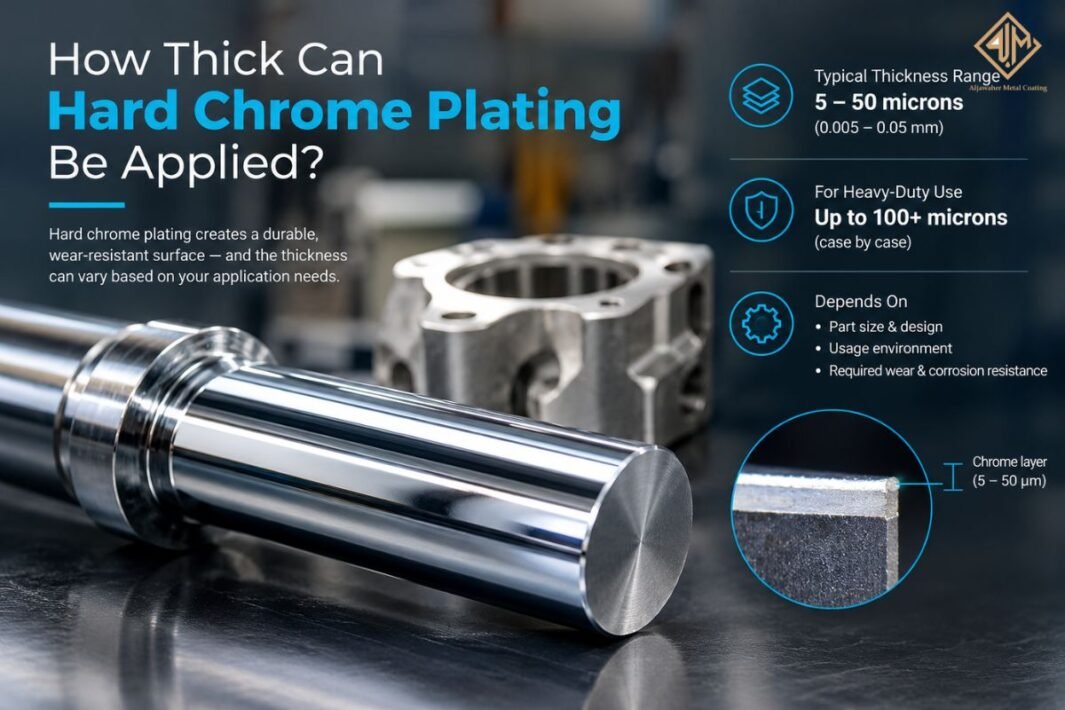
Table of Contents
- Key takeaways
- Understanding hard chrome plating and why thickness matters
- Typical thickness ranges for hard chrome plating
- What factors affect how thick the chrome layer can be?
- Can hard chrome be applied thicker than 500 microns?
- How is chrome thickness measured and controlled?
- Hard chrome plating services for industrial users
- How to choose a metal coating partner in Dubai?
- Wrapping up
- Frequently asked questions
Normally, hard chrome plating can be done anywhere from 2 to 500 microns. While most commercial pieces of equipment will receive between 20 and 50 micrometres of hard chrome, it is possible to apply a thicker layer for worn-out parts, but this can take longer, and the process has to be more controlled before the layer is ground to the desired thickness.
Therefore, a lot of customers want to know what the thickness will be prior to placing an order, but the answer differs based on the piece of equipment and its purpose. If you are looking for hard chrome plating in Dubai for hydraulic cylinders, axles, or molds, then the process starts by understanding the range of thicknesses that might be required.
Key takeaways
- In general, industrial components are subjected only to hard-chrome plating within the range of 20–50 microns.
- In restoration processes, plating thickness may be up to 100–500 microns, and precision grinding will be applied.
- Select the thickness according to the application of the component, as well as its loading and final dimensions.
- Do not select the maximum thickness, as it depends on the specific needs of the component.
Understanding hard chrome plating and why thickness matters
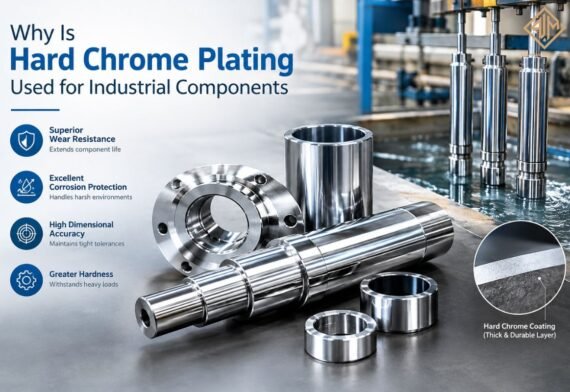
Hard chrome is also known as industrial or functional chrome and is the process through which chromium is deposited electrolytically onto the metal surface. Its main purpose is the enhancement of hardness, ability to resist wear, low friction, and corrosion resistance. Decorative chrome is a type of plating that is extremely thin and purely aesthetic, while hard chrome has to be applied in sufficient thickness for the needs of the part.
The reason for considering thickness is very simple. A layer that is too thin may be worn under the load very quickly, while a coating that is too thick may crack or flake. Therefore, the goal is to apply a layer that meets the needs without going beyond the margins. Searching for hard chrome plating near me for more information regarding hard chrome plating.
Typical thickness ranges for hard chrome plating
- What Is the Standard Thickness for Most Industrial Parts?
Many industrial components are plated with a thickness from around 20 to 50 microns (approximately 0.0008 to 0.002 inches). This thickness enables increased surface hardness and wear resistance for parts like piston rods, hydraulic cylinders, and shafts, as well as optimizes the plating cycle, lowering the chances of cracking.
- When Is a Thicker Chrome Layer Needed?
Thicker coatings are used when the part is either worn and has to be restored to its original dimensions or when it is heavily worn in operation. In such cases, the thicknesses used are usually 100 microns and above, followed by a process of grinding down to the finished dimension. Since restoration in this case is time-consuming, the lead time and cost mainly increase with thicker coatings.
The table below provides general recommendations. The final specification always depends on the specific part and the standards it has to conform to.
| Application | Typical Thickness | Main Purpose |
| Light-duty wear surfaces | 5 to 20 microns | Surface hardness and appearance |
| Standard industrial parts | 20 to 50 microns | Wear and corrosion resistance |
| Heavy-duty components | 50 to 150 microns | Abrasion resistance and longer service life |
| Worn part restoration | 150 to 500 microns | Rebuilding dimensions before grinding |
What factors affect how thick the chrome layer can be?
Several factors determine the final build, and a quality plating shop can control all these factors simultaneously:
- Base material: The response to surface preparation differs for steel, stainless steel, and other substrates, and this will impact both adhesion and the allowable amount of build.
- Electrical current and cycle time: The deposition depends on the electrical current and cycle time, and with longer run times, thicker deposition is obtained.
- The chemistry and temperature of the bath: If it is stable, the deposits will be uniform and predictable from one batch to the next.
- The shape of part geometry: Edges and corners tend to build more quickly than recessed areas, and shape has a direct impact on part uniformity.
- Required finish: Extra allowance above required size must be provided for parts to be ground or polished.
Can hard chrome be applied thicker than 500 microns?
The process can be more than 500 microns, but this is not usually recommended. The higher the deposit, the more internal stress and the less adhesive there will be, increasing the chance of micro-cracking. In extremely large rebuilds, an experienced plating shop will likely consider if the part was better suited to a different material or process.
How is chrome thickness measured and controlled?
Typically, quality plating companies perform multiple tests to verify thickness. Magnetic induction and eddy current types provide rapid non-destructive readings for appropriate base materials. In the case of critical components, a cross-section of the component is removed, and the build is verified under a microscope, showing any defects below the surface.
However, process control is as important as measurement! The plating speed can be determined from the current density, and assuming normal conditions, chrome will deposit at a rate of approximately 25 microns per hour. Rates will vary depending on the bath conditions and should not be assumed, but verified for each batch.
Hard chrome plating services for industrial users
The industrial atmosphere in Dubai is challenging. Wear and corrosion occur more rapidly under high ambient temperatures, airborne dust, coastal humidity, and with continuous operation of machines. One solution is to use hard chrome to provide a low-friction surface that lasts with repeated use on components.
Which common parts benefit from hard chrome?
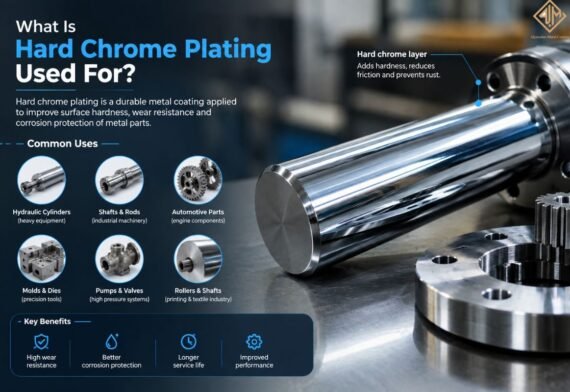
Hard chrome is used extensively for components that are subject to friction, sliding contact, or severe operating conditions. Typical examples include:
- Hydraulic and pneumatic cylinders
- Piston rods and shafts
- Rollers and guide elements.
- Moulds and dies
- Parts subjected to abrasion.
How to choose a metal coating partner in Dubai?
When choosing a supplier, don’t just consider the price. Ask about thickness tolerance, how they measure results, how surfaces are prepared, and if grinding or polishing is done in-house. When selecting the best metal coating company in Dubai, it is crucial to have a clear understanding of the requirements and provide honest recommendations regarding the technology.
A good provider will fully describe the process and suggest a thickness that fits your part. Beware of somebody who just offers the most expensive one without inquiring about how the part is going to be used. When looking for hard chrome plating near me, ask the shop if they can provide sample reports, explain the tolerances, and whether they can do post-plating; much of the finishing will be done so that the part is ready to fit.
Wrapping up
Hard chrome plating is a highly wear- and corrosion-resistant process but must be installed at the appropriate thickness to achieve the desired results. A build of 20 to 50 microns is sufficient for most industrial parts, and much more may be necessary for restoration projects, followed by precision finishing. Aljawaher Metal Coating collaborates with industrial clients throughout Dubai to provide a thickness that meets the required function, and at the very start, technical guidance is provided.
When looking for hard chrome plating services in Dubai, provide your part drawings, operating conditions, and dimensions to the team, which will then be able to suggest a practical specification. When choosing the best metal coating company in Dubai or looking for “hard chrome plating near me,” a comprehensive technical conversation will assist you with your decision.
Frequently asked questions
Hard chrome can be thin but is generally applied in microns that are relatively thin for light wear or appearance. The thickness of deposit required for industrial parts is generally 20 microns or more.
Typical round 20 to 50 microns are used on hydraulic rods, depending on the design of the seal, stroke and operating pressure. Reconditioned rods might require additional build and then grinding and polishing.
Not always. If too thick, it will cause high self-stress and crack risk, and the thickness of the product should have a balance between wear resistance and adhesion, and dimensional accuracy.
Yes. Grinding is a common operation for thick deposits and restoration, and it restores the part to the desired size and surface finish.
It is possible, but stainless steel must be properly surface treated and the correct process used to ensure proper adhesion. It is important that suitability must be confirmed with a plating specialist prior to production.
The cycle time is a function of the desired thickness. Standard builds require a few hours of plating, while a thick restoration may require much longer and may also require some grinding time.