-
aljawahermetalcoating
- September 19, 2026
- No Comments
What Is Chemical Etching and How Does It Work?
Table of Contents
- Key takeaways
- What is chemical etching?
- The step-by-step etching process
- Which metals etch best?
- Chemical etching vs. laser cutting vs. stamping
- Common industries that rely on it
- Why do Dubai businesses choose local etching services?
- Choosing the right metal coating and etching partner
- Final thoughts
- Frequently asked questions
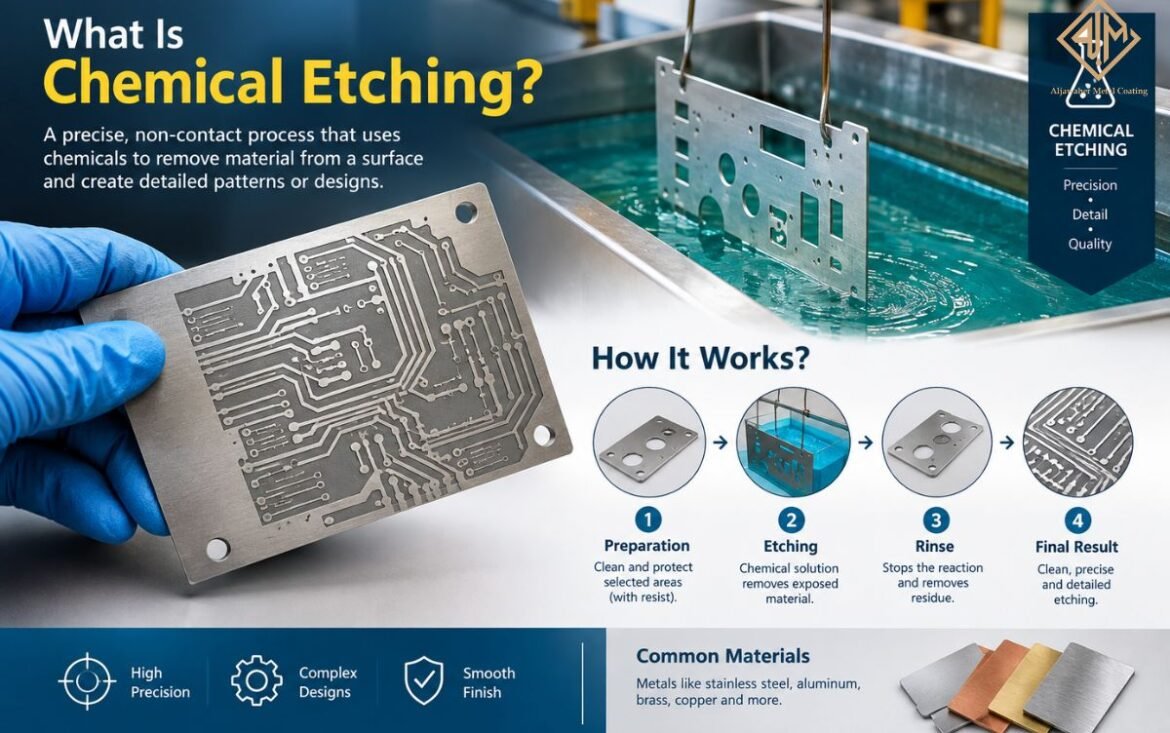
Chemical etching, also known as photo etching or photochemical machining, is a method of fabricating metal where everything unwanted is removed through a carefully controlled reaction, not through a blade, laser, or die. The process utilizes a photoresist to protect the part that must be kept, while the etchant does the removing.
That is why chemical etching services in Dubai are in constant demand, because even thin and intricate parts produced through this process will come out flat and burr-free, which is something stamping or cutting cannot always achieve.
Key takeaways
- Metal is removed through chemical etching, which leads to flat parts without any existing stress.
- Normally, tolerance is around ±10% of the material thickness used for precision tasks.
- Copper, brass, and stainless steel are efficiently etched when appropriate process control is used.
- Finishing by means of Aljawaher Metal Coating increases durability, aesthetics, and resistance to corrosion.
What is chemical etching?
Chemical etching is subtractive, but not in the way people usually picture subtractive manufacturing. There’s no blade, no bit, no physical contact at all. A thin metal sheet gets coated with a light-sensitive photoresist, exposed through a film carrying the part’s design, then developed so the resist hardens only where metal needs to stay put. Everything else washes clean.
That bare metal is what disappears next. The sheet runs through a spray etching line where an etchant, usually ferric chloride or something close to it, eats away the exposed areas while the resist-covered sections sit untouched. What comes out the other end is your part, still tethered to the sheet by small tags until it gets punched free.
Here’s why that’s relevant if you’re sourcing chemical etching services in Dubai: no tool ever contacts the metal. No cutting force. No heat distortion. And for thin gauge stock or parts with fussy internal geometry, that difference shows up immediately once you compare finished edges side by side with a stamped part.
The step-by-step etching process
In order, this is what happens on the floor:
- Design and tooling- The part geometry becomes a photo tool, a high-resolution film negative marking exactly where metal stays and where it goes.
- Cleaning the sheet- Raw metal gets degreased so the photoresist bonds evenly. Skip this step or rush it, and you’ll see uneven etching later. It’s a small step that causes a disproportionate number of headaches.
- Applying photoresist- A liquid or dry-film resist gets laminated onto both faces of the sheet.
- Exposure- UV light passes through the photo tool and hardens the resist in the part’s pattern.
- Developing- A developer solution strips away the unexposed resist, exposing bare metal where the etch needs to happen.
- Etching- The sheet moves through the etch chamber, where heated etchant sprays from both sides at once to keep the attack even across the surface.
- Stripping and inspection- The remaining resist comes off, and parts get checked against the original drawing.
Most shops run this as a continuous line rather than in batches. That’s part of why etching handles a prototype run and a production run without any retooling cost between them.
Which metals etch best?
Metal choice affects the outcome more than most first-time buyers expect going in.
| Metal | Etching Behavior | Typical Use |
| Copper & Brass | Fast, predictable, cleanest edges | Electrical contacts, EMI shielding |
| Stainless Steel | Industry standard, consistent results | Filters, medical components, nameplates |
| Aluminum | Natural oxide layer must be bypassed first, slightly rougher edges | Lightweight brackets, aerospace parts |
| Titanium & Nitinol | Difficult, needs specialized chemistry | Medical implants, high-performance parts |
However, copper and brass sit at the easy end of the spectrum and consistently hit the tightest achievable tolerances. Aluminum needs its oxide layer chemically stripped before etching even starts, which is exactly why aluminum parts often carry a slightly looser tolerance spec than an equivalent copper part.
Chemical etching vs. laser cutting vs. stamping
Clients ask this constantly, so here’s the honest version, not the sales version.
| Factor | Chemical Etching | Laser Cutting | Stamping |
| Tooling cost | Low, film-based tooling | Low to none | High, hard tooling required |
| Burrs/stress | None | Minimal, heat-affected edge | Present |
| Best for thin sheet | Excellent | Good | Poor below certain gauges |
| Complex patterns | Excellent | Good | Limited by tool geometry |
| Cost at high volume | Moderate | Higher for thick material | Lowest once tooled |
A few hundred prototypes with intricate cutouts and no mechanical stress? Etching wins, no contest. Stamping the same bracket by the hundred thousand? Hard tooling eventually pays for itself.
Therefore, a shop running a genuine photo etching service in Dubai should be willing to tell you which method actually fits your volume, not just push whatever they happen to run in-house.
Common industries that rely on it
Chemical etching turns up in more everyday products than people assume:
- Electronics: lead frames, EMI/RFI shields, flex circuits, connector contacts
- Aerospace: turbine components, fuel cell plates, lightweight structural parts
- Medical: surgical instrument components, stents, filter meshes
- Signage and decorative metal: nameplates, architectural panels, branding elements
- Automotive: sensor components, gaskets, precision brackets
Electronics manufacturing pulls the biggest share of demand here, mostly because miniaturized circuit components need micron-level precision that mechanical cutting just can’t hit affordably at volume.
Why do Dubai businesses choose local etching services?
Dubai’s manufacturing base has grown to the point where sourcing precision metal parts locally beats importing them on most projects. A local supplier cuts lead times noticeably, and it lets an engineer walk in and check a first-article sample before signing off on a full production run.
There’s a finishing piece worth thinking about too. An etched part isn’t really finished if it’s headed into a humid environment, salt air, or constant handling. That’s where a company like Aljawaher Metal Coating fits in, since etched components frequently need chrome, nickel, or gold plating afterward for corrosion resistance. If you’re already comparing the best metal coating company in Dubai for that finishing step, it’s worth checking whether they also handle etching, so parts aren’t shipped back and forth between two unrelated vendors.
Choosing the right metal coating and etching partner
Before signing off on a supplier, ask a few direct questions:
- Can they show sample tolerances on your specific metal, not a generic spec sheet?
- Do they handle etching and finishing under one roof, or do parts travel between separate facilities?
- What’s their real turnaround on a first-article sample versus a full run?
- Can they adapt mid-project if your design changes?
Furthermore, Aljawaher Metal Coating, for example, works across etched and stamped components in multiple metal types, which matters once your project needs precision shaping and a durable finish handled by the same team rather than two.
Final thoughts
Chemical etching comes down to a masked photoresist and a controlled chemical reaction removing metal exactly where you need it gone, with zero mechanical stress on the part. That’s why it holds up so well for thin, detailed, or high-precision components across electronics, aerospace, and general manufacturing. If you’re weighing chemical etching services in Dubai for a project, the useful next step is requesting a first-article sample on your actual metal and design, so you can check tolerances and finish quality before committing to a full run.
Frequently asked questions
Basically yes. Search for a photo etching service in Dubai, and you’ll find the same process under a different name: photoresist plus a chemical etchant.
Around ±10% of material thickness is the usual baseline, though thinner gauges and copper alloys can beat that.
It doesn’t. No mechanical or thermal stress is involved, so the grain structure stays exactly as it was.
Very thick sections and some resistant tool steels do better with mechanical or laser methods instead. Most other metals etch fine.
Prototypes can turn around in days, since the tooling is film-based rather than hard tooling that needs machining lead time.
7. At low to medium volumes, yes, since there’s no hard tooling cost. Stamping only pulls ahead at very high volumes?
All the time. It’s a common next step, especially where corrosion resistance matters, which is why etching and coating often get paired.
Electronics, aerospace, medical devices, and precision signage, mainly for the tight tolerances and clean edges.
The etchants themselves need careful handling and disposal. Established facilities recycle solutions and follow environmental compliance rules.
Thin, flat, or lightly formed metal with intricate features usually works well. A supplier can confirm feasibility from your drawing before quoting.