-
aljawahermetalcoating
- July 28, 2026
- No Comments
Nickel Plating vs Stainless Steel: Which Is Better for Corrosion Resistance?
Table of Contents
- Key Takeaways
- What is nickel plating?
- What is stainless steel?
- Corrosion resistance compared
- Durability and wear performance
- Cost comparison
- Appearance and finish quality
- Best applications for each option
- Common mistakes to avoid
- Expert recommendations
- Conclusion
- Frequently asked questions
Key Takeaways
- Nickel coating provides resilience to surfaces, but it does not make them change their original base metal.
- Stainless steel has corrosion protection throughout its cross-section.
- Environmental conditions in Dubai make corrosion-resistant metal important for good performance and durability.
- Nickel Plating Services in Dubai provide the right solution for any need.
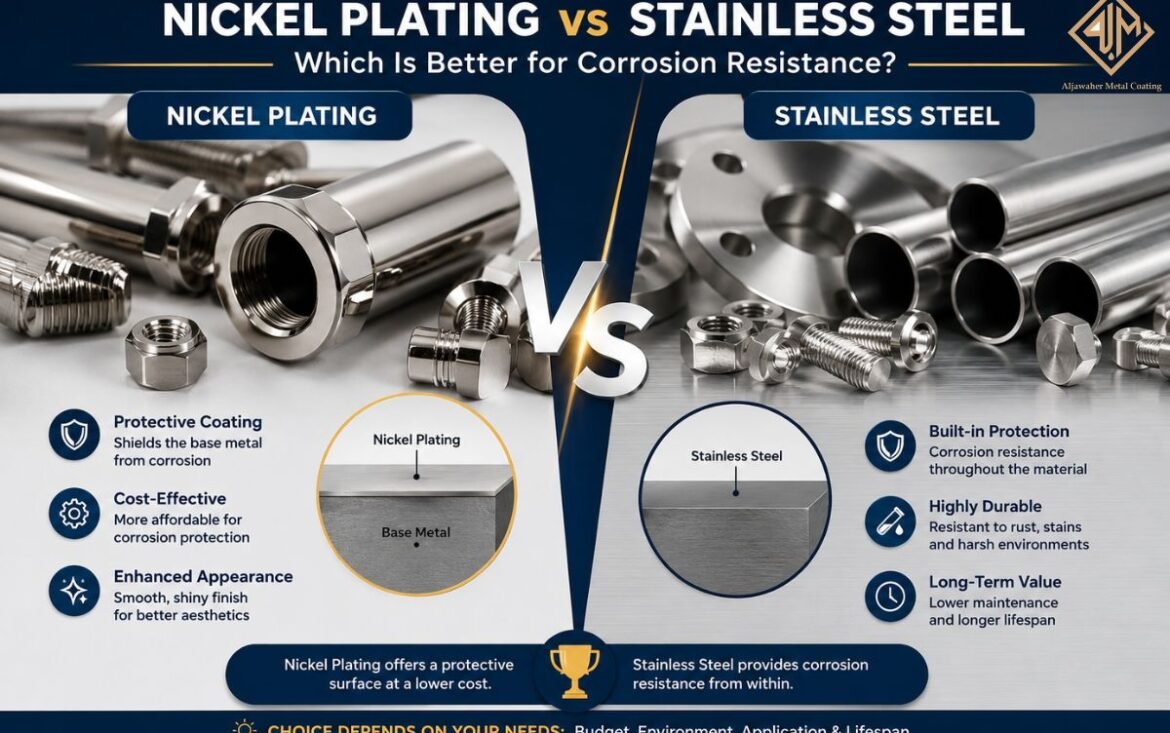
The choice between nickel plating and stainless steel depends on the function of the part. Nickel Plating is a protective layer that is deposited on the base metal. When stainless steel is exposed to corrosion, it can resist it directly. That gap translates into UAE-based businesses experiencing the heat, humidity and salty coastal air faced increased part replacement frequency, and increased replacement costs. Let’s take a simpler view of the comparison between the two.
What is nickel plating?
Nickel plated surfaces refer to the layer of nickel deposited on the metal surface which can range from aluminum to steel and brass. Nickel plating can be done using the electroplating method which utilizes electricity or the electroless process which utilizes a chemical reaction.
Electroless nickel plating services in the Dubai process became popular due to its ability to produce the even coating on even the odd-shaped parts, including the parts with the intricate inner surfaces which cannot be plated using electroplating technique. This has been particularly useful when coating such parts as valves and fittings plus the components of machines featuring intricate shapes.
Why do manufacturers choose nickel plating?
Manufacturers prefer the nickel plating process since it allows the application of nickel coating on the cheaper metal instead of the high-cost metal that will be immune to corrosion from the very beginning. Nickel coating also enhances the hardness and wear-resistance of the product while ensuring excellent appearance.
What is stainless steel?
Iron is the primary material in stainless steel as it is made up of some amount of chromium and nickel along with molybdenum in some cases. Due to these properties, stainless steel becomes resistant to corrosion and rust. There is a thin protective layer formed here which is created on the surface and can heal itself when it becomes scratched. It should not be confused with a coating on the metal because here the metal itself is made safe and thus all its scratches will not harm it.
Moreover, grades matter here. Grade 316 contains molybdenum and holds up against chloride exposure- salt air near the Gulf coastline, for example – noticeably better than Grade 304.
Corrosion resistance compared
This is the factor that determines what the choice hinges on in the majorities of cases.
Nickel coating is durable as long as it is undamaged. As soon as it gets scratched or worn out, there may be problems related to the corrosion of the base metal, as now it will corrode even more than it would in case there was no coating applied. In industrial settings with regular friction or impact, that risk is real.
Stainless steel doesn’t have that failure point. Because the resistance is built into the metal itself, minor surface damage doesn’t open up the same vulnerability. That said, plenty of parts don’t need that level of protection, especially ones that get replaced on a regular schedule anyway.
Practical example: An indoor decorative railing will likely do fine with nickel plating for years. A marine fitting facing salt spray and constant handling is a better candidate for stainless steel or, at minimum, a thicker electroless nickel coating with added phosphorus.
Durability and wear performance
High phosphorus content electroless nickel can notably surpass conventional stainless steel in terms of hardness and wear resistance. For this reason, the metal is commonly used for hydraulic components, gears and moulds where surface hardness is of greater importance than the corrosion resistance of the full part.
Therefore, stainless steel wins on consistency instead. There’s no coating to wear through, so it handles impact, structural stress, and repeated flexing better in most cases- which is why it’s still the default for structural fasteners, food processing equipment, and medical instruments.
Which wears better under friction?
Regarding bearings and sliding systems, electroless nickel plating often appears more attractive in theory due to its hardness. However, when that surface wears through, stainless steel comes out on top once again as it does not have to worry about a layer being breached in the first place.
Cost comparison
Nickel plating is nearly always cheaper up front. You’re coating an inexpensive base metal rather than sourcing and machining solid stainless steel stock, which costs more per kilogram and is harder to work with.
Stainless steel costs more initially but can end up cheaper over the part’s full life, particularly in harsh environments where plated parts need recoating or replacing sooner. A company offering solid steel coating services in Dubai can walk you through those numbers instead of just quoting the lowest price.
A rough guide procurement teams tend to use:
- Short-term or easily replaceable parts: nickel plating usually makes more sense
- Long-term structural or exposed components: stainless steel tends to pay for itself
- High-precision parts needing surface hardness: electroless nickel plating is often the better technical fit
Appearance and finish quality
Nickel plating gives a bright, reflective finish that plenty of clients want for visible fixtures and decorative hardware. It polishes up to a high shine and stays consistent.
Stainless steel has a duller, more industrial look- one that a lot of architects and designers actually prefer for a modern feel. It also keeps its finish longer, since there’s no plated layer to flake or dull over time.
Best applications for each option
Nickel plating works well for:
- Decorative fittings and hardware
- Automotive trim and accessories
- Precision tools and molds
- Electrical connectors needing conductivity plus corrosion protection
Stainless steel works well for:
- Marine and coastal-exposed structures
- Food and beverage processing equipment
- Medical and pharmaceutical instruments
- Structural components exposed to constant weathering
The best metal coating company in Dubai looks at your part’s environment, load, and expected lifespan before recommending one over the other — you shouldn’t have to guess.
Common mistakes to avoid
- Choosing on price alone- The cheapest option today gets expensive fast if the part needs replacing twice as often.
- Ignoring the environment- A part sitting outside near the coast needs a different spec than one indoors in a climate-controlled space.
- Skipping coating thickness- Not all nickel plating is the same. Thin coatings wear through faster, and asking about micron thickness matters more than most buyers think to ask.
- Assuming stainless steel can’t corrode- It resists corrosion far better than untreated steel, but the wrong grade in the wrong environment can still pit or stain.
Expert recommendations
If a part sees regular handling and moderate wear but isn’t exposed to harsh saltwater or chemicals, nickel plating is usually the smarter buy- especially applied through electroless methods, which cover complex shapes more evenly.
Furthermore, if the part is structural, safety-critical, or sitting outside in Dubai’s coastal humidity year-round, stainless steel is generally worth paying more for up front. Aljawaher Metal Coating works directly with clients to look at load conditions, environment, and budget before recommending a finish, which tends to save on rework later- something easy to miss when you’re only comparing numbers on paper.
Conclusion
There’s no single winner here. Nickel plating is not only cost-effective but also increases the hardness and enhances the appearance. Stainless steel is not only resistant to corrosion on the surface, but also throughout the entire part. Which one makes sense depends on the environment the part sits in, how long it needs to last, and how much risk is acceptable if a coating eventually wears down.
Even when in doubt, it’s better than a guess to talk to a specialist. Aljawaher Metal Coating provides hands-on tips on the part’s actual requirements, rather than what’s most easily marketed.
Need some inspiration for your project and don’t know which finish to choose? Contact a reputable and reliable company for Nickel Plating Services in Dubai to get a simple overview of your parts, your budget, and your environment before you agree to a coating.
Frequently asked questions
Depends on the job. Nickel plating also can be less durable, but stainless steel is better because its durability isn’t dependent on a surface layer.
When the nickel is worn away or scratched, the underlying metal will start to rust when it comes in contact with moisture.
Typically, nickel plating is used over a lower-cost base material rather than the use of solid stainless steel stock.
Yes, but it is not very common in practice. When the stainless is not plated, an extra plating is not necessary to resist corrosion.
Nickel is deposited onto the steel by electroplating. Instead, a chemical reaction is used in electroless plating, which has a more uniform application over complex or difficult-to-reach surfaces.
Years (depending on the thickness and maintenance, but lots influenced by the environment and usage).
Yes. In Dubai’s hot and coastal environments, stainless steel provides better long-term corrosion resistance.
In fact, it enhances the conductivity of many electrical connectors and prevents the base metal from oxidizing.
Most coastal or high-chloride applications benefit from its molybdenum content, making it better performing than standard Grade 304 in these environments.
It all depends on exposure, load, and anticipated service life. A metal coating expert can duplicate a finish that matches a part’s requirements.