-
aljawahermetalcoating
- July 24, 2026
- No Comments
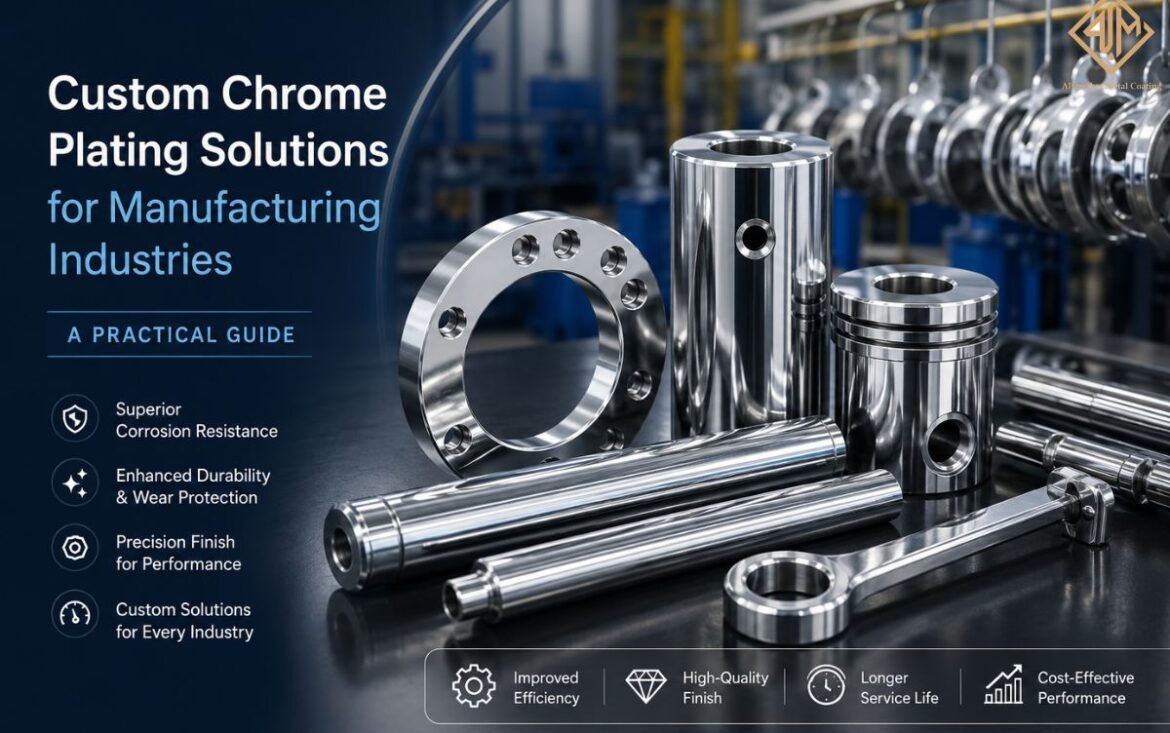
Custom Chrome Plating Solutions for Manufacturing Industries: A Practical Guide
Table of Contents
- Key takeaways
- What does custom chrome plating mean for manufacturers?
- Why do manufacturing industries rely on chrome plating?
- Hard chrome vs. decorative chrome: knowing the difference
- The chrome plating process- step by step explained
- Industries that benefit most from chrome plating
- What to look for in a metal coating company?
- Common mistakes manufacturers make with plating
- Maintenance tips for chrome-plated components
- Final thoughts
- Frequently asked questions
Key Takeaways
- Chrome plating helps prevent corrosion, scratches, and friction damage of industrial components effectively.
- Chrome plating services in Dubai enhance resilience in challenging industrial conditions.
- The choice of a reliable company that provides metal coating may lower downtime and maintenance expenses.
- Hard and decorative chrome plating serve their particular industrial and decorative purposes.
Manufacturers that specialize in hydraulic cylinders, molds, or heavy-machine parts know for a fact that unprotected metal does not stand a chance under constant strain. The wear and tear caused by friction and moisture, as well as repeated use, gets to components faster than even the largest budgets for maintenance can cover. Chrome plating shops in Dubai came into existence in order to create a resistant and hard protective layer that can help parts that would otherwise break down in months.
At Aljawaher Metal Coating, they have been serving companies in the UAE that require much more than standard plating. Custom chrome plating is what they need and the kind of plating that can withstand industrial usage and is not going to overprice their production costs and time. Come and find out what goes into custom chrome plating, why it is important for producers, and how to choose the right company.
What does custom chrome plating mean for manufacturers?
Custom chrome plating isn’t a one-size-fits-all treatment. Standard plating processes work fine for simple, low-stress parts. But manufacturing components often have irregular shapes, tight tolerances, or specific thickness requirements that a generic approach can’t satisfy.
However, a custom process accounts for the base metal, the part’s intended use, and the exact thickness of chromium needed to perform under real working conditions. A hydraulic cylinder rod moving thousands of times a day needs a different plating thickness than a decorative fixture that only needs to look good.
Working with the best metal coating company in Dubai that actually understands manufacturing, rather than general plating, matters here. Aljawaher Metal Coating has handled projects ranging from small precision tools to large industrial shafts, and each one needed a slightly different approach to get the coating right.
Why do manufacturing industries rely on chrome plating?
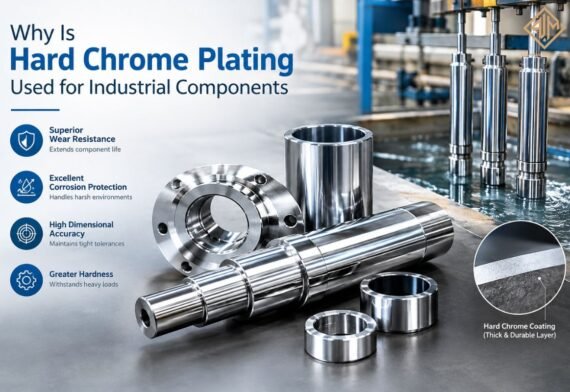
The major causes of degradation of metal components are corrosion, heat, and friction. These are some of the best causes for which chrome-plated products work, and hence why they have been one of the most preferred industrial coatings for many years.
- Corrosion Resistance That Actually Holds Up
Given the properties of chromium, after the chrome covering is applied, it will coat the surface of the part with a protective layer of passive oxide. Such protection is able to withstand moisture, oxidation, and chemicals significantly better than bare iron or steel. As a consequence, when the parts are exposed to oils, coolants and high humidity, the resistance prevents unnecessary replacement of the product.
- Reduced Friction and Wear
The coefficient of friction of chrome plating layers is low. Therefore, working parts, like pistons, rods and bearings, will not need to be repaired as frequently without plating as they do with it, because of the reduced friction.
- Improved Surface Hardness
Hard chrome plating can push surface hardness well above that of the base metal. That matters for parts under constant mechanical stress, where a softer surface would deform or scratch under repeated pressure.
Hard chrome vs. decorative chrome: knowing the difference
Manufacturers sometimes assume all chrome plating is the same. It isn’t, and the distinction matters for budgeting and part selection.
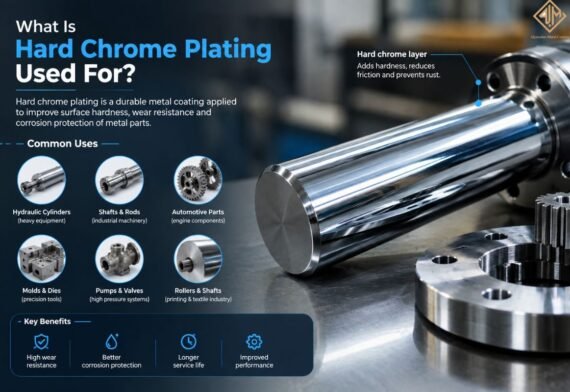
- Hard chrome plating is applied in thicker layers, typically for functional purposes. It is utilized in hydraulic cylinders, molds, shafts, and machine tools where durability and wear resistance are very important. While the finish may not always be shiny, it is effective in performing.
- Decorative chrome plating, however, is thin and is used mostly for the sake of appearance, frequently over a layer of nickel base. It is commonly used in automotive trim, hardware, and consumer products that need to focus on the aesthetics.
A few practical differences worth noting:
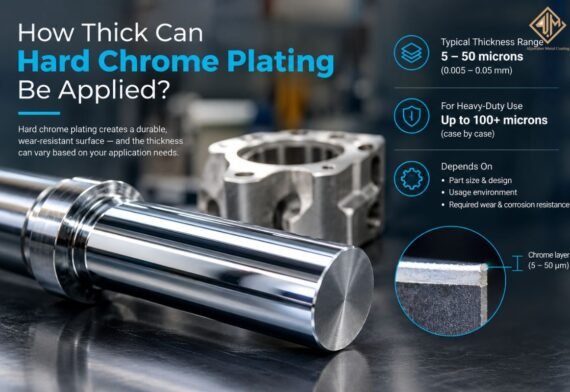
- Hard chrome layers typically range from 0.0002 to 0.020 inches depending on application
- Decorative chrome is usually under 0.00002 inches
- Hard chrome can be applied to worn parts to restore original dimensions
- Decorative chrome cannot correct dimensional wear
Furthermore, knowing which type a project needs before requesting quotes saves time and prevents paying for a finish that doesn’t match the actual use case.
The chrome plating process- step by step explained
Understanding the process helps manufacturers ask better questions when evaluating a provider. Here’s roughly how it works.
1. Surface Preparation
Before any plating happens, the base metal goes through cleaning, degreasing, and often grinding or polishing. Skipping this step, or rushing it, is the single biggest cause of plating failure. Contaminants trapped under the chrome layer lead to bubbling, flaking, or premature corrosion.
2. Masking
Areas that shouldn’t be plated get masked off, particularly threaded holes, precision bores, or sections that need to stay conductive for later assembly.
3. Electroplating Bath
The part is submerged in a chromic acid solution, and an electric current is applied. Chromium ions in the solution bond to the metal surface, building up in thin layers until the desired thickness is reached.
4. Grinding and Polishing
Once plated, parts are ground and polished to achieve the final dimensional tolerance and surface finish. This step is where precision really shows. An experienced shop will hold tolerances within microns for critical components.
5. Quality Inspection
By conducting thickness measurement, adhesion testing, and visual inspection, it can be verified that the coating is up to standard before the parts are sent back to the customer.
Industries that benefit most from chrome plating
Chrome plating isn’t confined to a single industry. Its adaptability is one of the main reasons for the demand for chrome plating services in Dubai remaining stable over the years.
- Oil and gas equipment– valve stems, drill components, and pump shafts that have been exposed to corrosive liquids.
- Automotive manufacturing– pistons, shock absorbers, and engine components that need to be wear-resistant.
- Printing and packaging — rollers that need a smooth, consistent surface for repeated contact
- Plastic injection molding — molds that benefit from both corrosion protection and easier part release
- Marine and industrial machinery — components constantly exposed to moisture and salt air
Each of these industries has different tolerance requirements. That’s exactly why custom plating tends to hold up better long-term than a standard, off-the-shelf process.
What to look for in a metal coating company?
Not every provider handles industrial-grade plating the same way. A few factors separate a reliable shop from one that ends up costing you more in reworks and delays.
- Experience with Industrial Tolerances
General plating shops often work with automotive or decorative parts and may not have the equipment or experience for tight manufacturing tolerances. Ask directly about past projects similar to yours.
- In-House Quality Testing
A shop that measures thickness and adhesion before shipping parts back saves you from discovering problems after installation. This should be standard, not an optional add-on.
- Turnaround Transparency
Manufacturing schedules don’t leave much room for surprises. A provider that gives realistic timelines upfront is worth more than one promising the fastest turnaround and then missing it.
- Capacity for Large or Irregular Parts
Some parts don’t fit standard plating tanks. If your components are oversized or oddly shaped, confirm the shop has the tank size and fixturing to handle them before committing.
Therefore, Aljawaher Metal Coating built its process around these exact concerns, working directly with manufacturing clients who need consistent results across repeat orders, not just one-off jobs. Being recognized among the best metal coating companies in Dubai comes down to whether parts perform correctly once they’re back on the production line, not marketing claims.
Common mistakes manufacturers make with plating
A few recurring issues show up across manufacturing plating projects, and most are avoidable.
Choosing a plating type based on cost alone is a common one. Decorative chrome is cheaper, but using it on a functional part that needs hard chrome leads to early failure and repeat costs.
Moreover, skipping pre-plating inspection is another. Parts with existing surface damage, pitting, or cracks should be addressed before plating; coating over damage doesn’t fix it, it just hides it for a while.
Underestimating masking needs can create costly rework. Forgetting to specify areas that shouldn’t be plated, like threaded fittings or precision bores, is an easy oversight with expensive consequences.
Vague tolerance requirements lead to guesswork on the shop floor. Providing exact drawings and tolerance ranges upfront prevents mismatched results.
Maintenance tips for chrome-plated components
Chrome plating extends part life significantly, but it isn’t maintenance-free. A few habits help components last as long as the coating is designed to.
- Clean parts regularly to prevent buildup of debris or chemical residue
- Avoid abrasive cleaning tools that can scratch the plated surface
- Store parts in dry conditions when not in use to prevent moisture exposure
- Inspect periodically for early signs of flaking or thinning, especially on high-friction areas
- Reapply protective oils on hydraulic rods and similar components as recommended by the manufacturer
Catching wear early, before it reaches the base metal, is far cheaper than replacing an entire component.
Final thoughts
For manufacturers, chrome plating is a custom job. The distinction can be between a part that lasts one year or five years. To get it right, it’s important to select a provider that has experience with industrial applications, not just common industrial plating.
When considering chrome plating services in Dubai for a new project, inquire about the company’s experience with your type of part, how they inspect and verify parts, and how they communicate the turnaround time. Any brochure won’t tell you as much as those answers do.
Looking for a plating partner with knowledge of manufacturing tolerance? Aljawaher Metal Coating partners with manufacturers in the UAE for bespoke hard chrome and decorative plating jobs, ranging from single prototypes to production quantity orders. Contact us to talk about your specifications and receive a quote for your requirements.
Frequently asked questions
Thicker layers of hard chrome are used for functional parts, for durability and wear resistance. A thin finish is applied primarily for decoration to visible surfaces.
Hard chrome can offer several years of life if properly applied in a normal industrial environment, depending on load, friction, and maintenance.
Yes. Worn shafts, rods and other components can be restored to original dimensions by hard chrome plating to build up material on the worn surfaces.
Chrome plating has excellent resistance to many chemicals; however, depending on the chemical environment, there are some exceptions, and the situation should be discussed with your plating provider in advance.
Depending on the application, the thickness of the plating on hydraulic rods will range from 0.0005 inches to 0.002 inches, depending on the load and cylinder specifications.
The most common reasons for early plating failures are poor surface preparation, lack of masking, or plating over existing surface damage.
Yes, but it takes a certain tank capacity and fixturing. Check with your provider first before ordering if he or she will be able to fit your part in the correct size and shape.
Yes, plating does ‘thicken’ the surface. Plated parts are usually ground and polished in the provider’s facility in order to restore the desired tolerances.
Chrome plating is an important process for corrosion and wear in oil and gas, automotive, plastic injection molding, printing, and marine applications.
Check for experience in industrial tolerances, in-house testing, realistic turnaround time, and the ability to work with your part size and shape.