-
aljawahermetalcoating
- June 18, 2026
- No Comments
What Is Brass Plating? Benefits, Process, and Industrial Uses
Table of Contents
- Key Takeaways
- What is brass plating?
- How does brass plating work?
- Benefits of brass plating
- Industrial uses of brass plating
- Brass plating vs other metal coatings
- Industry insight: why businesses choose brass plating?
- Wrapping up
- Frequently asked questions
Key Takeaways
- Brass plating is a thin plating of the brass coat material to enhance the aesthetics and functionality.
- It provides corrosion resistance, conductivity and surface protection.
- Brass plating is used in many industries, such as the automotive, electrical, and construction industries.
- By selecting a reputable coating service, you can rely on their expertise to deliver a long-lasting and consistent finish that meets your expectations.
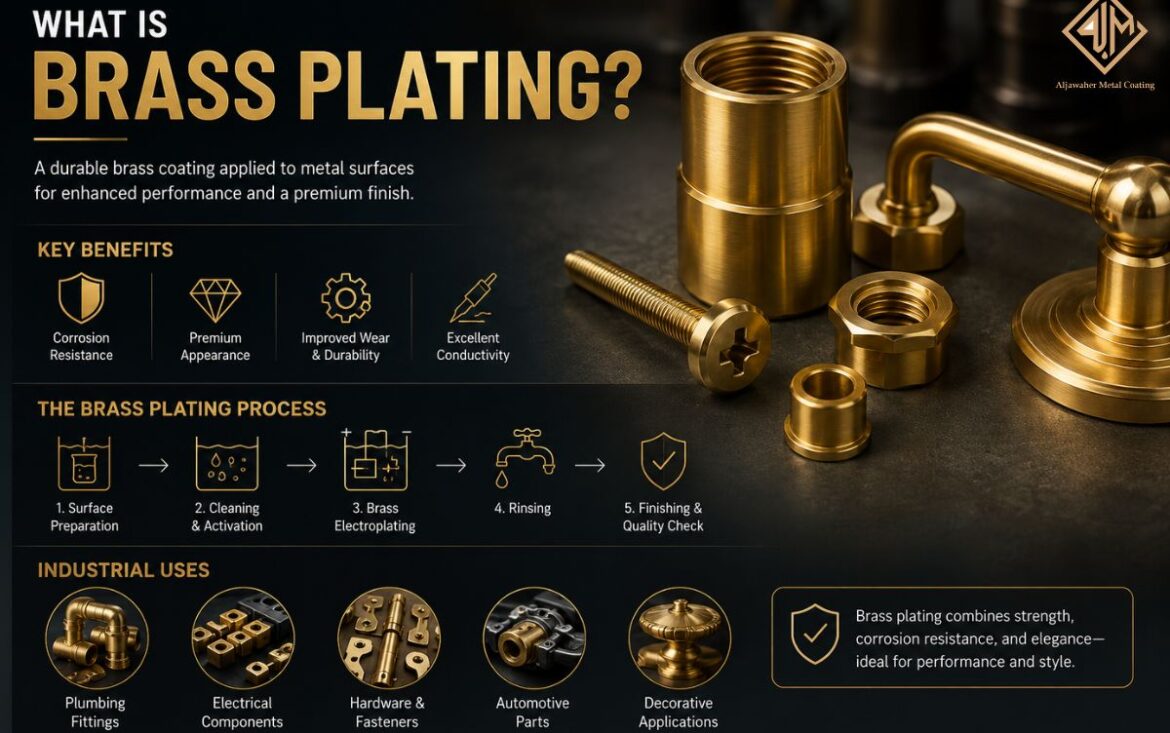
Brass plating is a metal finishing process in which a thin layer of brass is applied to the surface of another metal through electroplating or chemical coating methods. It is a popular additive for various purposes, including appearance, corrosion resistance, conductivity and surface durability. Brass plating is used for various industries, such as automotive, electrical, decorative metalwork, etc., for functional and aesthetic purposes.
Furthermore, with industries always looking for durable and attractive finishes, brass plating is a preferred choice for manufacturers. Brass plating service companies in Dubai are responsible for providing businesses with the metal finishes they need for their various industrial uses, ensuring that they achieve a reliable and durable result.
What is brass plating?
Brass plating is the technique of thinly coating metal with a layer of brass, an alloy of copper and zinc.
Why is it used?
Brass plated on:
- Improve surface appearance
- Increase corrosion resistance
- Enhance electrical conductivity
- Design and make a decorative gold finish
- Increase bond strength with subsequent coatings.
Moreover, the process can be applied to steel, iron, copper, aluminium and other metal parts, depending on the application needs.
How does brass plating work?
There are a number of steps in the brass plating process that are carefully controlled to produce a consistent and durable finish.
| Process Step | Purpose |
| Surface Cleaning | Removes dirt, oil, and contaminants |
| Surface Preparation | Improves coating adhesion |
| Electroplating | Deposits brass onto the metal surface |
| Rinsing | Removes residual chemicals |
| Finishing & Inspection | Ensures quality and uniformity |
Step-by-Step Process
- Surface Preparation
Rust, grease and oxidation are completely removed from the metal part.
- Electroplating Stage
The part is dipped in a solution of brass ions. This process is done by the application of an electric current which causes the brass particles to weld to the surface of the metal.
- Finishing
This coated section is then polished, inspected and tested to guarantee the correct thickness and finish.
Therefore, Aljawaher metal coating implements a quality control system at each stage of the manufacturing process to ensure a uniform plating result.
Benefits of brass plating
Brass plating has the following advantages in industrial and commercial applications:
1. Attractive Appearance
Brass is used for a warm golden appearance to add to the beauty of components, fixtures and decorative products.
2. Improved Corrosion Resistance
This coating is designed to prevent moisture, oxidation and environmental factors from damaging metal surfaces.
3. Better Electrical Conductivity
The brass-plated components are used in electrical and electronic systems, as they have excellent conductivity properties.
4. Cost-Effective Alternative
Brass plating provides a shiny metal finish at an affordable price.
5. Enhanced Surface Protection
The coating helps to enhance the durability and maintenance life of metal parts in harsh conditions.
6. Excellent Adhesion for Further Finishing
Brass plated surfaces can be used as a layer for further decorative or protective plating.
Industrial uses of brass plating
The functional and aesthetic properties of brass plating make it a popular choice for various industries.
1. Electrical Industry
Applications include:
- Connectors
- Terminals
- Switch components
- Electrical contacts
2. Automotive Industry
Brass is used for plating the following parts by manufacturers:
- Fasteners
- Decorative trims
- Fuel system components
- Speciality hardware
3. Architectural Applications
Brass-plated items are commonly seen in:
- Door handles
- Railings
- Light fixtures
- Decorative panels
4. Manufacturing Sector
Brass-plated industrial equipment can be found on many industrial equipment parts to enhance the durability and performance of the equipment.
Additionally, when companies need reliable brass plating service in Dubai, they might look for brass coating service providers who have experience in both decorative and industrial applications.
Brass plating vs other metal coatings
| Coating Type | Main Benefit | Common Use |
| Brass Plating | Appearance + Conductivity | Decorative & Electrical |
| Nickel Plating | Wear Resistance | Industrial Components |
| Zinc Plating | Corrosion Protection | Fasteners |
| Chrome Plating | Hard Surface Finish | Automotive & Machinery |
However, the application and the requirements for the performance of the component determine the best coating.
Industry insight: why businesses choose brass plating?
A manufacturing company in the electrical connector industry had an ongoing problem of electrical connectors corroding and losing conductivity in humid conditions.
The company’s brass-plated components provided a better level of conductivity, a longer component life and reduced maintenance costs. As seen in this example, brass plating continues to be a useful solution for businesses that need both functionality and style.
Moreover, the best metal coating company in Dubai is experienced, and they know how the thickness of the coating, their preparation, and quality control influence the performance of the finished product. Aljawaher metal coating also offers businesses in various industries custom metal coating solutions that comply with industry standards.
Wrapping up
Brass plating is still one of the most versatile metal finishing techniques used today. It is visually appealing, corrosion-resistant, conductive, and economical, making it suitable for various applications in the industry and home.
In Dubai, you can find experienced specialists who will provide the best brass plating in Dubai for electrical parts, architectural hardware, and manufacturing parts alike. Therefore, businesses like Aljawaher metal coating can help them obtain high-quality finishes, performance uniformity and long-lasting durability. Professional brass plating is an effective solution to improve the utility and aesthetics of metal products.
Frequently asked questions
Brass plating is a surface treatment process for enhancing the appearance, corrosion resistance, electrical conductivity and durability of metal components.
Yes. It is common in the electrical, automotive, manufacturing and architectural fields.
It has a relatively long lifespan based on the thickness of the coatings, environmental exposure and maintenance, but proper coatings can last for years.
Yes. Brass plating is one of the most widely used processes for plating steel.
The professional providers are responsible for the surface preparation, uniformity of the coating, quality tests and adherence to industry standards.
The durability, conductivity, and attractive finish of brass plating make it an ideal choice for a variety of industries, including electrical, automotive, construction, manufacturing, and decorative hardware