-
aljawahermetalcoating
- November 13, 2026
- No Comments
Common Hard Chrome Plating Defects and How to Avoid Them
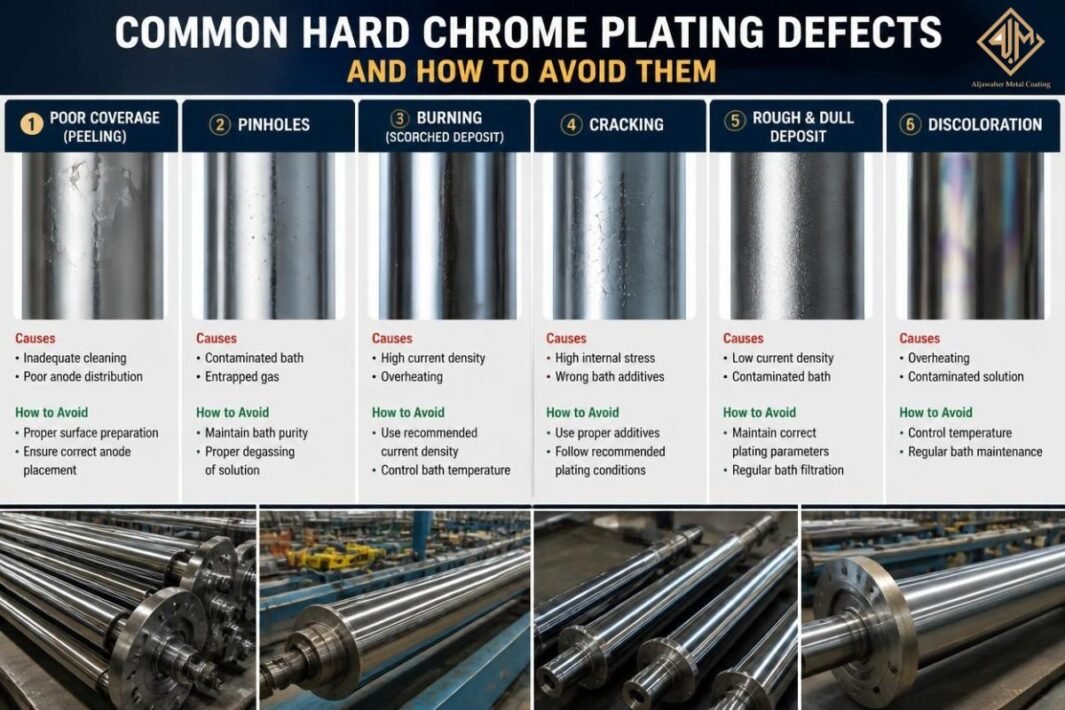
Hard chrome plating defects are problems that occur in the finished chrome deposit. The defects include pitting, cracking, edge burning, peeling, undulating, pinholes, uneven thickness, and dull surfaces. Most issues arise from four specific areas of plating: preparation of the surface, chemistry of the plating solution, control of the voltage, and the treatment of the plated surface after the process.
However, the bright side is that practically all the defects can be avoided with the proper procedures and inspections. This guide explains every issue, why it happens, and how to avoid it, whether you own a plating company or need hard chrome coatings in the UAE for hydraulic rods, molds, or industrial shafts.
Key takeaways
- The surface preparation, bath chemistry and electrical control, and post-plating treatment are the major areas where most of the hard chrome defects arise.
- The reduction of the risk of crack formation or delayed failure is very important for high-strength steel, for which hydrogen relief baking is essential.
- The use of rack design, anode positioning and thieving shields help to reduce burning and thickness variations on more complex parts.
- The best way to prevent the cost of rework is to pick the best hard chrome plating services in Dubai that have quality control procedures in place.
What causes hard chrome plating defects?
Common causes of hard chrome plating defects are contamination or improper preparation of the base metal, the improper balance of the plating bath, improper current density or temperature, and improper post-plating treatment. Each step of the process can add a defect which may manifest itself at a later time as pitting, cracking, or peeling. Early identification of the root cause saves time, material, and customer trust.
Plating is a process of steps, and when one of the steps is weak, it is likely to be evident in the last step. The basic phases that most shops follow are:
- Substrate preparation: Grinding, polishing, degreasing, and cleaning of the base metal
- Bath control: Control the concentration of chromic acid, catalyst ratio, and impurities in the bath
- Electrical control: Current density, plating time, and rectifier stability
- Post-treatment: Baking, polishing, and inspection of the finished part.
Therefore, knowing these stages will help in the diagnosis of a defect. For example, a pitted surface will indicate cleaning or bath contamination, and cracks will indicate lack of hydrogen relief baking or hardness of the base metal.
Pitting and porosity: why does chrome look pitted?
Pitting is a small hole or darkened area that can be seen on the chrome surface. A similar condition that occurs is porosity, in which the deposit has a network of tiny openings. Both decrease corrosion resistance, as moisture and salts can enter the base metal through those openings.
What causes pits in the chrome layer?
Pits develop from the presence of gas bubbles or contamination on the part’s surface. In the chrome bath, hydrogen and oxygen bubbles are constantly being created, and if they remain on the surface of the part, they will prevent the deposit from forming on this part. Common triggers include:
- Oil, grease, or fingerprints on the part before plating
- Any solid particles or sludge in the bath.
- Casting Voids or other internal defects or porosity present in the original casting
- Low bath temperature, inadequate agitation (allowing bubbles to remain in the bath)
How can you prevent pitting?
The main prevention for pitting is the maintenance of a disciplined preparation and bath. Do the following in this order:
- Use an approved alkaline or solvent cleaner to thoroughly degrease the part, then rinse with clean water.
- Prior to plating, examine casting voids and surface inclusions on the base metal.
- Regularly remove solids or plating sludge from the plating bath.
- Keep the bath temperature and agitation within the recommended limits for the process.
- Apply wetting agents or bubble release methods like moving racks to aid in the release of gas from the surface.
Cracking and hydrogen embrittlement: how can you stop cracks?
One of the most severe faults of hard chrome is cracks, which may affect the part’s integrity. Many chrome cracks form because of the introduction of hydrogen into the base metal during the chrome plating process. This phenomenon is called Hydrogen Embrittlement and is particularly dangerous in high-strength steels.
Microcracks vs macrocracks
Microcracks are small, narrow fractures that are frequently only visible with magnification. They are common in hard chrome deposits, since they are under natural tensile stress. Macrocracks are larger cracks that are typically visible and signify a more severe issue, like high current density or high base metal embrittlement. Microcracks can be acceptable for some decorative or low-load applications, but should be carefully evaluated for high-performance applications.
Why does baking matter?
One of the most crucial steps in crack and delayed failure prevention is hydrogen-relief baking. In the case of high-strength steel, parts are usually baked at a controlled temperature (usually in the 190-220°C range) and for a certain amount of time after plating. The heat enables the hydrogen to escape the metal without harming it. One of the most common failures to service high-strength components is due to this step being either skipped or delayed.
Burning and edge defects
Burning is a defect that is manifested as dark, rough, or powdery deposits, typically on edges, corners, and sharp features. It occurs when the current density at those points is too high, and the chrome does not form properly or may not bond properly.
The cause of burning is usually improper rack design, incorrect anode placement, or current that is too high for the part geometry. The edges are always a point of interest, and they have a higher chance of attracting more current than flat surfaces.
In order to avoid burning, apply thieving or shielding devices on high-current areas, ensure anodes are distributed around complex shapes, and decrease current density on sharp areas of parts. The design of the rack is also important, as it will ensure that the current is distributed more evenly throughout the part.
Poor adhesion and peeling
Adhesion failure occurs when the chrome surface raises, flakes off, or peels off the base metal. It is also one of the most annoying flaws that can arise, as it is usually found after the part is used.
Peeling is indicative of a problem at the chrome or base metal interface and is almost always a result of that. Most of these can be attributed to insufficient cleaning, poor activation or etching prior to plating, or lack of a bake step. Oxide films and other surface contaminations, as well as oils left over from the electroplating process, inhibit the formation of a strong metallurgical bond between the chrome and the surface.
Avoid adhesion problems by carefully controlling the sequence of the parts to be cleaned, activated, and plated, and by minimizing the time elapsed between the operations. Do adhesion tests on sample parts whenever there is a change in process, material, or bath.
Rough deposits and nodules
Rough deposits are bumps or grainy surface features on the chrome surface. Often referred to as “nodules” or “growths,” they can spoil the appearance of a correctly looking part.
Solid particles in the bath, dust, or chromium sludge get trapped in the deposit as it is growing, creating nodules. They may also be produced from contamination of the bath with trivalent chromium or by metallic contamination.
There are several practices to decrease roughness:
- Regularly clean tanks and filter baths continuously.
- When tanks are not in use, cover tanks to prevent dust and airborne debris from accumulating in the bath.
- Keep an eye on bath chemistry and clean up any contaminants before they accumulate.
- Don’t use dirty gloves or tools when handling parts after cleaning.
There is also the possibility of improved rough surfaces after plating, but that can only be done with care, and is more prone to failure and more costly than prevention.
Uneven thickness and low throwing power
Uneven thickness refers to varying thickness of the chrome layer in different places. Hard chrome has relatively poor throwing power, making it a challenge to apply to parts that have recesses, holes, or complex geometry. Throwing power is defined as the uniform deposition of metal over a part having different shapes.
Poor rack design, incorrect anode placement, or a wrong current setting are among the reasons for thickness problems. Areas that are very close to the anodes will get more deposit, and recessed areas will get less. Helpful tips are using auxiliary anodes or shields, noticing that each part should be placed in the same location and measuring thickness at several locations along each part. Therefore, for such components as components that will fit tightly in a bores or seals, the thickness should be checked for conformance to the specification.
Discoloration and dull finish
Discoloration will manifest as yellow, stained, or dull areas on the chrome. If a coating has a dull finish, it will not look as good or sometimes function as well as a bright, shiny coating, especially if the part needs a bright, shiny finish.
Discoloration may be caused by the chemicals remaining on the part after plating, by the presence of spots of water on the surface, and by contamination of the bath. If the finish is not bright, it can indicate poor bath temperature, bad ratios of chromic acid, or lack of adequate polishing prior to plating.
Moreover, rinse parts thoroughly with clean water, dry parts immediately, and store them in a dry place. Monitor bath chemistry frequently to make sure the finish is as bright and as coloured as desired.
Defect quick reference table
The table below is a summary of the most frequent defects, their usual causes, and the best ways to prevent them.
| Defect | Typical Cause | Prevention Strategy |
| Pitting and porosity | Trapped gas, bath contamination, base metal voids | Thorough degreasing, bath filtration, bubble release |
| Cracking | Hydrogen embrittlement, excessive current density | Hydrogen relief bake, controlled current, base metal checks |
| Burning | High current density at edges and corners | Thieving shields, optimized rack design, anode positioning |
| Peeling | Poor cleaning, weak activation, skipped bake | Proper prep sequence, adhesion testing, timely processing |
| Nodules | Solid particles and sludge in the bath | Continuous filtration, dust control, bath maintenance |
| Uneven thickness | Poor throwing power, anode placement issues | Auxiliary anodes, consistent rack loading, thickness checks |
| Dull or discolored finish | Residual chemicals, water spots, low bath temperature | Thorough rinsing, prompt drying, temperature monitoring |
How do you choose the right coating partner?
One of the most critical choices you can make to prevent defects is selecting the appropriate coating partner. A shop that has good process control, quality documentation, and skilled people will be able to identify issues before they become issues for your customers. When seeking out the services of hard chrome plating near me, don’t just consider the quality of the work, but the capabilities that the shop has to offer.
Inquire of prospective partners about methods of controlling bath chemistry, hydrogen relief baking if needed, and methods of thickness and adhesion measurement. A trustworthy provider will also be able to define the rack design strategy and their rework process. The inspection reports and the examination of sample parts can give a lot of information about the consistency of a shop.
When comparing, the best metal coating company in Dubai will typically show a solid grasp of the technical aspects, an honest process of quality assurance, and awareness of the load, wear, and environmental conditions of your application. From the smallest precision parts to the largest industrial components, find a team that makes process control more than a task; it’s a duty.
How does Dubai’s climate affect chrome quality?
The environment in Dubai is unique, making chrome-plated components more demanding. Coastal locations with high humidity, high temperatures, and high salt concentrations can be a challenge for unplated components if they are not properly maintained. A failure that may be ok in dry climates can not be acceptable in Dubai.
This is why all those who opt for hard chrome plating services in Dubai should be aware of porosity, adhesion, and crack prevention. In many applications, such as in oil and gas, marine, vehicle, and construction equipment, parts are constantly exposed to moisture and dust.
Furthermore, knowing the appropriate thickness, asking for the correct hydrogen relief baking, and confirming the adhesion of the part being baked can go a long way toward achieving a longer service life. Protective storage and handling after plating also help to ensure that the finish will not be affected during shipment and installation throughout the region.
How are chrome defects inspected?
The last line of defense against defects is inspection. Visual checks, combined with measurement instruments, are used to ensure all parts are to specification before they are removed from the shop. It will depend on the type of defect and the critical requirements of the application used.
| Inspection Method | What It Detects | Best Used For |
| Visual inspection | Pitting, burning, discoloration, roughness | Every part, as a first check |
| Thickness measurement | Uneven or insufficient coating thickness | Precision and sealing components |
| Adhesion testing | Peeling and weak bonding | Process validation and sample batches |
| Magnetic particle inspection | Surface and near-surface cracks | High-strength steel and critical load parts |
| Dye penetrant testing | Surface-breaking cracks and porosity | Non-magnetic materials and detailed checks |
These inspections help establish a record of what has occurred, and this is helpful if a problem occurs in the future. Any extra record keeping of bath chemistry, baking times and inspection results also enables you to see trends before they become defects.
Bottom line
The defects that occur in hard chrome plating are predictable; most can be avoided with proper preparation, bath control, electrical parameters, and inspection. Once you know how to prevent pitting, cracking, burning, peeling, and uneven thickness, you’ll have the answers to your questions and the information to make better decisions. While considering hard chrome plating near me, or researching a supplier of critical parts, put process control and transparency at the forefront.
The best metal coating company in Dubai is the one that is able to explain the methods they use, document quality checks, and back up the work. At Aljawaher Metal Coating, we put these principles into practice on all of our projects, ensuring that your components are reliable in use in harsh environments.
Frequently asked questions
Typical thickness of hard chrome is between 25 and 50 microns, depending on the wear requirements, part geometry, and operating load.
If there are minor defects, they can be removed, and the piece replated; if the pitting or damage to the base metal is severe, the part must be machined or replaced.
The life of the hard chrome is greatly affected by wear, corrosion exposure, and maintenance, but can last many years in service.
This peeling is typically caused by inadequate cleaning, insufficient activation or lack of bake treatment that will not ensure a strong chrome-to-metal bond.